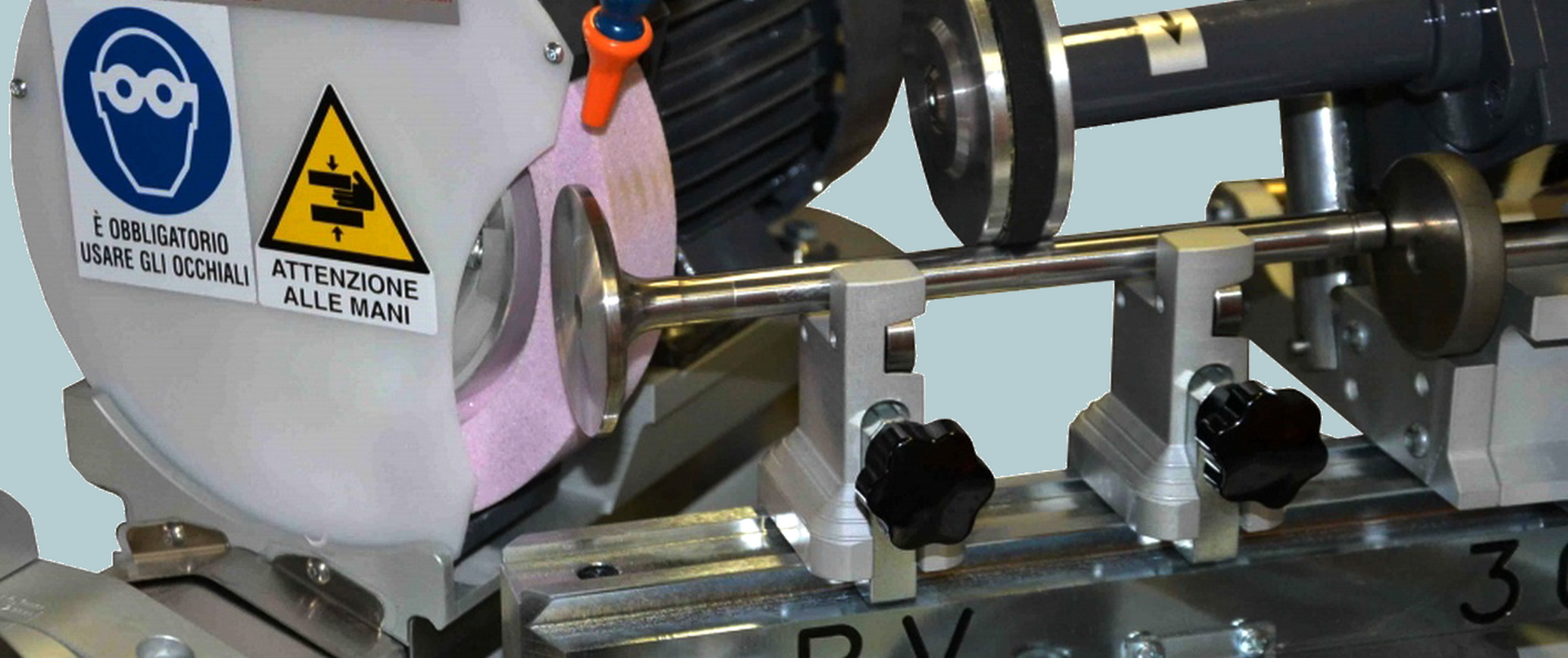
It’s no secret that a real engine mechanic knows for sure that no grinding of any valves is needed, but just a lot of abrasive paste. In fact, this is a joke, but in which, unfortunately, there is only a grain of a joke. Because practice almost every day shows more and more new examples when not only they cannot choose the right machine for valve grinding, but they cannot even say exactly why it is needed…
Part 1. GENERAL INFORMATION ABOUT VALVE GRINDING
1.1. When things are not going well…
In general, everything is clear: if the valve is worn out, it needs to be repaired somehow. But the first question immediately arises: why fix them if there are plenty of new ones? Let’s went and bought a new one. But no: it turns out (oh, horror!), the new valve also needs to be ground. And why is that?
In previous years, almost no one had any such problems and, moreover, questions at all. Because apart from abrasive paste and lapping, there was no equipment or technology for repairing valves and seats. More precisely, they existed, but somewhere out there, far away, and we didn’t need that. And if you lap for a long time, then it doesn’t matter at all whether it’s a new valve or an old one. If it’s supposed to be done, then lap, don’t argue.

Difficult work…
And everything was fine and wonderful for them (this is when all the workshops and garages were using up abrasives by the tens and hundreds of kilograms), when suddenly trouble came from where they weren’t expecting it. And not even one…
At first it turned out that some seats were made of some kind of magic material: after lapping, the valve chamfer was quickly “eaten away” completely. Then everything went awry. Multi-valve engines with electronic control systems stopped working smoothly after lapping the valves, and no matter how many sensors and control units you change, the engine continues to shake at idle, as if it were out of its mind.
It turned out that the reason is in that lapping: the abrasive penetrates the porous material of the seat and turns it into a grindstone, which quickly wears away the valve chamfer. In addition, the abrasive kills the seat profile, and also does not allow the working chamfer of the seat to be made strictly concentric with the valve guide. Therefore, no matter how much abrasive paste you lap and how much kerosene you pour in, even with complete tightness on the workbench, the valve will very quickly lose this tightness when working in the engine.
What to do? The solution was found completely unexpectedly for many.
1.2. Why grind the valve?
It turned out that you can (and should) get rid of the abrasive paste only by processing the seat on a special seat cutting machine (we have already talked about such machines here). Only such a machine ensures the precise geometry of the seat, and this is what guarantees long and happy operation of the engine after repair. But as usual and always happens, the machine for cutting seats turned out to be only a necessary condition for achieving success, but not sufficient. Because one precise seat cutting is not enough, it is necessary to ensure the precise geometry of the mating surface — the valve chamfer. And this is exactly what a valve grinder is needed for.
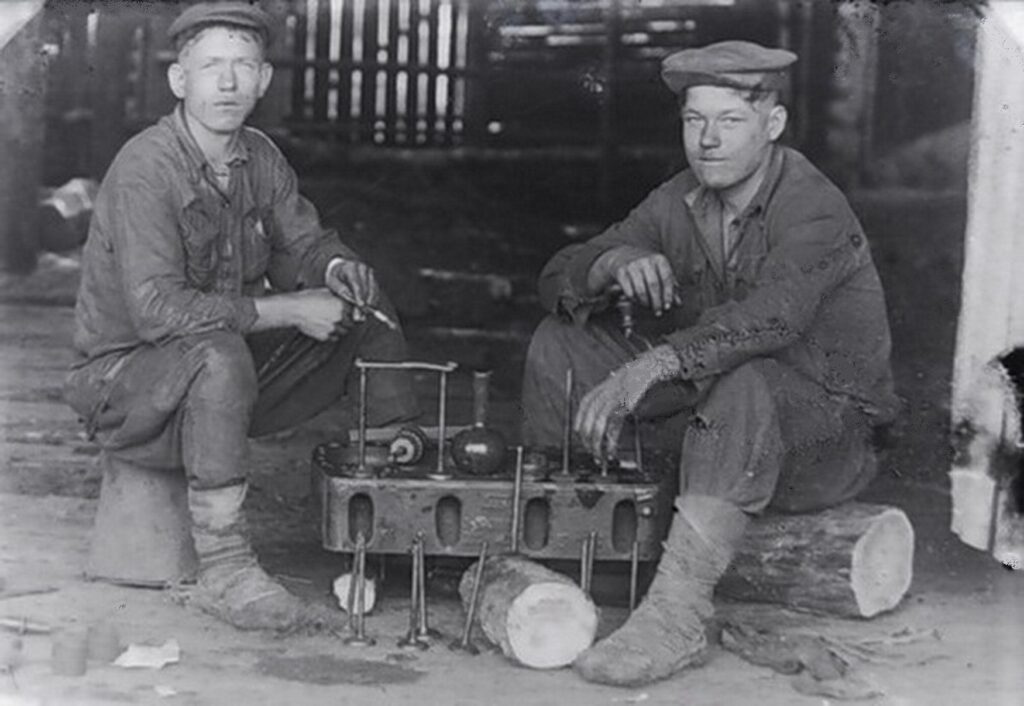
This is how valve and seat repairs were done until recently — old men who lap the valves have been doing exactly this kind of work for over 100 years.
So, the main reason why a valve grinder is required in engine repair is the need to close the set of works on repairing seats. That is, if one of the mating surfaces, the seat is processed, then the other mating surface, the valve, must also be processed. After that, they just need to be connected and the quality of the mating checked, and this is usually done with a vacuum. And no more lapping!
As they say, you will laugh, but if you check a set of the newest valves for run-out of the chamfer to the stem, and then it is easy to identify valves that are clearly crooked, as after a long work. And they are very easily corrected by grinding the working chamfer. In addition, it is easy and quick to adjust the valves of engines with pushrod cups after repair simply by grinding the end of the valve.
In other words, if there is a machine for cutting seats in the workshop, then there must also be a machine for grinding valves. This is a pair that cannot be broken without violating the repair technology. As soon as you remove the machine for grinding valves from the pair, a old man-lapper with an abrasive paste at the ready appears from around the corner. And vice versa, if the entire process of repairing heads is built on the old man-lapper, then there is no need for a machine for cutting seats, and even less so for a machine for grinding valves.
Therefore, if someone somewhere says that he has even a super-machine for cutting seats in his workshop, but does not have a machine for grinding valves, because, like, he installs the new valves only, then he has such an old man-lapper working in the corner of his shop. And he laps, laps, laps…
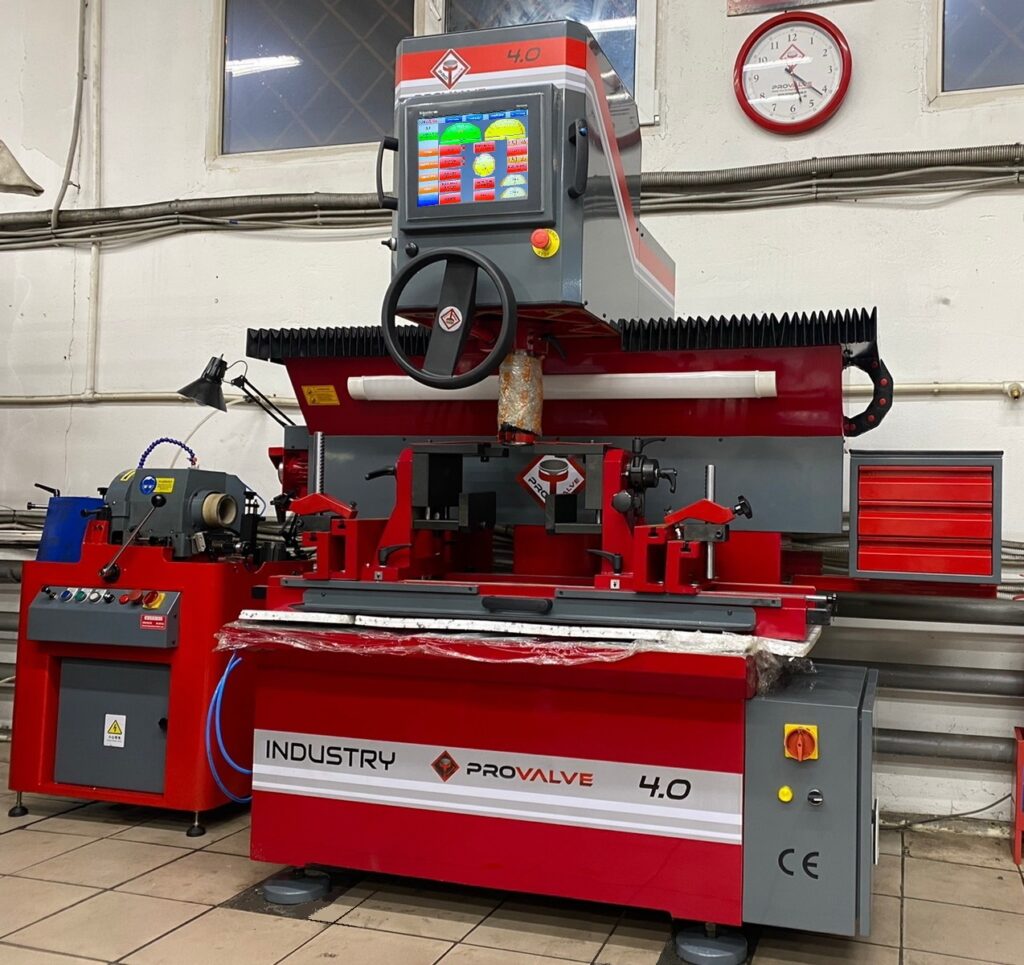
Feel the difference: nowadays, valve mechanism repair can only be done with the help of this “sweet couple” – a machine for cutting seats and a machine for grinding valves
Part 2. BASIC REQUIREMENTS TO THE VALVE GRINDING PROCESS AND MACHINES FOR IT
2.1. How to grind a valve?
If you look at the valve after a long period of operation, you don’t need a diamond eye or a diamond nail on a golden hand to see that the valve has three surfaces that are worn to varying degrees – the working chamfer along which it contacts the seat, the end of the rod where the rocker arm presses, and the side surface of the stem that “rides” in the valve guide.
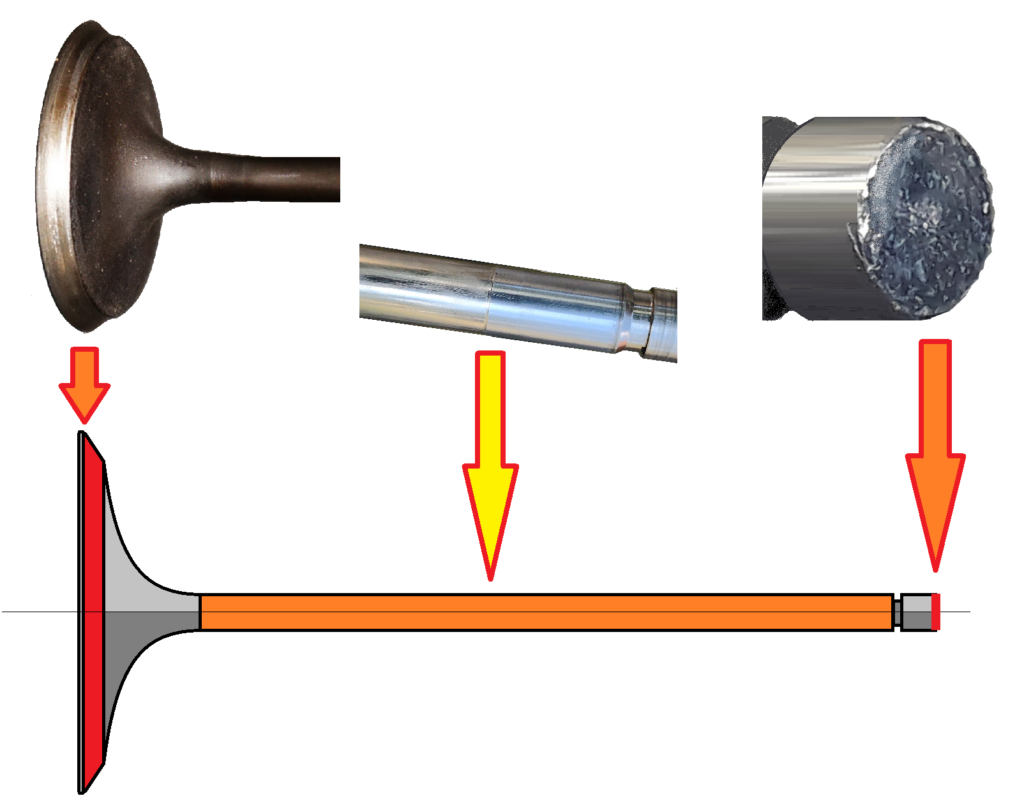
The main surfaces of the valve that wear out during operation are the chamfer, stem and its end. Only the outer two of them are subject to grinding.
We will definitely not repair the side surface of the stem due to its uselessness and high cost (although the technology exists) – it is believed that if the wear of the side surface does not exceed 0.01-0.02 mm, then the valve can still serve. If it exceeds, then it is definitely a replacement. A simple rule applies here: all deviations from the original state of the parts, including runout and wear, must fit into half the working clearance of the valve in the guide, which is usually approximately 0.03 mm.
The main attention during repair should be paid to the valve chamfer. Not only the tightness, but also the durability of the seat and the valve itself depend on it. New valves require a bevel check and grinding if the run-out exceeds 0.02 mm (and it very often exceeds). Therefore, during repair, the chamfer is definitely and always ground. And it is for new valves too — at least if they are crooked. Well, or if the client has not brought the new valves to replace the substandard ones.
In addition, it is usually customary to grind the end of the valve stem “as cleanly as possible”, approximately by the amount of allowance when processing the seat. This is done specifically so that the end of the valve stem does not change its original position much and does not go too far up. If it is necessary to adjust the clearances in the valve mechanism by selecting washers or tappets-cups of different thicknesses, then it is easier not to run around looking for these parts and not to buy them in buckets, but simply grind the end of the stem directly to the required clearance.
Thus, it is already clear that the machine for grinding valves must perform 2 functions: grinding the chamfer and grinding the stem end. Moreover, the end, of course, must be and all that, but the main thing is still to process the chamfer. Therefore, let’s see how this can be done technically.
2.2. What to grind a valve on?
It seems like a simple question, but today it has at least 6 possible answers. And we are talking only about the types of valve grinding machines, because each type has at least several models of difference manufacturers. That is, the answer is not as clear as we would like. And this creates significant difficulties in practice. Which, as expected, lead to the fact that many ignorant people easily fall for a beautiful wrapper (or a rusty lure, whichever is closer to them) and buy something completely different from that they wanted, and for completely different from the work they planned to do.
To figure it out and understand how not to make stupid mistakes, let’s consider the types of grinding machines for valves in sequence. But first, let’s see what kind of machine it is.
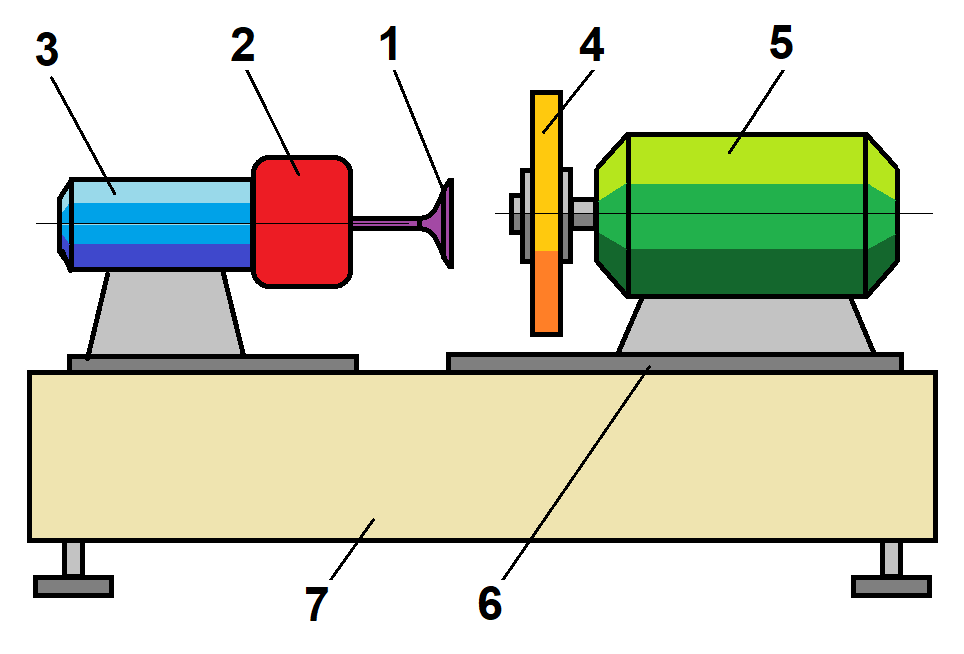
Valve grinding machine diagram:
1- valve, 2- valve clamping (fixing, installation) device, 3- valve drive motor, 4- grinding wheel, 5- grinding wheel motor, 6- grinding head guides, 7- frame
Of course, we can talk for a very long time about all sorts of completely secondary parameters and features of these machines, as their sellers usually do (see, for example, here). They can talk about some mythical operating speed, about pneumatic clamp drives, about super-precise centerless grinding, etc., etc., etc., right down to super-bright LED lighting and a super-convenient spray for supplying coolant. But all this will be about nothing at all. You won’t believe it, but the whole point of grinding a valve on this very simple, almost like a regular grinder, machine is not in the frame, not in the grinding head and not in the grinding wheel made of silicon carbide or diamond, and certainly not in the lighting with beautiful buttons, but… in the valve clamping-driving device. Why?
This is very simple: because each valve is different, and the valves can be completely different. For example, it can be regular or medium valves, with a stem diameter of 8-10 or even 12 mm. Or it can be the large valves – with a stem, for example, 18 or even 20 mm. And they can be very small – 5 mm or even 4 mm. And such stems can be easily bent by hand. If they begin to bend in the machine, then that’s it – such a machine will no longer provide any accuracy for obvious reasons. Even despite all its super-drives, centerless devices, lighting and nice buttons on the panel.
Therefore, it becomes very important to determine what valves we are going to grind? It will be just like we found out when choosing a machine for cutting seats, because the situation with valve grinding looks exactly the same as with seat cutting. That is, if only medium-sized valves need to be ground, and today these are engines of trucks and heavy duty vehicles, then almost any grinding machine will do. But as soon as there is a requirement to grind small valves, and these are, first of all, engines of cars and motorcycles, then the choice narrows sharply — to the point that recognized (by sellers) world brands and authorities immediately move somewhere to the end of the queue. But what to do, who has it easy now?
Figuring out what is happening and what machine to buy is not as easy as it seems. First of all, you should consider, and in great detail, all types of existing valve clamping schemes used on machines for valve grinding.
So…
Part 3. PRACTICAL APPLICATION OF VALVE GRINDING PRINCIPLES: THE STATE OF THE VALVE GRINDING MACHINE MARKET
There are only 3 (three) types of valve grinding machines: chuck, steady rest and hybrid chuck-steady rest. The types are determined solely by the method of clamping the valve – in a chuck or in steady rests (prisms), where the way of driving is important too. And all this, in turn, determines everything else, which is generally not so important.
3.1. Chuck-type machines
The main feature of this type of machine is the presence of a chuck for rigid and stationary clamping of the valve by the stem and its rotation together with the chuck. That is, the chuck allows you to immediately combine two functions: both the installation of the valve and the drive of its rotation. On the one hand, this provides certain advantages, for example, to simplification of machine design. Also, if the valve stem has some worn areas, the chuck can theoretically clamp the stem exactly on the unworn part (some sellers usually talk like this, but in fact, this is nonsense – a valve with a worn stem is subject to disposal at a scrap metal dump). In addition, the chuck provides a rigid clamp that eliminates valve slippage, which can also, in some cases, improve grinding accuracy. However, such minor advantages can be easily and completely leveled by the design features / shortcomings of a particular machine.
3.1.1. Chuck-type machine with a collet chuck
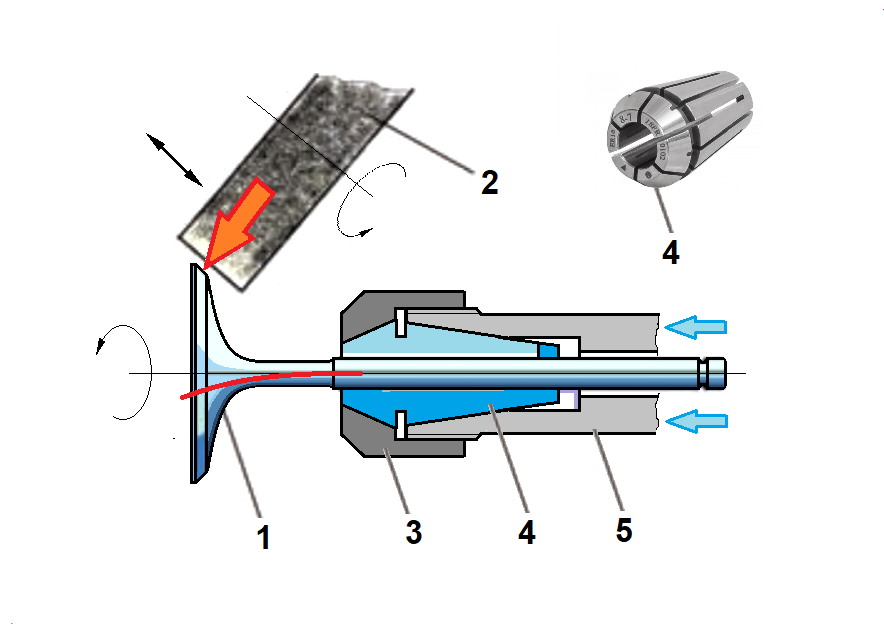
Machine with a collet chuck (AZ, Robbi, Chinelatto, Manek, etc.) means the number of landings between the spindle and the valve is minimal, but bad for small valves, where due to the cantilever arrangement of the plate, pressing the circle on the valve leads to deformation and loss of grinding accuracy:
1- valve, 2- grinding wheel, 3- nut, 4- collet, 5- spindle
This scheme is probably the simplest and at the same time the oldest of all, it is already 100 years old (but it is not exactly known, maybe more). Machines of this type were the first that actually appeared 100 years ago, and they were produced by a large number of companies-manufacturers.
The essence of the scheme is that the valve is clamped in the spindle using a precision conical split collet. The main advantages of the scheme:
- Simplicity of design means the number of parts is minimal.
- High precision – this is ensured by the precision of the collet, such collets are available and widely used in milling machines.
- Low price due to the absence of expensive components.
- Exceptionally high durability due to the absence of quickly wearing parts.
- Very low operating costs due to the lack of need to replace quickly wearing parts.
It is these advantages that explain the fact that machines of this type remain the most popular today, and their price, as a rule, is low.
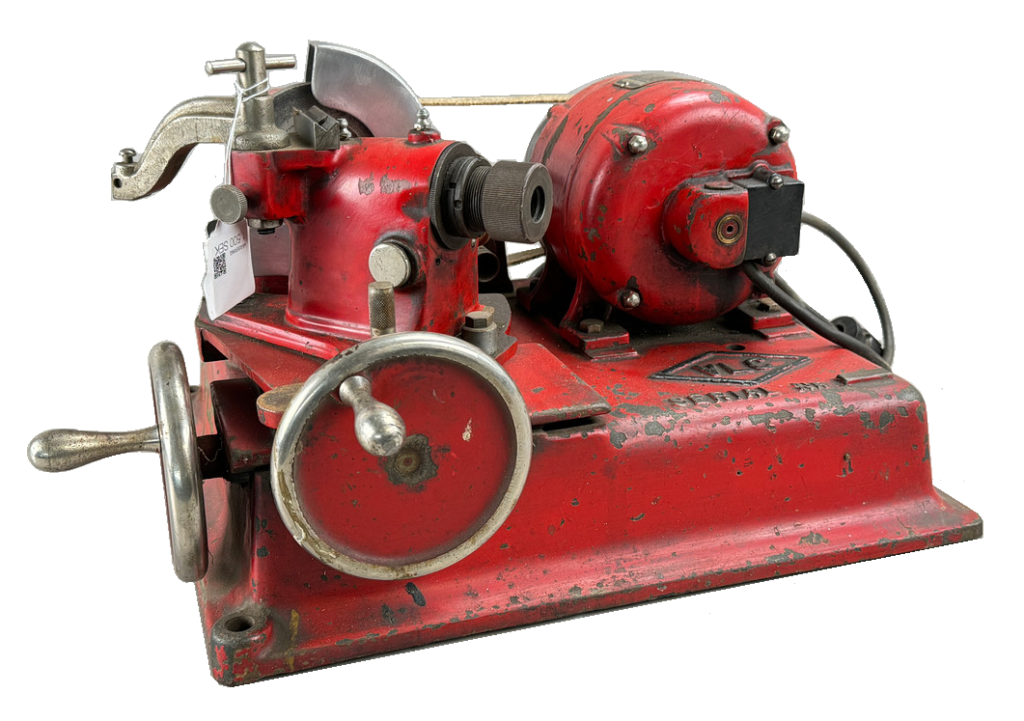
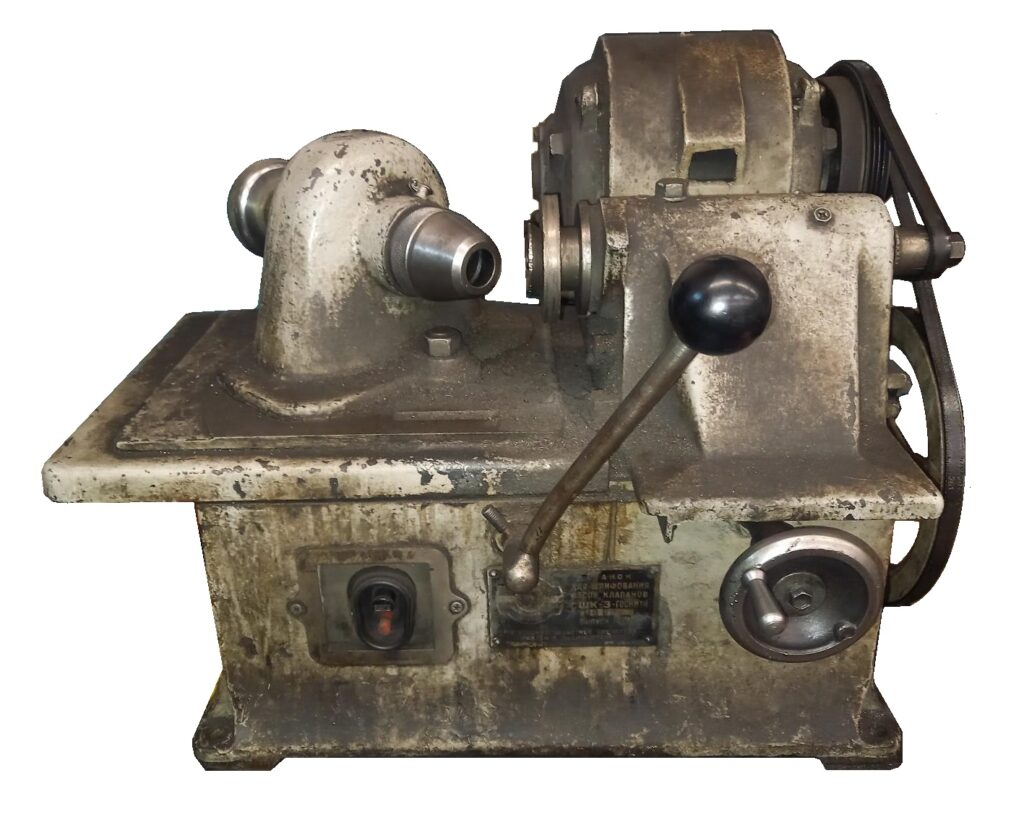
Chuck collet machines produced 70-90 years ago – the VLC machine from the 1930s and the Soviet SShK-3 GOSNITI machine from the 1960s (a 30-year lag is noticeable even here)
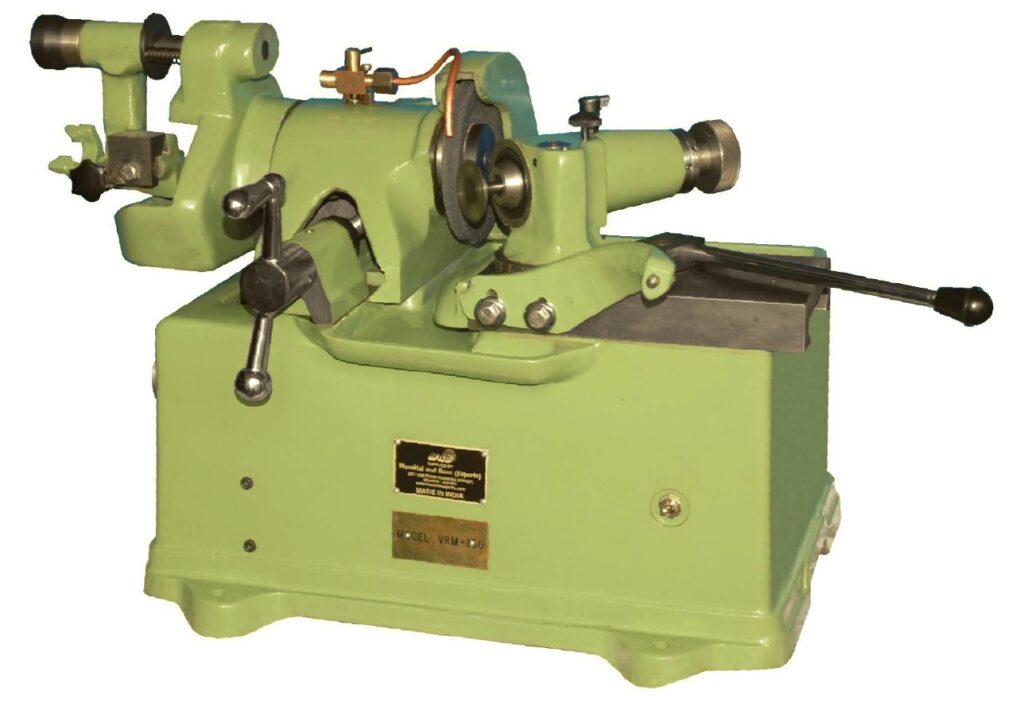
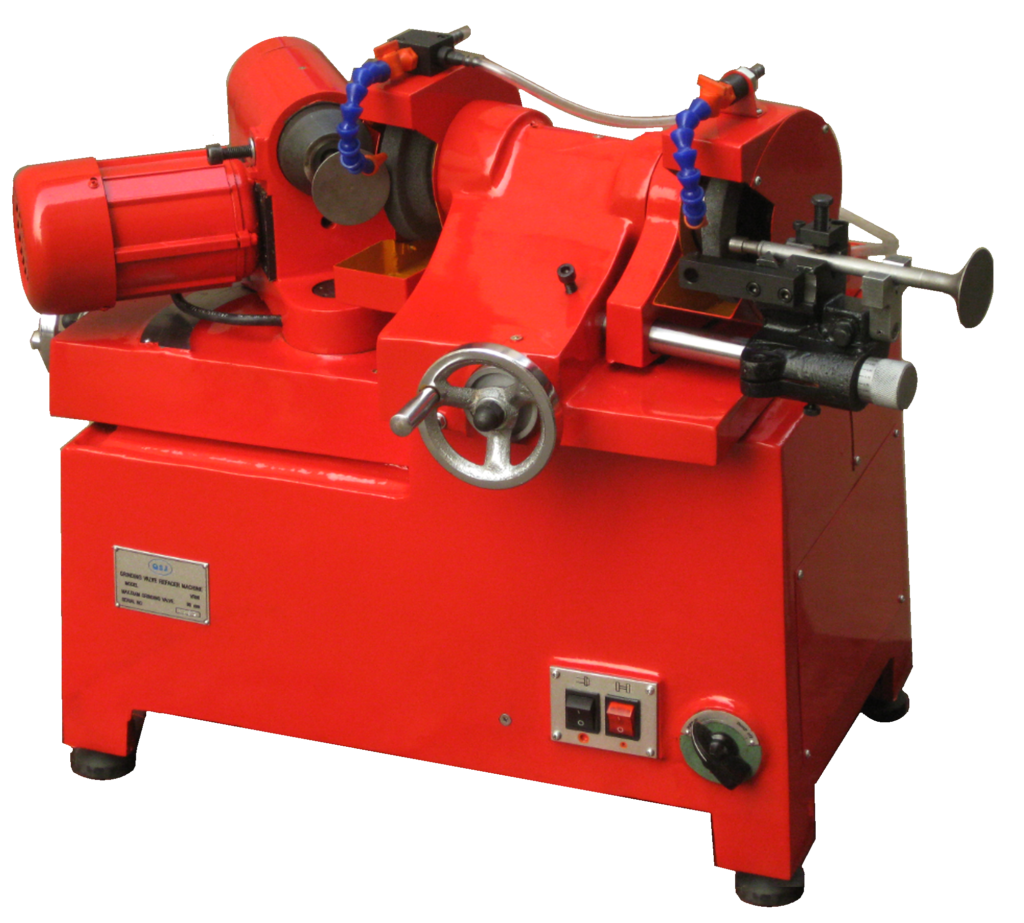
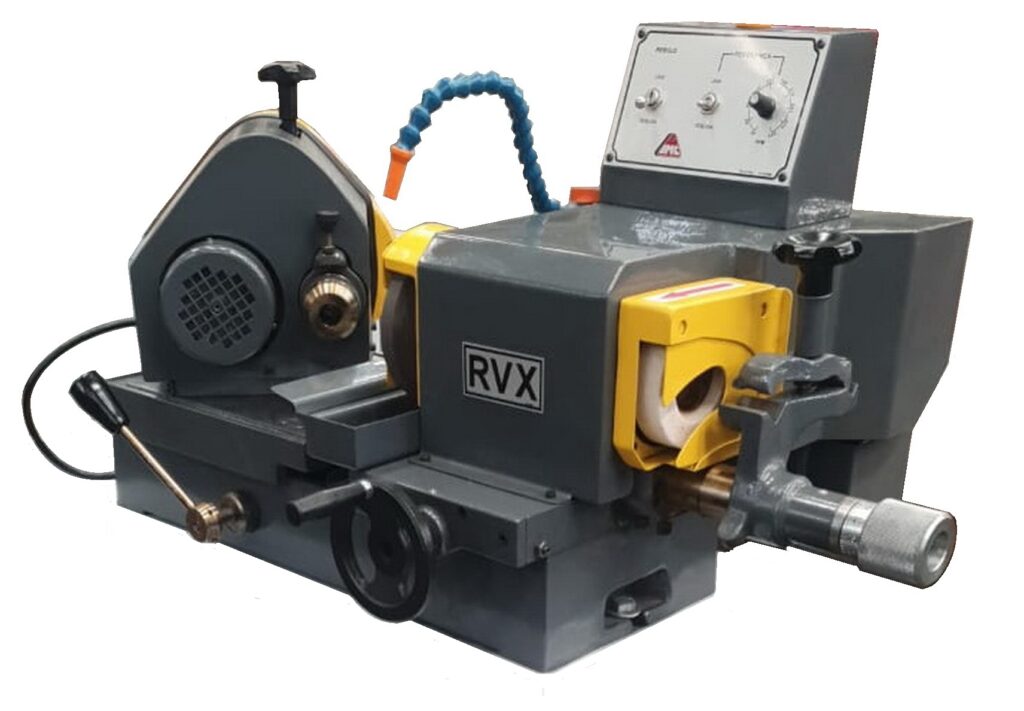
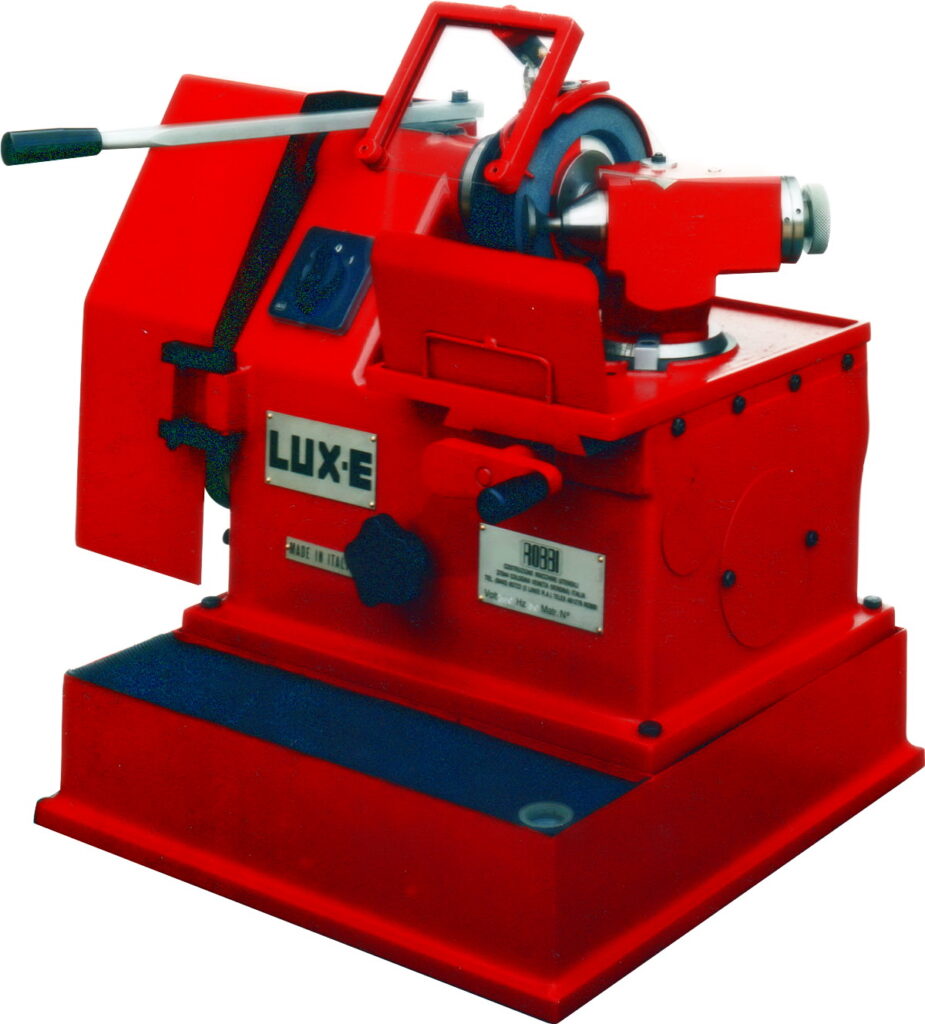
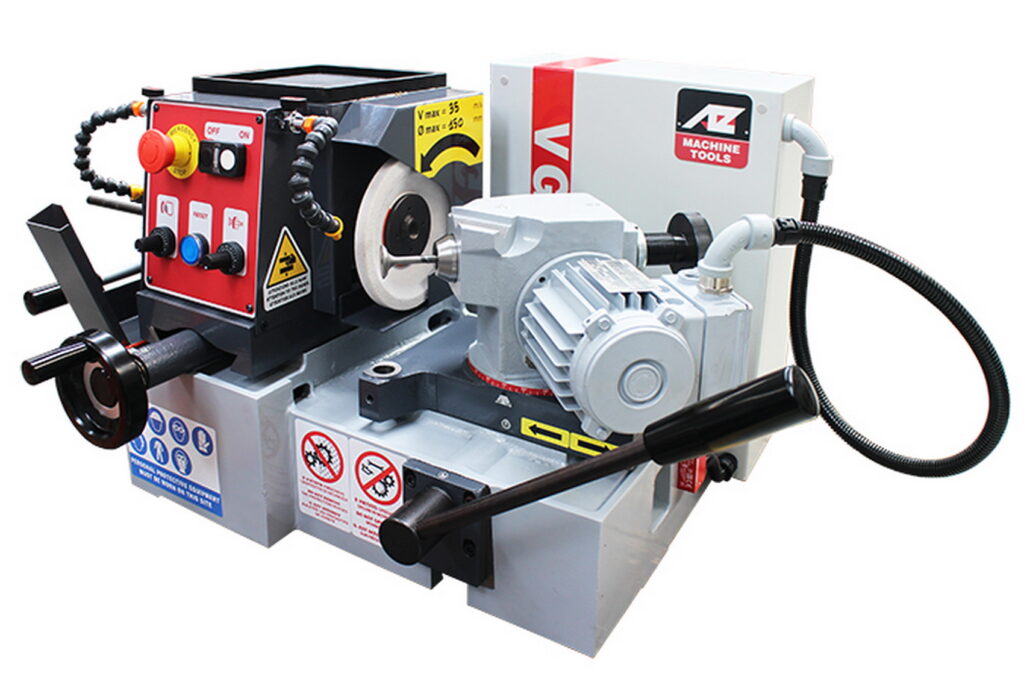
Chuck collet type machines: Manek VRM-50 (India), SMJC VR90 (China), Chinelatto RVX (Brazil), Robbi Lux (Italy), AZ VGX (Italy)
However, these machines also have disadvantages:
- The valve is clamped cantilever, this means that a small valve will be pressed (deformed) by a grinding wheel. That is, such a scheme is not suitable for small valves, or suitable with limitation.
- Each valve size requires its own collet. That is, many collets are needed, and they need to be changed.
- Changing collets takes time, in fact, a retooling of the machine is required.
- An attempt to use high-speed devices for changing/clamping collets complicates and increases the cost of the design.
All of these shortcomings were supposed to be eliminated by an improved type of chuck grinder, which also appeared a good 100 years ago.
3.1.2. Chuck-type grinder with a ball chuck
To make the grinder more versatile and faster, and perhaps even more accurate, it was decided to use a special chuck with 2 rows of balls, 3 balls in a row (support). In fact, it is like a precision 2-row ball bearing, only without rotation.
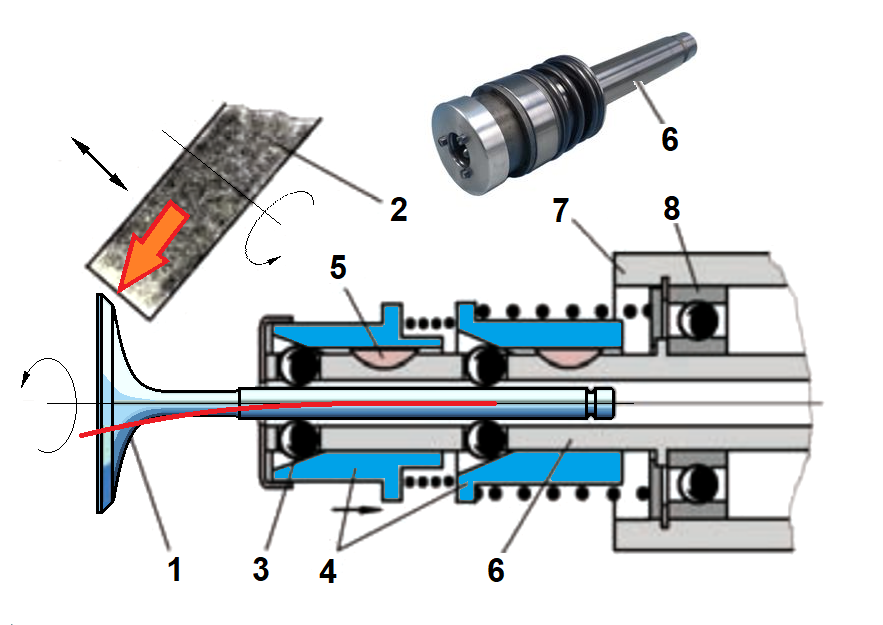
Chuck grinding machine with a ball chuck (Kwik-Way) means a huge number of intermediate parts is located between the spindle and the valve and guarantees a rapid loss of grinding accuracy during operation, especially for small valves:
1- valve, 2- grinding wheel, 3- ball, 4- conical bushings, 5- key, 6- spindle, 7- body, 8- spindle bearing
And indeed, the idea was good, but as usual and always, “it was smooth on paper, but they forgot about the ravines”. In fact, this scheme did not have any advantages compared to the collet, while the disadvantages appeared simply overwhelming:
- The cantilever valve clamping scheme remained, which is bad for small valves.
- The chuck has a rather complex design, especially if it has a pneumatic drive.
- It was not possible to completely eliminate the non-versatility of the machine; different chucks are required for different diameter ranges.
- High price. The use of a ball chuck has led to a significant increase in the cost of the machine (the price of just one chuck can reach the cost of some collet-type machines entirely!)
- Reduced accuracy, because a large number of fits have formed between the spindle and the valve, which has not improved, but only worsened the accuracy.
- Unstable accuracy. The grinding machine always works in the presence of cloud of abrasive particles, and the ingress of abrasive into the mating areas of precision parts is guaranteed to further worsen the accuracy.
- Extremely low durability due to the presence of quickly wearing parts. Even with various types of protective curtains, the ingress of abrasive into the chuck is absolutely inevitable, leading to wear of parts and the need to replace the expensive chuck.
- Extremely high operating costs. Given the high price of the chuck and the need for its frequent replacement, maintaining the accuracy of the machine in operation leads to extremely high operating costs.
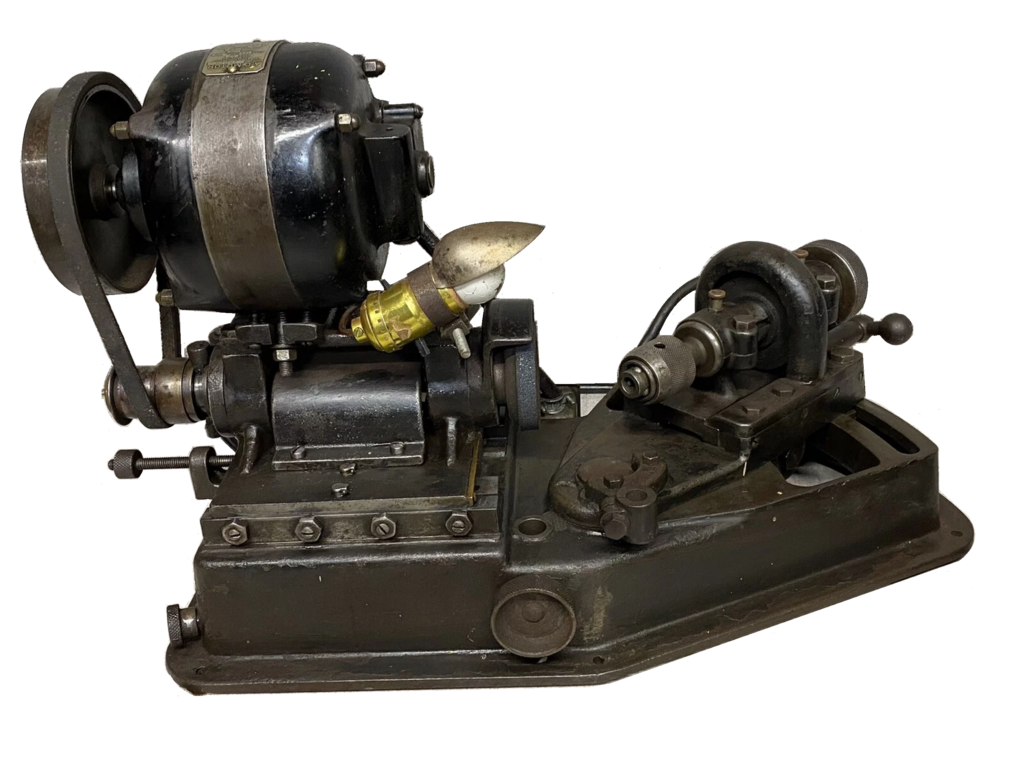
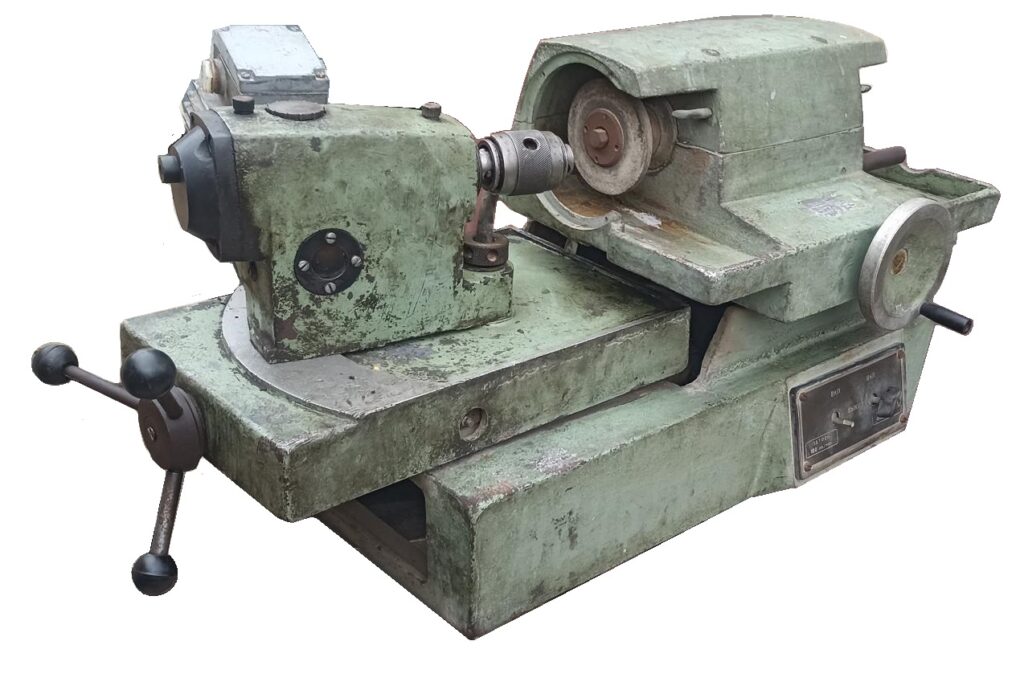
The original Kwik-Way machine with a ball chuck, it released 90 years ago, and the Soviet “Kwik-Way”, the P108 machine, released 50 years ago. They have a ball chuck completely open to abrasive particles, which makes the use of such machines in repair completely ineffective due to the extremely rapid loss of accuracy.
A machine of this type has the Kwik-Way brand and has been produced for more than 90 years by virtually only one company, Irontite (we do not count China, because it always produces everything, but in copies). Now this is a much-improved version of the first machine (including even a pneumatic drive for the valve clamp and a curtain to protect against abrasive particle getting to the balls), but all the shortcomings of the ball-based design have not gone away.
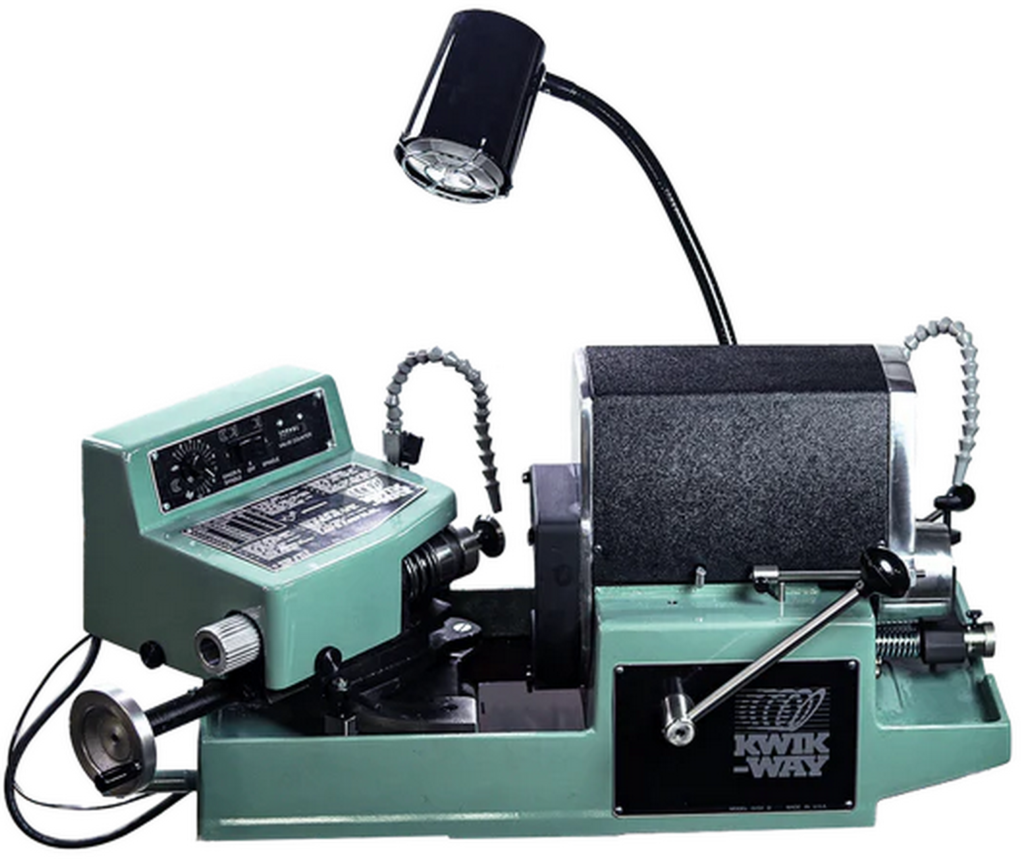
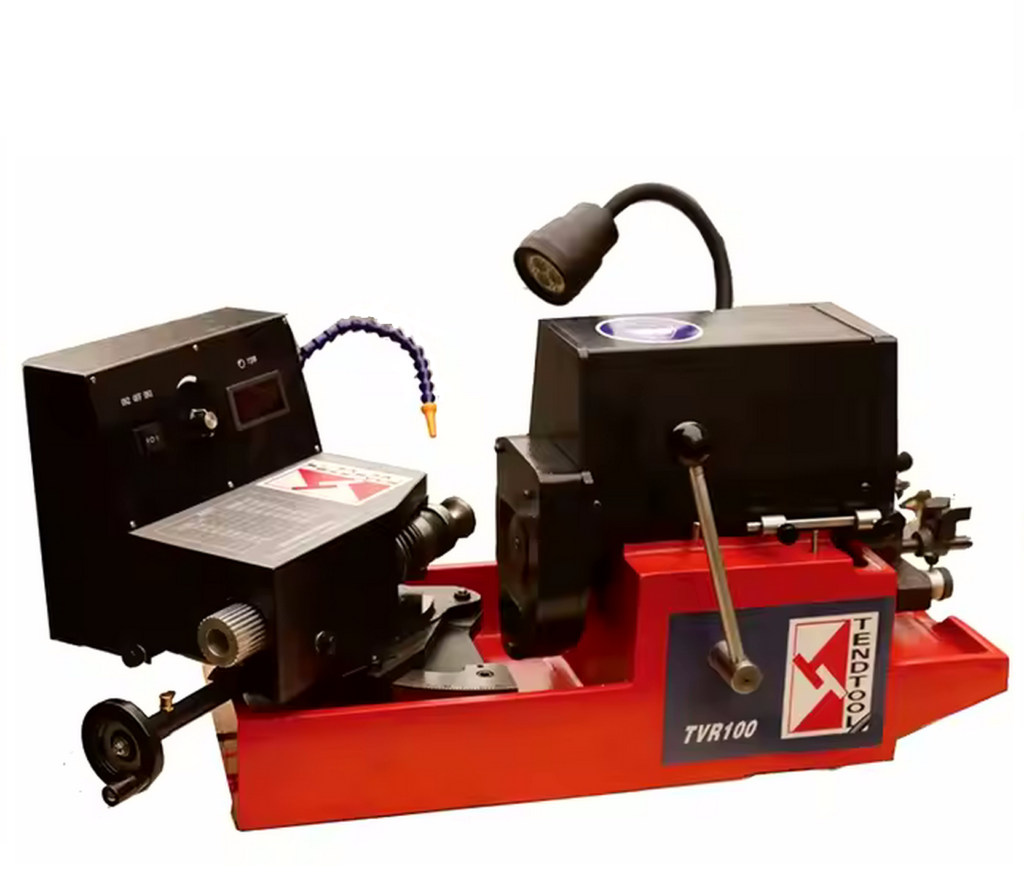
The original Kwik-Way machine and its Chinese clone: the difference in price is approximately 2 times, but the result is absolutely the same, neither one works for a long time.
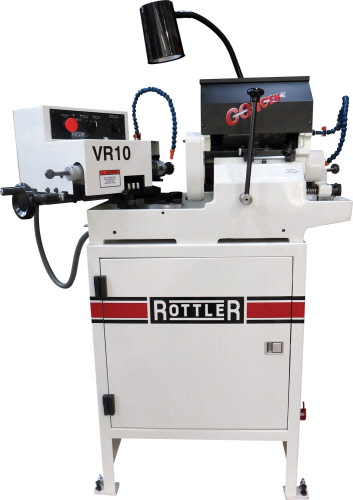
Taking the unsuccessful design under its wing by famous American company Rottler failed to add either precision or durability. But the laws of marketing work 100%.
The usual result of using this design in repairs is as follows. The machine is characterized by unstable grinding accuracy – and it continuously deteriorates as the chuck parts wear out. After 2 years of operation, the machine can grind valves with a chamfer runout relative to the stem no better than 0.04-0.05 mm (which is completely unacceptable!). Maintaining the original accuracy requires regular replacement of the chuck, which costs about 2,000 Euro, at least once every 2 years. Over 20 years of operation (the standard operating period for professional machine tools), such conditions will require adding another 2.5 of its prices to the initial price of the machine. This is simply a super business for the seller and manufacturer at the expense of the unlucky buyer. And such a business has actually been going on for 90 years!
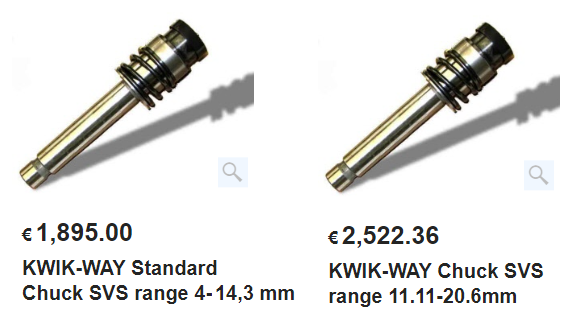
Prices for Kwik-Way machine chucks from a well-known online store – as they say, no comments needed!
That is, when buying such a machine, do not forget to multiply its price by 3.5. For such a price, you can buy yourself a whole workshop for serial repair of valves of all types and kinds. The purchase of a machine with such performance characteristics can only be justified by deep respect to American traditions, skillful marketing of the seller and a complete lack of knowledge and experience on the part of the buyer.
All of these signs indicate that the machine with a ball chuck, no matter how to embellish it, is simply hopelessly outdated and can no longer meet the most basic requirements for the accuracy of grinding valves of modern car engines.
But in fact, the reason is much simpler and closer. The Kwik-Way valve grinding machine, due to its technical features, is simply not suitable for professional use in an engine repair shop. It is good in all respects, but… only for your own American garage, where it will work perfectly once a year for seat machining of real classic American V-8. An attempt to use it for other conditions is obviously doomed to failure. Although, if there are still brave souls who want to try, then, of course, we are not against it. Do you really need it?
3.2. Steady rest machines
Considering the huge number of problems with chuck machines, especially with ball chucks, some manufacturers began to develop their own designs of a completely different type – a steady rest machine.
A common feature of steady rest machines is the absence of a chuck (the term “steady rest chuck”, invented by some very clever sellers, is stupid). Steady-duty machines use steady-duty rests instead of a chuck for clamping the valve stem – V-form plastic or roller prisms (supports), in which the valve not only lies, but also rotates (for comparison, the valve is always clamped rigidly in a chuck). That is, in a steady rest machine, the functions of installing the valve and its rotation drive are separated – steady rests are responsible for the precise installation of the valve, but there may be variations with rotation drive.
In general, the presence of steady rests makes the design of the machine much more precise, stable, functional and versatile. However, in this case, the main details and nuances were not so much in the supports as in the valve rotation drive…
3.2.1. Machine with steady rest type clamping of a valve
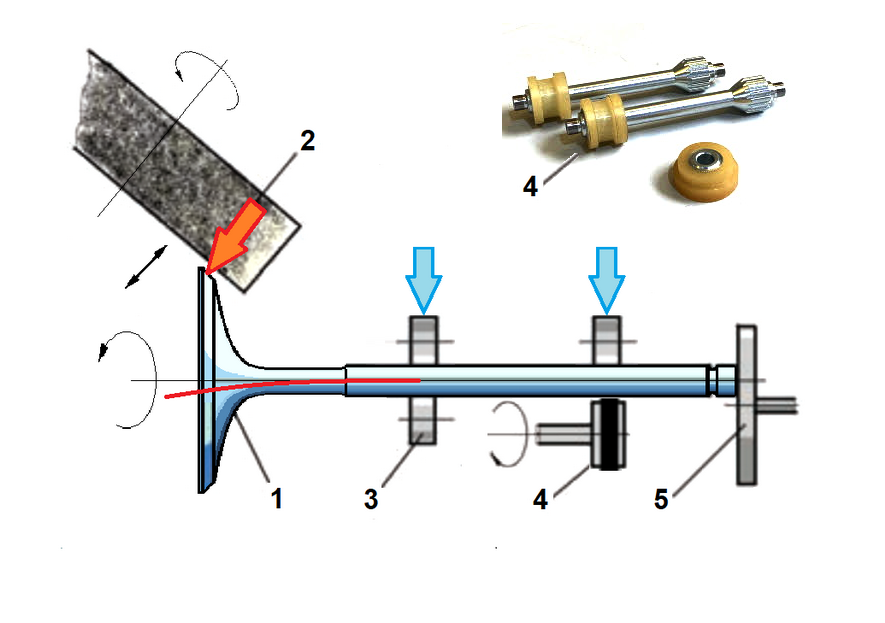
The first manufacturer of this type of machine was the Italian company Rossi&Kramer (Peg). Its scheme appeared about 40 years ago, back in the 80s of the last century. The essence of the scheme is extremely simple: no chuck is needed, the valve can simply be placed on 2 prisms (steady rests) and pressed from above with a rubberized drive roller. If the prisms are made roller, then the rotation of the valve will be easy and smooth without any chuck.
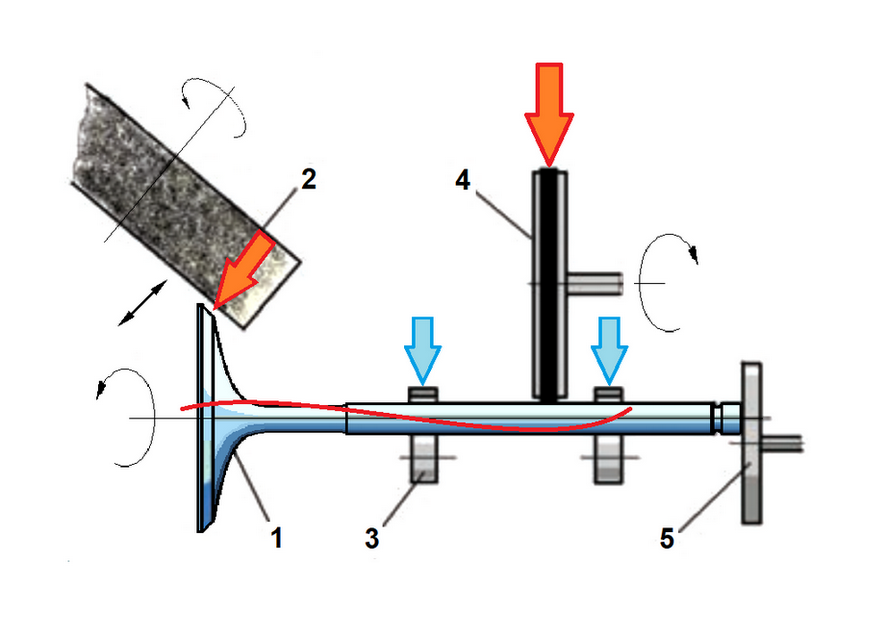
Steady rest machine with a steady rest valve clamping and pressing drive roller (Peg) means all good for medium-sized valves, but pressing the drive roller on a small valve can lead to its slippage, deformation and loss of grinding accuracy:
1- valve, 2- grinding wheel, 3- steady rest roller, 4- drive roller, 5- stop
Obvious advantages of the steady rest scheme:
- Simplicity of design, because there are no complex precision parts
- Low price is determined by the simplicity of the design.
- Quick installation of a valve of any size
- Stable accuracy, because during operation, the machine characteristics practically do not change.
- No wearing parts requiring periodic replacement.
- Low operating costs, because almost no parts for replacing, or they have low prices.
- Long service life.
It is all these advantages that have become the reason for the widespread use of the steady rest scheme: now such machines practically dominate in Europe market, where they are offered by 3 well-known companies at once. In addition, a similar machine with similar parameters is produced in Turkey.
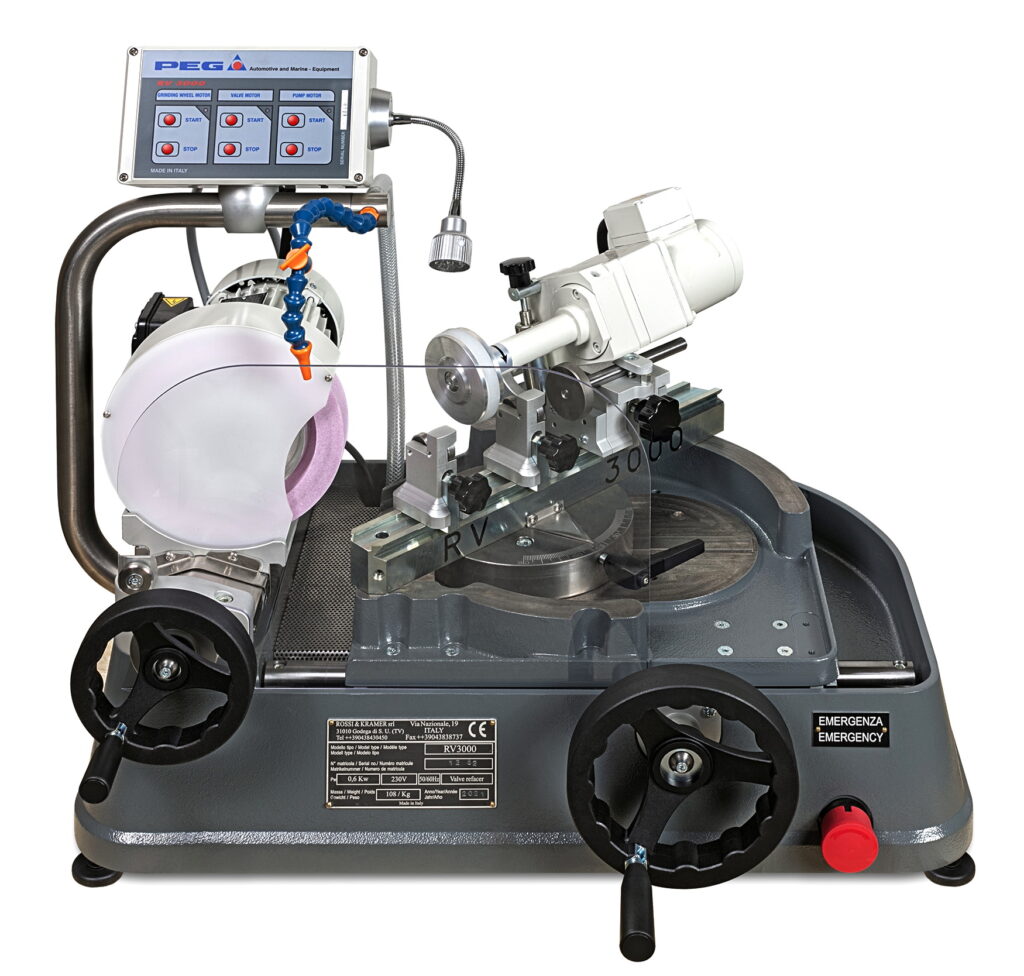
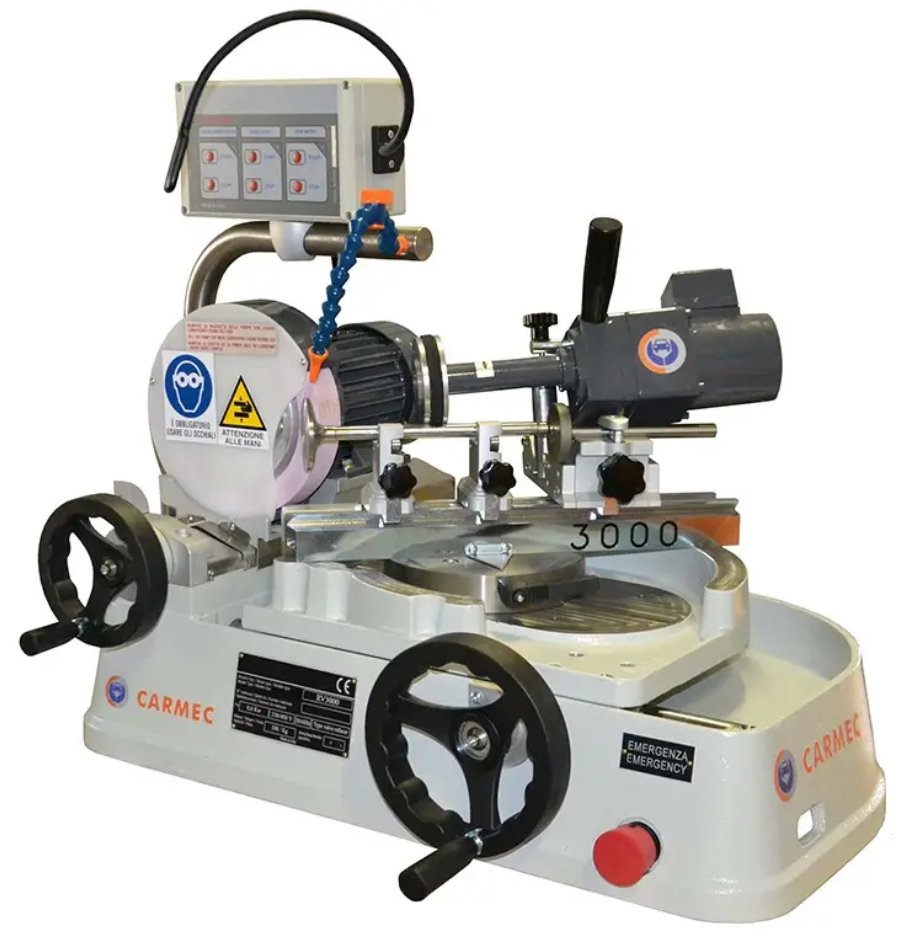
The original RV3000 machine from Rossi&Kramer. A machine with similar parameters offers by Carmec from Slovenia
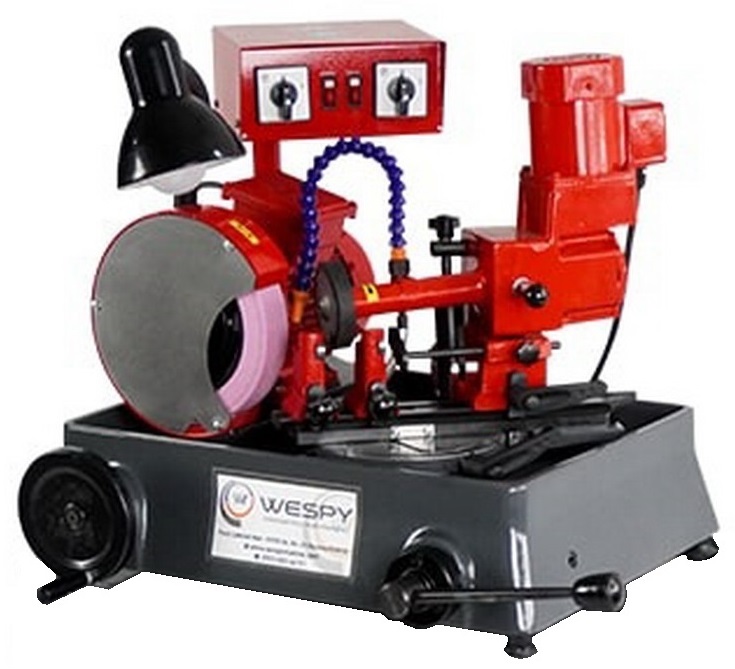
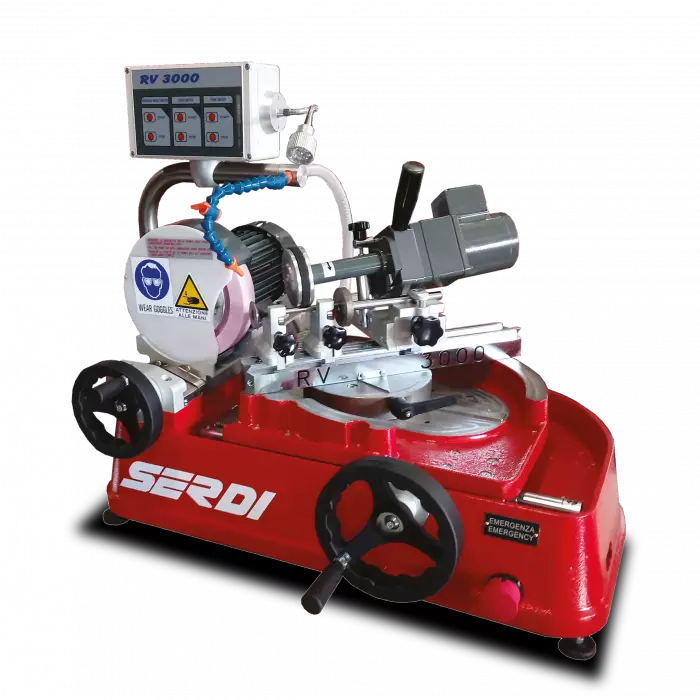
Turkish analogue and original Peg machine, offered by the French company Serdi now instead of original unique own machine
However, despite the obvious advantages, the scheme also has disadvantages, typical precisely for small diameters of the valve stem:
- Pressing the valve stem with a roller, with a small diameter of the stem, will inevitably lead to the stem deformation from the roller pressure.
- A significant increasing reduction ratio from the drive roller to valve stem of small diameter can be the cause of slippage, non-constant rotation speed and non-round of the valve chamfer.
- With a cantilever position of the valve head and a small diameter of the stem, its deformation by a grinding wheel is also possible, although in the direction opposite to the deformation from the roller.
- The combined effect of all these factors causes a significant deterioration in grinding accuracy with small diameters of the valve stem.
It should be noted that all these disadvantages appear only with a small diameter of the stem (the same effect appears in the machines for seat cutting). In fact, the steady rest machine of this design is not universal; its use for small valves is problematic. But at the same time, over the past 10-15 years, the repair of passenger car engines has consistently decreased in volume and has gradually become less relevant in Europe, though for heavy engines it didn’t change. This can explain the fact that these simpler and cheaper machines are becoming widespread step by step.
However, if it is necessary to grind valves with a small stem diameter, then it is only necessary to slightly change the valve clamping scheme, as many of the above disadvantages can be eliminated…
3.2.2. Machine with an improved steady rest valve clamping
In the 90s of the last century, the Italian company Comec improved the steady rest scheme: the drive pressure roller was removed from the design, and its function was transferred to a one steady rest itself, where its two support rollers became drives
Steady rest machine with an improved steady rest clamping of the valve (Comec), where the function of the valve rotation drive is transferred to one of the steady rests, which eliminates deformation from the drive and significantly improves the accuracy of grinding, but deformation of small valves from the grinding wheel remains:
1 – valve, 2 – grinding wheel, 3 – steady rest roller, 4 – drive roller, 5 – stop
In general, we got an excellent machine (Comec RV516ASM), in which the general advantages of the steady rest scheme are supplemented by the absence of deformation of the stem from the drive rollers pressing. In addition, due to the reduction in the diameter of the drive roller and its combination with the steady rest support of the stem, slippage is practically eliminated for small valves. However, the cantilever position of the valve head was preserved, and this did not allow us, in general, to make a completely universal machine: with small sizes, a cantilever clamped valve inevitably creates problems with grinding accuracy.
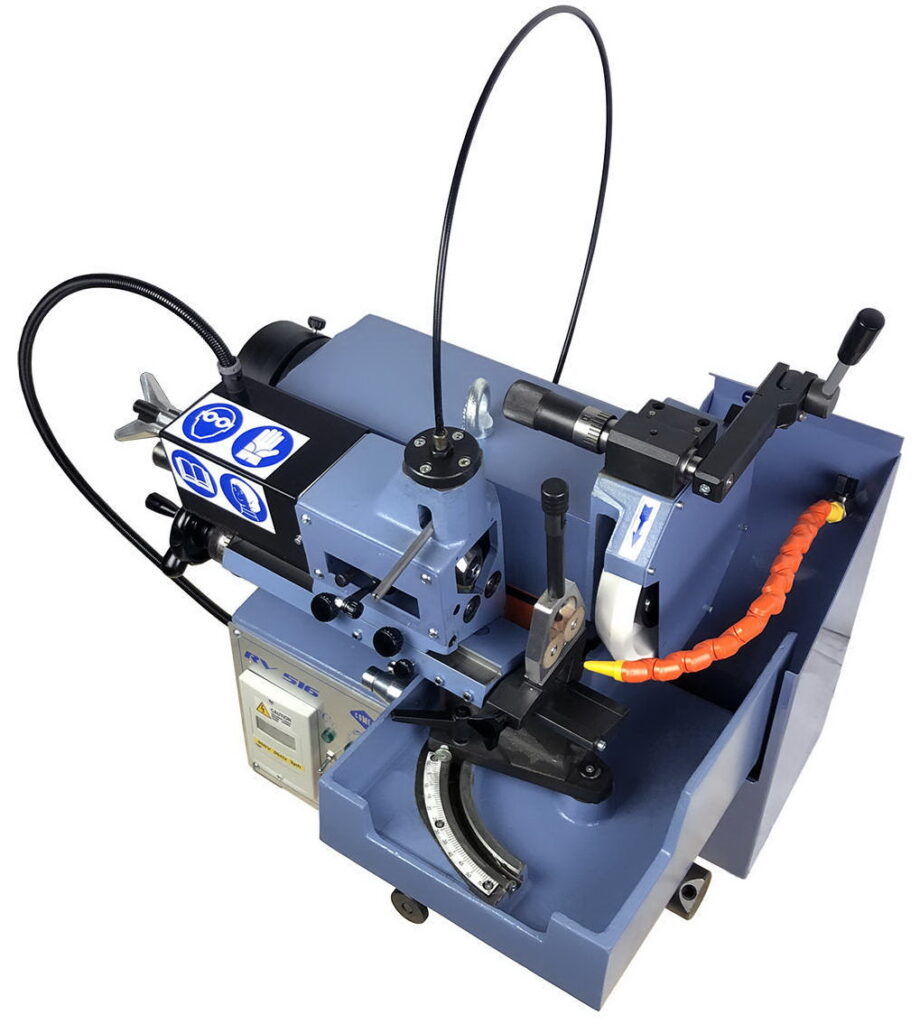
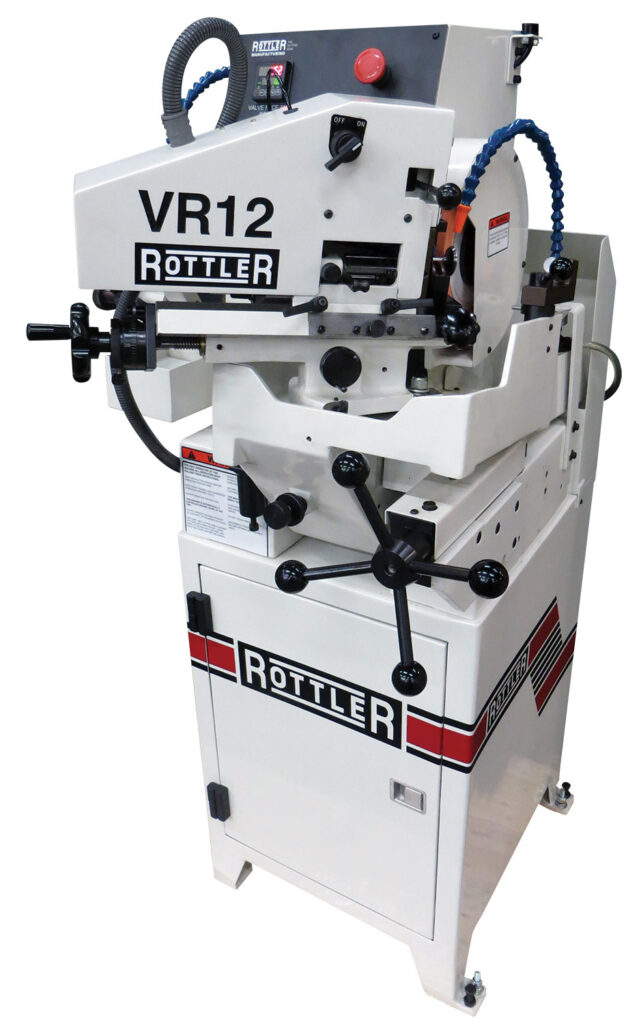
The original Comec RV516ASM unexpectedly turned out to be so much better than the Kwik-Way that the famous American company Rottler now offers the Italian Comec for a professional repair workshop instead of the American Kwik-Way for a private garage! (sometimes it happens?)
Despite these problems, the improved by Comec steady rest valve grinder has already become very close to being able to create a completely universal machine for grinding valves of any stem diameter, capable of grinding any valves with the same high precision. And such a machine was finally developed…
3.2.3. Universal machine with improved steady rest valve clamping
In the mid-90s, the French company Serdi, while solving the problem of increasing the accuracy of seat machining in multi-valve cylinder heads with small valves in a revolutionary way, simultaneously solved the problem of precision valve grinding for such engines in an equally revolutionary way.
In the improved steady rest scheme of Comec, the main drawback is the cantilever position of the valve head, on which the grinding wheel can press and deform the thin valve stem. In the scheme proposed by Serdi, there is no cantilever anymore: the valve head rests on a driving rubber shoe, which required the use of a special pneumatic cylinder pushing the valve to the shoe. Moreover, similar pneumatic cylinders are used for the rollers pressing the valve stem to steady rests (patented by Serdi).
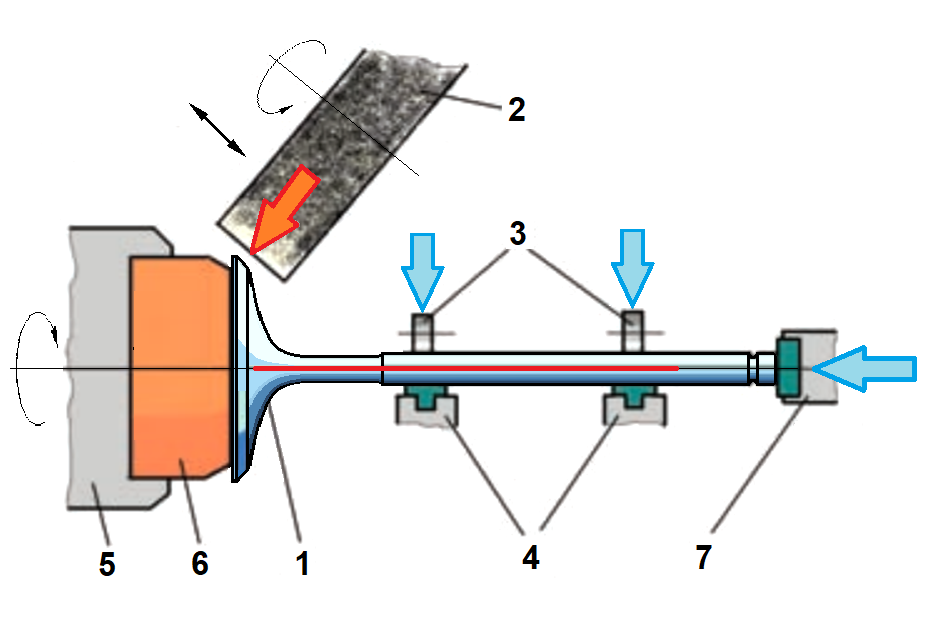
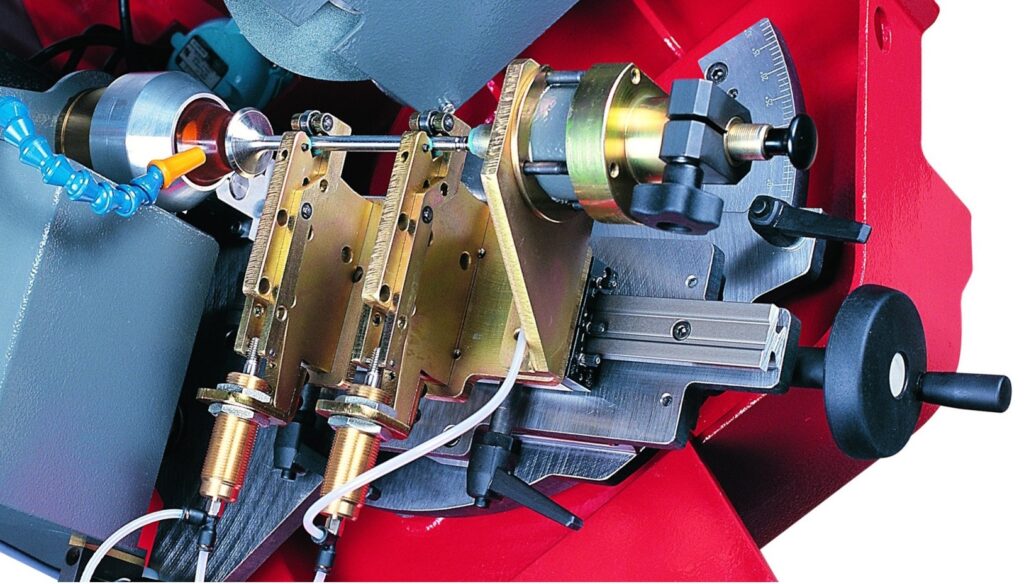
Universal steady rest machine with an improved steady rest valve clamping (Serdi), where the drive function is transferred to a special shoe by supporting the valve head on it, which completely eliminates valve stem deformation and dramatically increases the accuracy of grinding small valves:
1- valve, 2- grinding wheel, 3- steady rest pressure rollers, 4- steady rest support pads, 5- spindle, 6- drive shoe, 7- pressing pad
Thus, pressing the grinding wheel on the valve head does not lead to deformation of the stem (the drive shoe prevents this), but to pressing the head against the shoe! As a result, the only one completely universal machine on the market, the HVR90 model, was created, for which it makes no difference which valve to grind – with stem diameter of 14 mm or 4 mm.
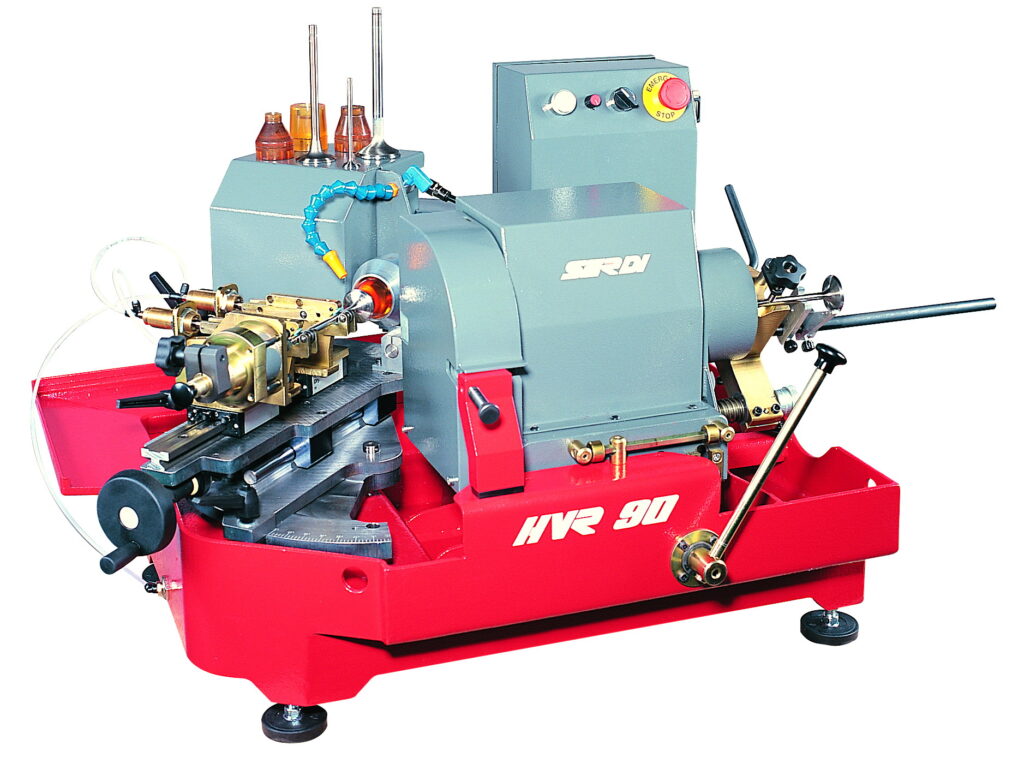
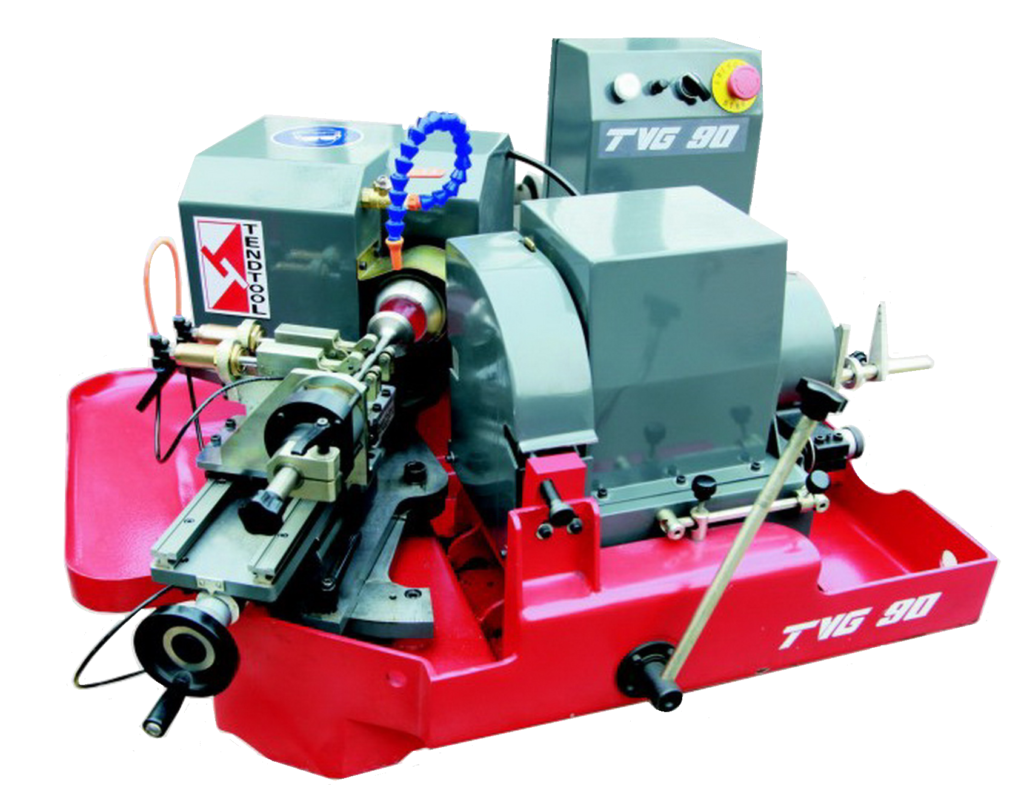
The original Serdi HVR90 valve grinding machine has not been produced anymore for a long time, but instead of it, a Chinese clone (Tendtool, SGMC, AMCO, THL, BestWin) is successfully and massively sold at 2.5 times less price
Further operation of these machines has shown their other advantages:
- High grinding accuracy. The normal level of valve chamfer runout after grinding is no worse than 0.01 mm.
- High stability, because grinding accuracy is maintained almost throughout the entire operation of the machine.
- High productivity provides valve installation takes seconds.
- Complete versatility means the same grinding accuracy is achieved for valves from the entire size range.
- Low operating costs, because only cheap plastic supports for the valve stem are subject to periodic replacement.
- High reliability: despite the complex design, the use of standard elements has virtually eliminated failures.
- Extremely high durability: over 20 years of operation, in addition to replacing the plastic supports, only a one-time replacement of the grinding head guides costing up to 200 Euros may be required.
However, the advantages did not come for free. The main disadvantage of this machine was its price, which was 1.5-2 times higher than other competing machines have. And this played a fatal role in the fate of the machine…
In the 2000s, the shadow of the uselessness of engine repairs in the passenger car sector gradually began to descend on Europe. Why repair if it is easier to buy everything new – valves, cylinder head, engine or even entire car? Then the crisis of 2008-09 intervened, somewhere around the same time, everyone was gradually absorbed by the idea of global electrification, then…, after… As a result, not only the needed operating life of cars decreased, but along with it, the need for repairs and repair equipment fell. Moreover, among repair equipment the first to “suffer” were predictably the most expensive machines.
If we add to the picture the complete inaction of the manufacturer to promote the competitive advantages of this machine on the market, then its fate was sealed: it was discontinued as unprofitable. However, it did not disappear. The clones of this development spread with absolutely unimaginable speed in China, where at first such a clone appeared in the production program of Tendtool Company, which was then a partner of Serdi, and then everywhere.
Unfortunately, Chinese clones do not suffer from such a useful property for consumers as durability, and are unlikely to work for 20 years without repair, like the original. But so far they work no worse. And since they consist mainly of standardized units, their repair in operation, if necessary, is not a big problem.
Well, and what about the Serdi company? You will not believe it, but after unique patented machines of its own design were completely removed from its production program (the special VVR120 machine for large valves lasted until the very end), it appeared there… the Peg VR3000 machine as a final solution to the issue of valve grinding. Probably, now to complete the entire process, as a final solution to the issue of the cylinder head repair in general, it would be logical to remove the universal seat cutting machines Serdi 3.5 and 4.5 (they are fitted for small valve seats) from the production program, simply replacing them with simpler Serdi 2.0 and 100 for truck and heavy duty engines.
3.3. Hybrid chuck-steady rest type machine
This machine was created specifically to make the largest valves – diesel locomotive and marine. When increasing the diameter of the valve head, and some good valves have a head diameter of up to 200 mm, high power and torque are required for grinding, at which no drive roller can rotate such a valve without slipping. For this purpose, it was necessary to go back to the chuck and its rigid valve stem clamping with its rotation. Well, and in order to reduce possible beating and increase the accuracy of grinding, one front steady rest was left.
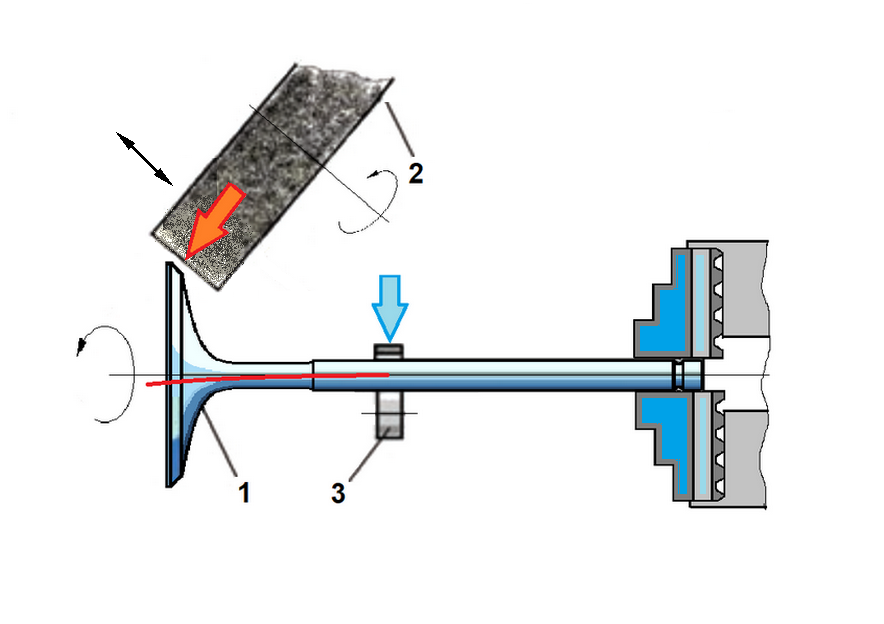
Hybrid chuck-steady rest machine Peg RV5500, which due to the fact that the function of one of the supports and the drive is transferred to a precision cam chuck, is used mainly for large valves, although it can also grind medium ones:
1- valve, 2- grinding wheel, 3- steady rest roller, 4- chuck
In general, such a scheme is also efficient for medium-sized valves. However, experience in grinding crankshafts suggests that thin valves will inevitably deform when clamped in a chuck, and no steady rest will save them from defects during grinding. So, this machine is not suitable for grinding small valves in principle. But it was not created for them. And in general, grinding machines for large valves are a completely different story…
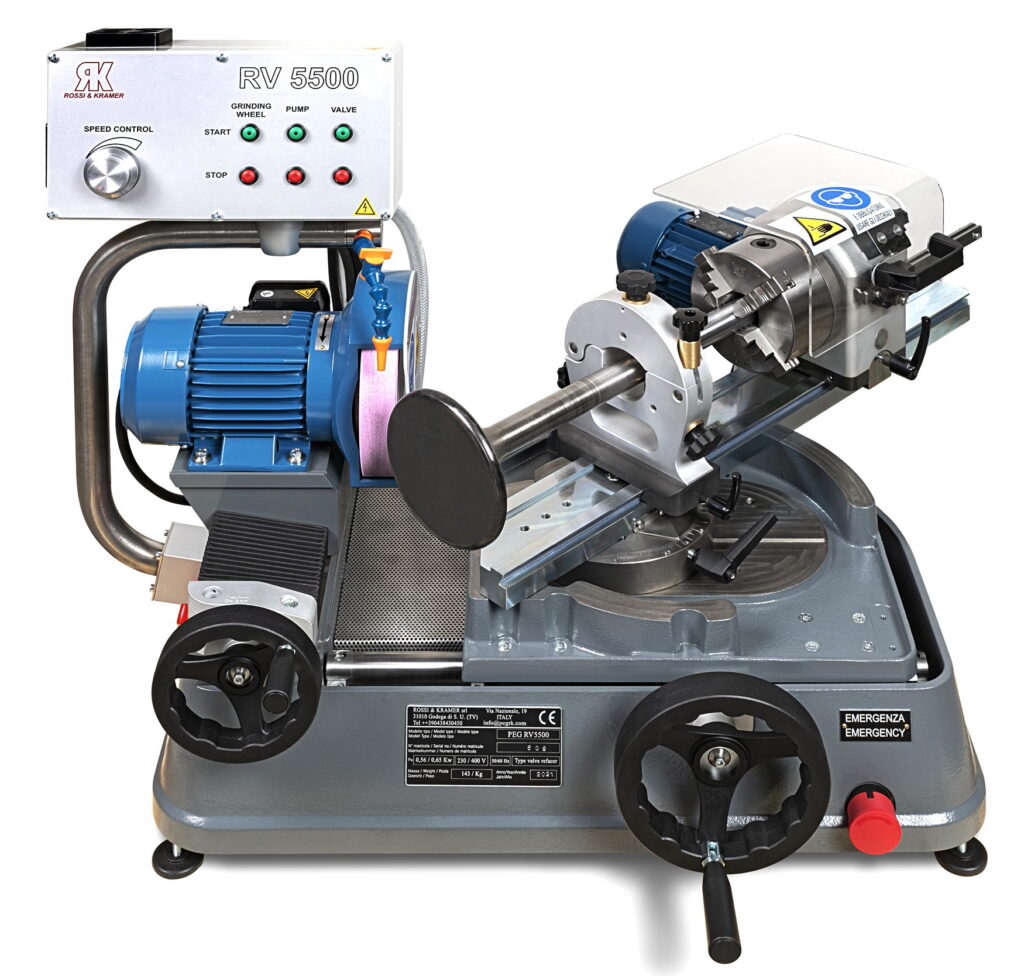
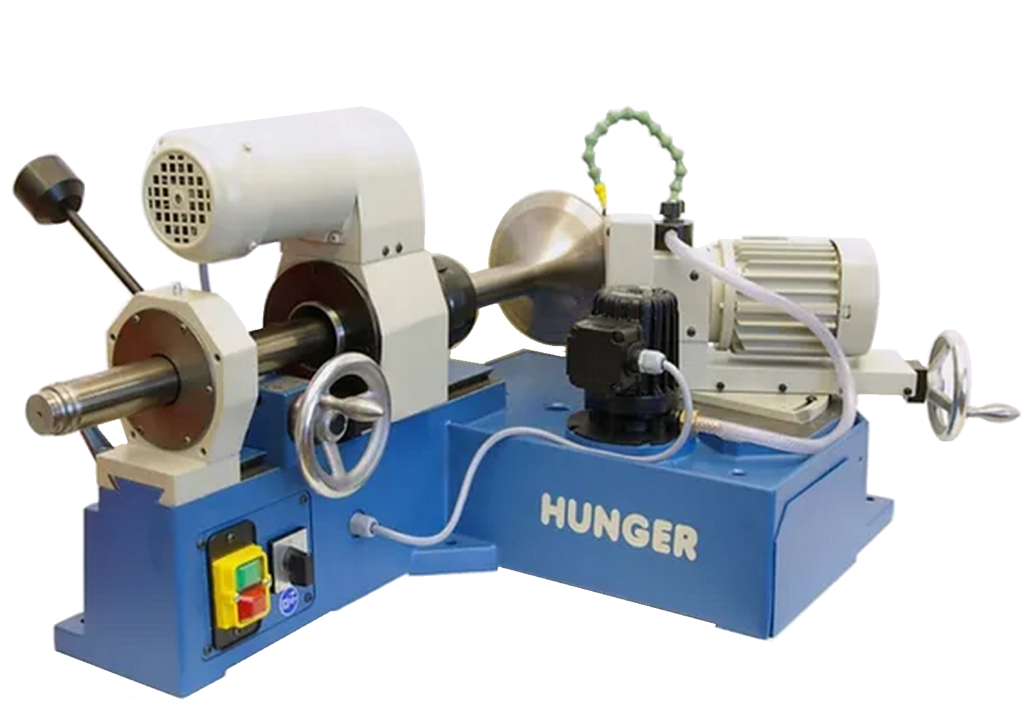
Specialized machine for large valves Peg RV5500 (valve stem diameter is up to 40 mm, valve head diameter is up to 200 mm) and similar machine Hunger VKM3.4
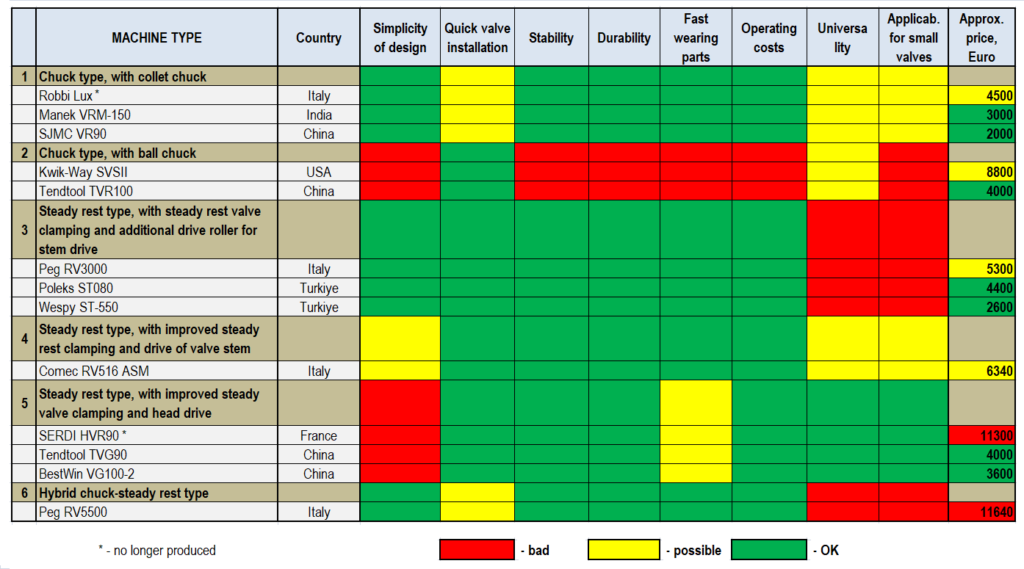
3.4. Comparison table by machine types
All existing types of valve grinding machines can now be summarized in a comparison table, with the help of which you can choose a machine with the required characteristics. It is easy to see that most of the machines produced are designed to work mainly with medium-sized valves.
Part 4. PROSPECTS AND FORECASTS OF THE VALVE GRINDING MACHINE MARKET
.
The main requirements for a modern valve seat grinding machine and recommendations for customers:
1. The valve grinding machine, despite its simplicity and low price, is of exceptional importance for ensuring high quality engine repair.
2. A valve grinding machine always works in tandem with a seat cutting machine. This means that the valve grinding machine must match both the engines being repaired and the characteristics of the machine for seat cutting in the heads of such engines.
3. When repairing only and exclusively the cylinder heads of engines of trucks and heavy duty vehicles, it does not matter in principle which valve grinding machine to use.
4. The use of obsolete grinding machines with ball chucks should be avoided due to their inconsistently low accuracy and extremely high operating costs for its maintenance.
5. It is impossible to deceive the laws of physics in an attempt to use obsolete equipment for the valves of modern cars and motorcycles; such an attempt will only lead to great disappointment for the “lucky” owner of an obsolete machine.
6. When choosing equipment for an engine repair shop, it is necessary to take into account the fact that the main type of machine for grinding valves is a steady rest type. However, in some cases, it is also permissible to use machines with collet chucks.
7. If the repair program includes small valves of passenger car engines, the choice of a valve grinding machine is significantly narrowed.
8. Only collet chuck and steady rest machines with an improved drive are permissible for grinding small engine valves.
9. The best results in grinding small valves in terms of accuracy and stability are given by a steady rest machine with an improved steady rest clamping and driving for valve head, made according to the Serdi scheme.
10. Due to the fact that the production of the original machine of this scheme has long been discontinued, it is permissible to use its copies offered by various companies from China. However, it should be taken into account that their quality, reliability and durability are lower than those of the original machine. But, at the same time, it is compensated by their low price.
11. One should not expect any breakthrough innovative solutions in this equipment sector in the near future.
12. But as a prospect in this segment of equipment, it is necessary to point out simple touch control with a clear interface as one of the main signs that the machine is modern, and not outdated.
Alexander Khrulev©
Dr.Eng.Sci., Senior researcher
*This article represents the author’s value judgment (opinion) on the topic discussed in the article and expresses a personal point of view that does not claim to provide irrefutable evidence or assert any indisputable facts. Accordingly, any use, in whole or in part, of the materials in this article must include a reference to the author’s value judgment.
