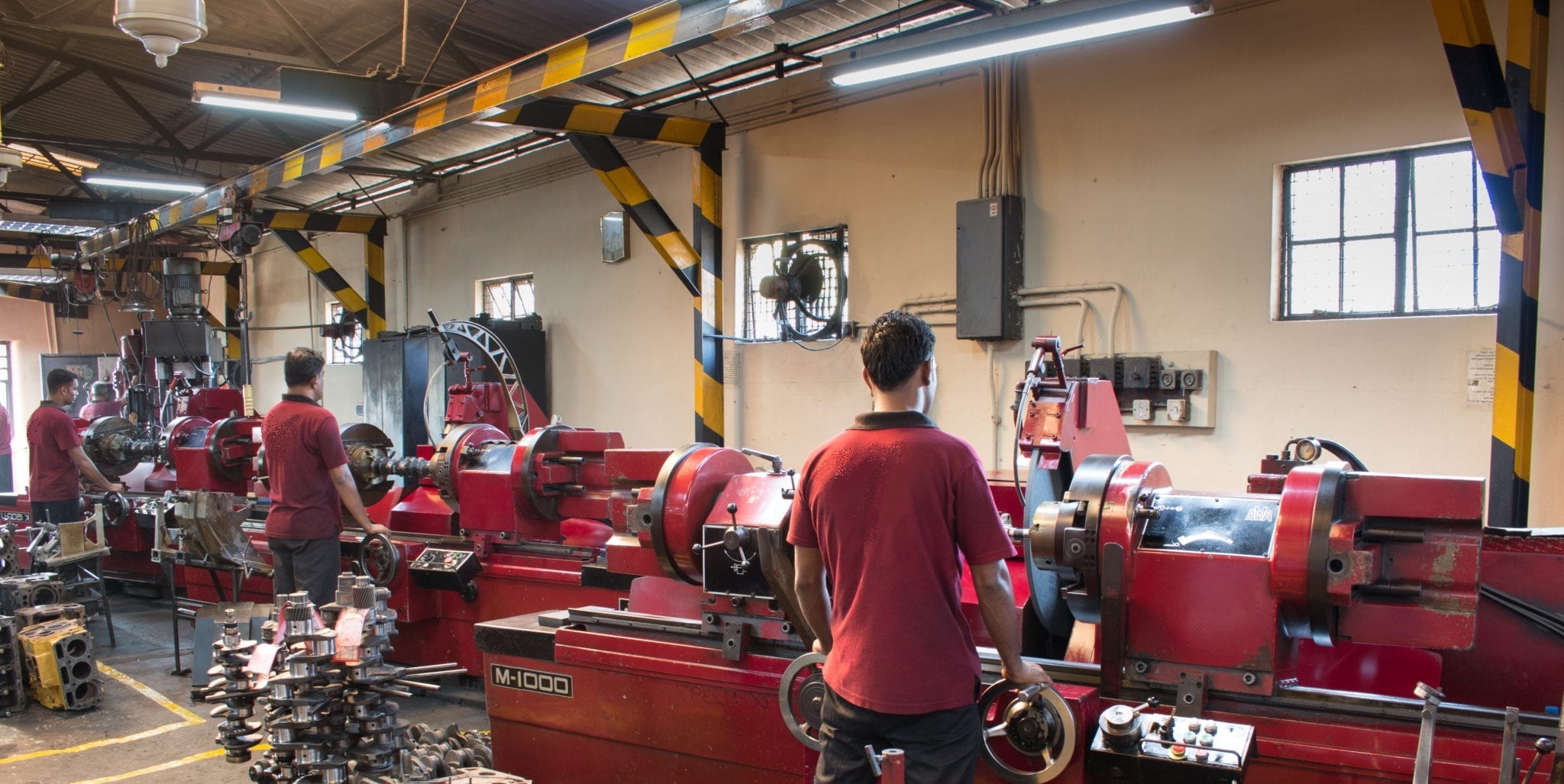
This question arises every time when it is necessary to purchase some expensive equipment to equip/re-equip a workshop. And the question is quite natural, since the answer to it allows us to understand what funds, from where and for how long it is necessary to attract for this purchase. At the same time, this is also a very important question, since the answer also determines the feasibility of the purchase, as well as equipment options in case the selected position turns out to be unprofitable.
At first glance, it seems clear that we’re talking about the efficiency of investing in equipment for an engine repair shop. This isn’t so much an engineering or technical problem as it is an economic one. And we have more economists than even electronics engineers. In sneakers. But… we’re faced with a paradoxical situation where everyone understands the importance of the topic, but for some reason no one can calculate anything. It’s so severe that even bachelors, masters, and PhDs in economics don’t know how. Apparently, they weren’t taught. Or, conversely, they were taught but didn’t learn. Or they learned, but not the right thing — that happens, too.
Well, if they don’t know, that’s no problem — engineers can certainly handle the economic problem. So, let’s start with the initial data for our problem.
.
1. EXPENSES
So, we want to spend X amount on equipment. How much? This can be calculated by creating a simple table and entering all the items that make up an engine repair shop. As demonstrated earlier, the entire engine production facility can be divided into two parts (shops) – a cylinder head repair shop and a heavy equipment shop (or a crankshaft and cylinder block repair shop).
A cylinder head repair shop, as practice shows, can exist separately and independently. This means that a heavy equipment shop can be added to it if necessary (or perhaps not). At the same time, a heavy equipment shop is essentially independent and, without cylinder head repair, simply loses its purpose. Consequently, in reality, there are only two shop setup options: a cylinder head-only shop or a full-cycle shop.
However, to simplify the calculations and make the results clearer, we will further consider both parts of the shop – cylinder heads and heavy equipment – separately.
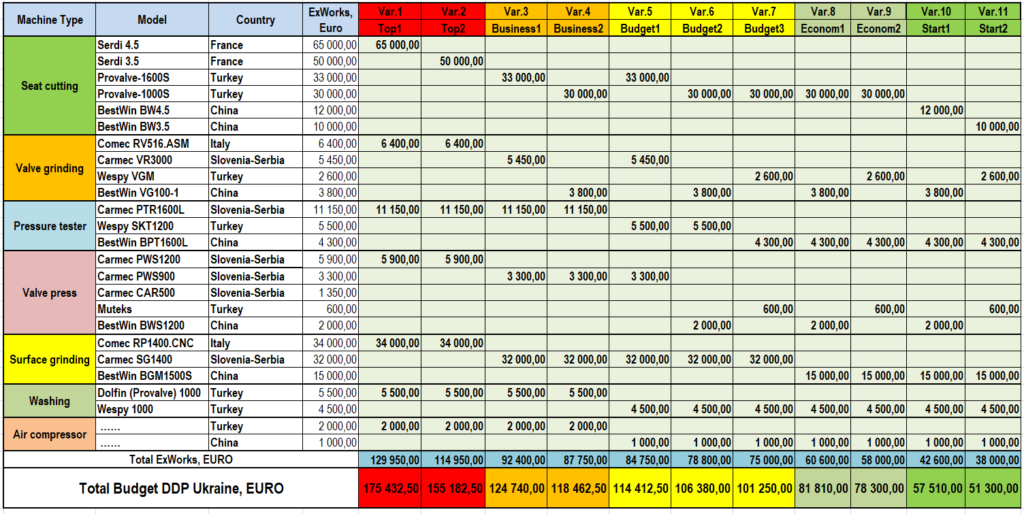
The composition and cost of equipment for a cylinder head shop are easily determined using data from our previous report:
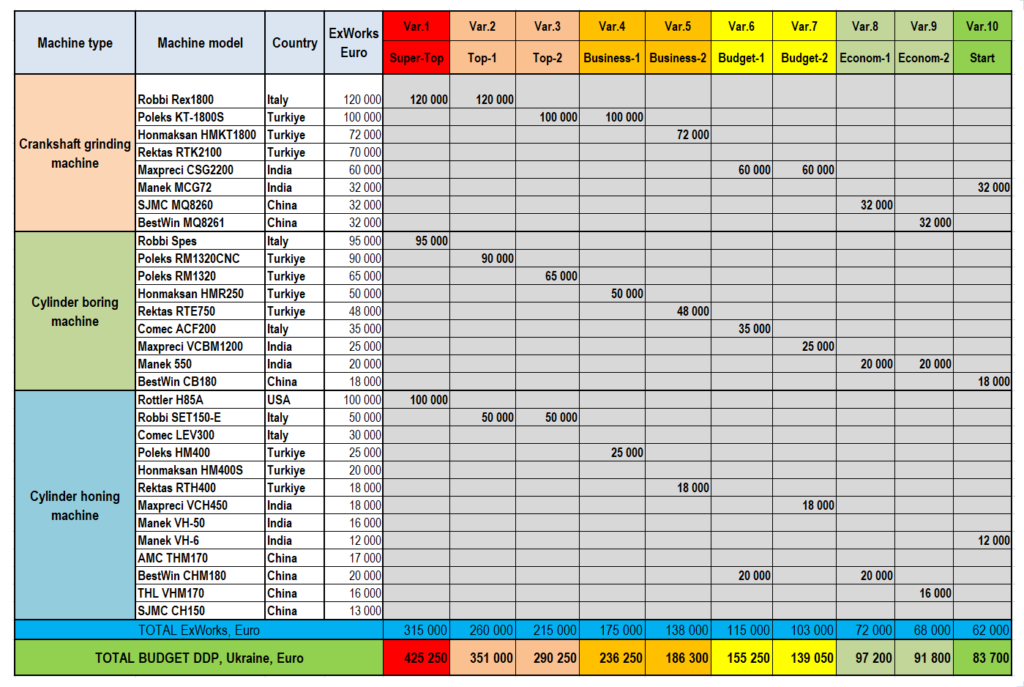
For a heavy-duty workshop, it’s also easy to estimate what to include and how much it costs. Let’s create a similar table for a heavy-duty shop, including only three main machines — grinding, boring, and honing. The result is a very interesting picture, where the difference between the most expensive and cheapest options is… 5 times:
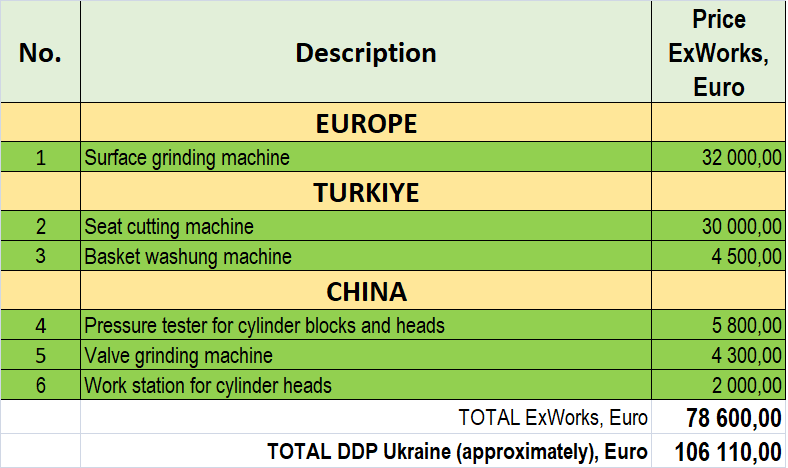
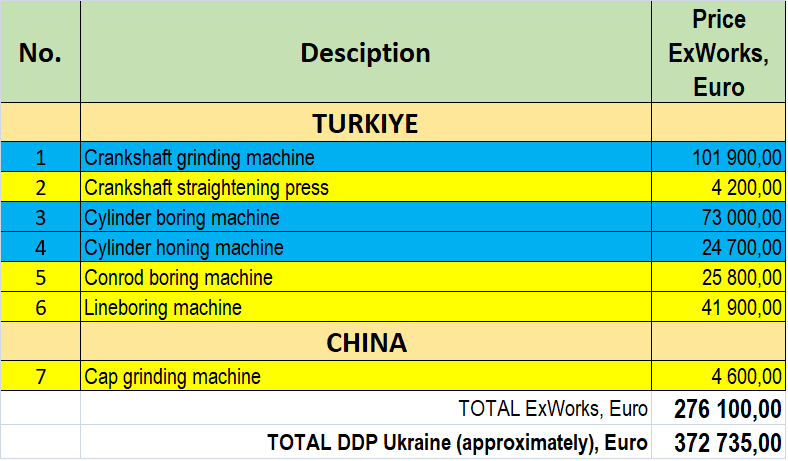
If we focus on budget options, but prioritize Turkish manufacturers (with a small addition from Europe and China), we’ll end up with this interesting table:
Cylinder head repair workshop, estimated budget:
The heavy-duty workshop is divided into 2 parts (lines) – the main (blue) and the additional (yellow):
Well, as a result, we sum it up and get the following budgets:
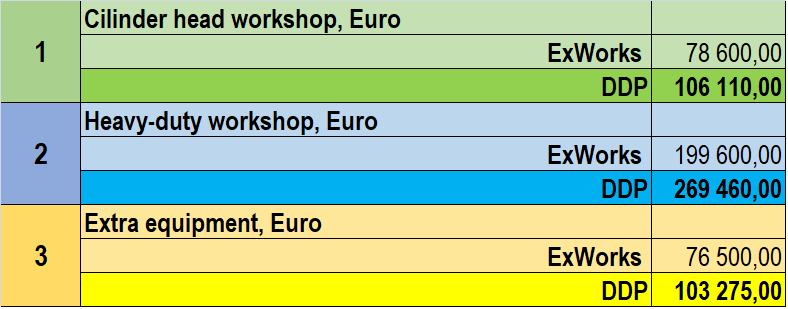
There’s no point in trying to cover everything, for obvious reasons. Therefore, we’ll only consider the main portion of heavy equipment, which is absolutely essential, and leave the additional portion, which is perfectly feasible to start without, for future calculations.
Thus, we have two costs that we’ll try to recoup – one at a time and one at a time.
.
2. INCOME
To recoup the investment (costs, investments), it’s clear that the equipment must generate income. What kind, where, and from where?
In general, it’s clear – the shop must produce work that needs to be sold to customers. This immediately raises several important organizational points, including:
…..1) the more customers you have, the higher your income, and the sooner you’ll break even.
…..2) it’s immediately clear that nothing will pay off at all if you rely solely on your own auto repair workshop’s equipment capacity — you need to organize the acceptance of parts for repair from outside the company.
…..3) when customers order work, the more different parts you make, the greater the income.
…..4) however, there are limitations on the maximum volume of work — they depend on the type of equipment and the number of employees. In any case, employees won’t be able, and the equipment won’t allow, to do more than a certain maximum.
…..5) but, on the other hand, achieving the maximum volume is usually impossible, especially in the initial period of a new business. An existing business won’t be able to scale up either, so it’s necessary to estimate the actual volume of work.
The question immediately breaks down into three parts:
…..1) you need to determine the actual volume of work (in types and quantities of parts) for the selected period;
…..2) You need to find the prices for this work;
…..3) And only then can you calculate the income and payback period, during which you can recoup your investment and begin making a net profit.
2.1. Volume of work
If we’re talking about a long-standing workshop or engine repair workshop, everything is clear – open the computer and look at how many parts, and what kind, the shop has produced in a day, week, month, or year. It couldn’t be simpler. It’s even worse when there’s no shop at all, and it’s unclear how much work should be done.
As a rule, in the initial period after opening, work is sparse, and its volume usually begins to increase only after a year, reaching a certain average value after three years of operation. We’ll simplify the task, since we’re initially assuming a fairly long payback period.
Based on experience, the following average daily output figures were adopted for the operating shop:
1. For the cylinder head workshop:
…..Cylinder heads for guide replacement, seat straightening, and valve grinding – 3
…..Cylinder head cleaning – 6
…..Cylinder head pressure testing and surface machining – 5
2. For the block and crankshaft repair workshop:
…..Cylinder blocks for boring and honing – 3
…..Cylinder blocks for liner fitting – 1
…..Crankshaft journal grinding and polishing – 3
…..Other turning and machining work – 1
Obviously, if other initial quantities are adopted, the results will change. The main point is that trends are more important than exact (and a priori unknown) quantities of work in a specific, yet-to-be-built shop. But in any case, it’s very easy to repeat the calculation with any number of parts – if you’re willing.
We, of course, offer everyone the opportunity to calculate everything freely and with any data. Simply open the magical Excel spreadsheet on your computer and paste all our figures into the required cells.
2.2. Labor prices
The labor prices were roughly taken from well-known online repair company websites. We did not evaluate the accuracy of these prices — we simply used what was available online:
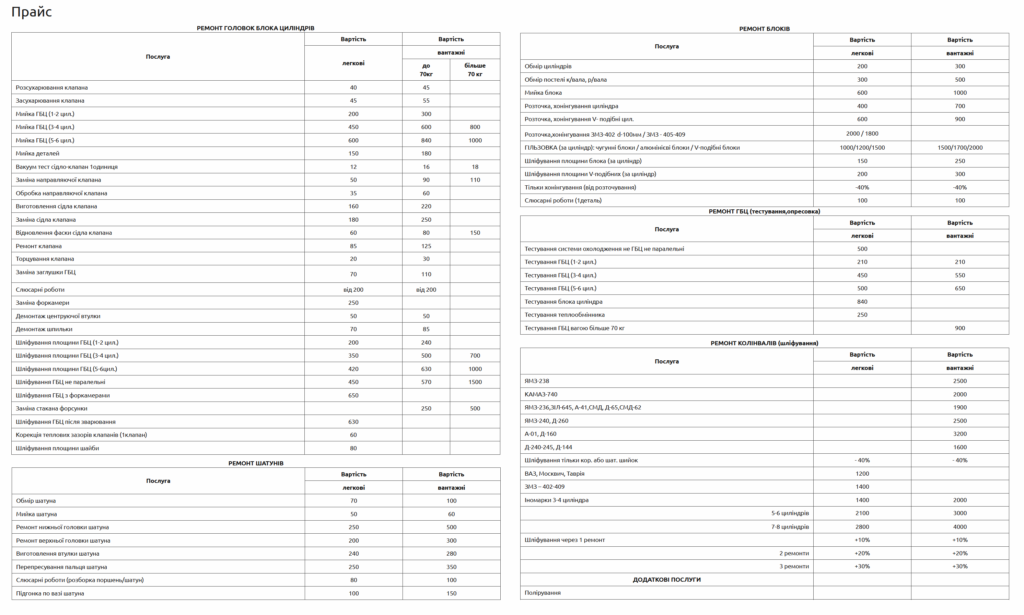
Based on this, the following prices in UAH are used for one cylinder head:
…..Disassembly-assembly = 1280
…..Wash = 600
…..Crushing = 600
…..Guide replacement = 960
…..Seat machining = 1120
…..Valve grinding = 1600
…..Face machining = 600
For blocks and crankshafts, the following prices are also used per unit, in UAH:
…..Block boring and honing = 2400
…..Block liner grinding = 6000
…..Crankshaft grinding = 2000
…..Crankshaft journal polishing = 500
…..Mechanical work = 3000
While researching prices, I suddenly discovered something surprising. These are the prices of one engine repair shop in Germany:
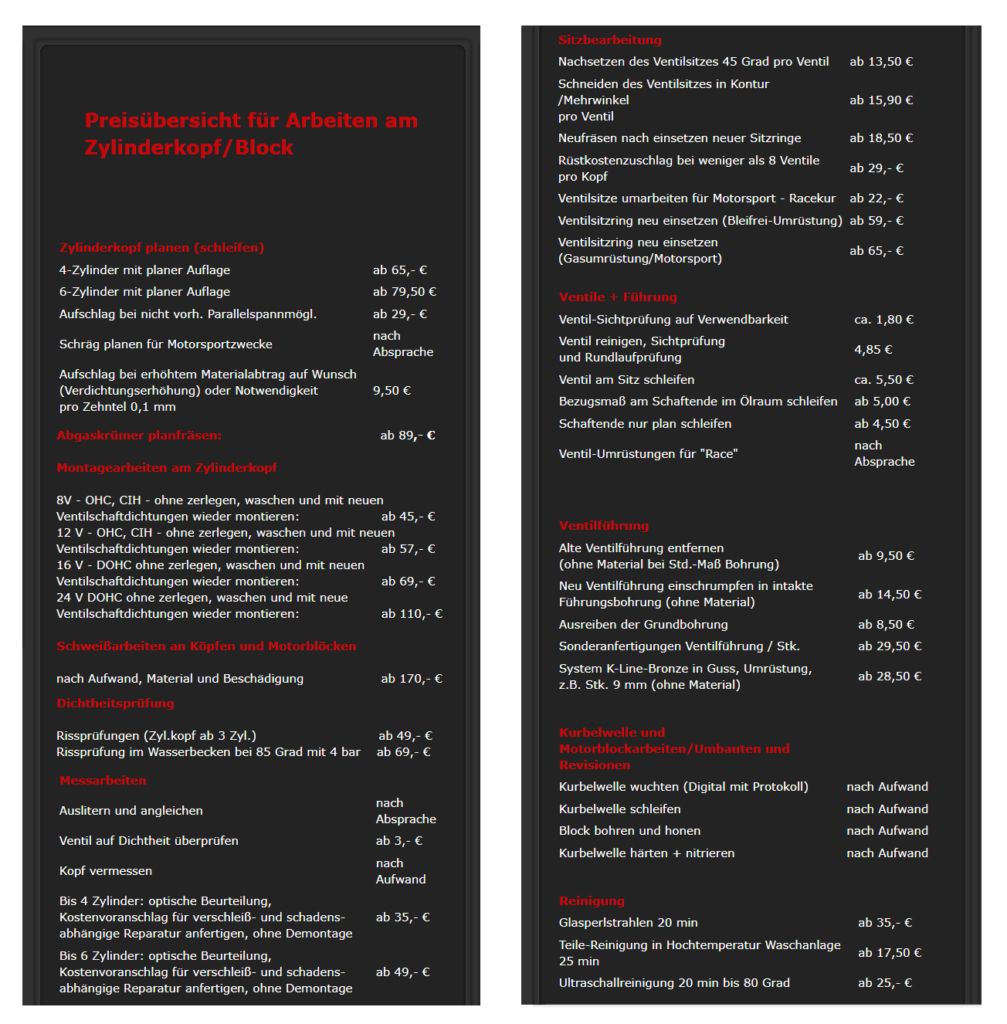
What could be interesting here? Well, here’s what:
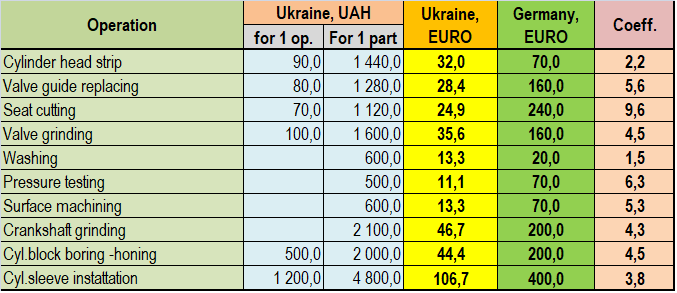
That is, the average price for machining work in Germany is 5-7 times higher than ours! And this despite the fact that fuel is only 1.3 times cheaper here. And many other things are even more expensive. The reasons for this imbalance are generally clear – old, worn-out machines are incapable of producing high-quality work, and low-quality work is worthless. But that’s a topic for another study.
.
2.3. Calculation Methodology
So, we know the investment amount. Let’s assume we don’t have our own money and are borrowing everything from the bank. To do this, we need to know and factor in the annual interest rate the bank will ask for. It’s clear that banks always want a lot, but even without calculations, it’s clear that if they want more than 20-25%, going to them and being left without any calculations makes absolutely no sense. Ideally, of course, we should strive for an interest rate of 0%. In effect, this would mean we’re spending our own savings on purchasing equipment.
The product of the number of paid jobs per day and the number of working days per month and per year will yield the desired annual income. We assume a month has 21 working days, and 12 months yields only 252 working days per year—very close to reality.
It’s also necessary to clearly define what portion of the income we can/will spend on recouping the costs. Experience shows at least three very important points:
…..1. It’s important for a company to break even initially and then begin to generate profit, which is the difference between revenue (what clients paid) and all expenses (salaries, rent, taxes).
…..2. This profit should be used to recoup the costs of equipment.
…..3. After all the money has been paid, this profit will be what the business will receive for its continued development (or the owner will receive to lie on the beach of an ocean island).
Here, as always, practice offers recommendations. For example, if a business’s profit is less than 20%, then what good is it? Wouldn’t it be better to focus on something else? And if the profit is more than 30%, will the business be able to generate such a profit? Unlikely (it will generate 20%, and the rest can be stolen—that’s another matter).
The amount that will have to be repaid to the bank is easily calculated using the formula:
e = N * P * (B + 1) / 2400 , (1)
where B is the loan term in months; P is the annual interest rate on the loan; N is the loan amount, equal to the investment (funds invested in equipment).
In equation (1), we have two unknowns – the repayment amount and the loan term during which we can repay everything. This can be found using the formula:
B = 1200 * (N + e) / (D * A) , (2)
where A is the annual income from the work; D is the percentage of income we will repay (equal to profit).
Two equations with two unknowns provide a solution for the repayment amount:
e = N * N * P / (D * A – N * P). (3)
From here, the payback period in years is:
R = B/12 = 100 * (N + e) / (D * A). (4)
First constraint: D * A cannot be less than N * B. That is, if profit is equal to or less than the interest that must be repaid to the bank, formula (3) implies that it’s impossible to recoup anything. This is perfectly obvious, because when expenses are simply greater than revenues, the company is bankrupt from the start.
.
3. RESULTS
We summarize everything in a real Excel spreadsheet, where we separate the head section and the heavy equipment section, and then combine them:
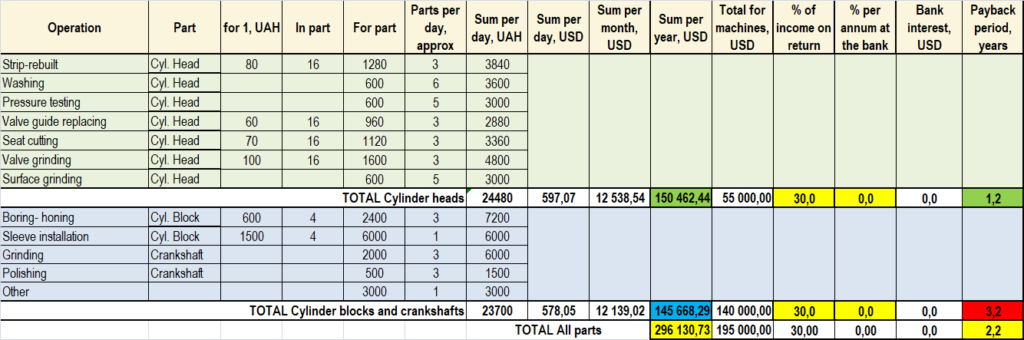
Now, using the table, it’s easy to calculate the options. And they’re worth the effort!
1. If we assume a constant profit of 20% and use it to pay off the loan, we’ll get the payback period for various workshop projects at different bank interest rates:
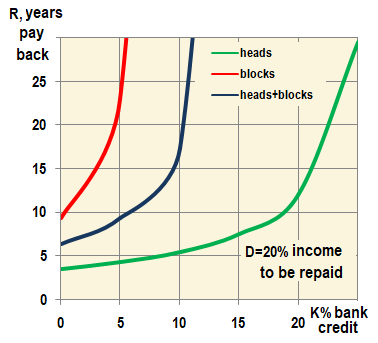
In fact, this is a fantastic result. We can see that a head repair shop has a chance of paying for itself in 5 years, even at 10% annual interest. However, as soon as we want to attach heavy equipment to it, the company will inevitably go bankrupt – it won’t be able to repay the debt even in 15 years. It turns out that while it’s still possible to borrow money to set up a head shop, building a full-cycle shop will require exclusively internal funds. Or, at the very least, don’t even bother with such a complex issue. So, if heads can do everything, then modern heavy equipment with such low labor costs isn’t for everyone, only the rich. It’s a paradox, after all, because work on the most expensive equipment is only for the poor.
2. What if we find and invest our own hard-earned money? Then it’s like this:
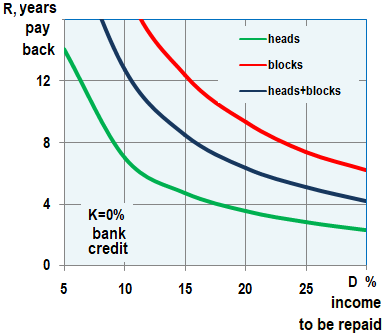
This means we have every chance of recouping the head shop project in a measly 2.5 years. And if we push ourselves and squeeze 25% of the total revenue out of the shop, the heavy equipment will also pay for itself within 5 years, and the money will be returned.
.
3.1. Verifying the Results
We can roughly verify the results as follows. We’ll divide the total revenue into four equal parts: wages, shop floor rent, taxes and overhead, and profit, or return on investment. A simple calculation shows that the payroll fund in this case allows us to hire at least 6-7 staff members who are fully capable of completing the specified volume of work. At the same time, a shop occupying, for example, 250-300 square meters and consuming approximately 50 kW of electricity will be able to pay rent at a rate of $30 per square meter per month, which more than covers the typical price of industrial real estate and electricity.
It’s typical that, given current electricity prices, if a frivolous owner suddenly decides to replace modern equipment with scrap metal, the monstrous old machines will bankrupt him with their excessively power-hungry electric motors. Which would be perfectly reasonable, because, as they say, there’s no other way.
4. WHAT OTHER OPTIONS ARE THERE?
What if… Let’s say you don’t have your own money, but you still need to build a workshop. In that case, you’ll have to descend from the European-Turkish heavens to the Indian-Chinese land. Even if you really don’t want to.
In the table above, the budget for a head repair shop built with Chinese equipment is unlikely to exceed $60,000.
As our table shows, a crankshaft grinder in India can be purchased for $60,000-$70,000 (including shipping), while a cylinder boring machine is unlikely to exceed $35,000. If we include a Turkish honing machine, also priced at $35,000 (which isn’t that expensive by comparison), the total budget for a heavy equipment shop won’t exceed $140,000, which is a very realistic figure. It’s also half the cost assumed above for a shop entirely made from Turkish equipment.
This fundamentally changes the picture. A second calculation shows that a head repair shop can be recouped in less than two years, and if a heavy equipment shop is added to it, the payback period gradually drops to five years, even with a 10% bank loan. Even a 15% loan no longer seems like a guarantee of bankruptcy for the new venture.
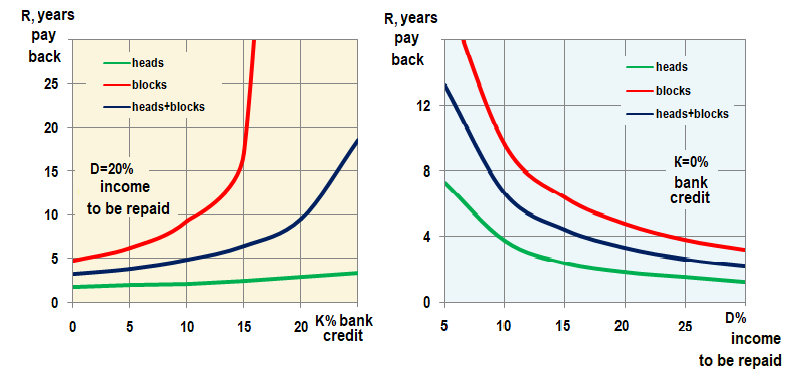
As can be seen, the payback curves under these conditions change dramatically, and what was impossible with Turkish-European equipment is easily achieved when replacing it with Indian-Chinese equipment.
However, this result should not be taken as an advertisement for cheap Chinese or Indian equipment — it is often of lower quality and less durable. This can lead to additional, difficult-to-calculate costs. But in fact, this is cause for concern. Because cheaper options make possible what is fundamentally impossible with expensive ones.
.
CONCLUSIONS
1. Given the current price level for machining services, the possibilities for establishing a new workshop and acquiring equipment for it are severely limited.
2. When establishing a cylinder head repair workshop, the maximum possible annual interest rate on a bank loan should not exceed 10-15% per annum. Otherwise, the payback period will exceed 5 years, increasing the risk of bankruptcy.
3. Heavy equipment for repairing cylinder blocks and crankshafts has extremely low profitability at current labor prices. When establishing a full-cycle workshop using expensive European-Turkish equipment, no bank loans can be obtained at any interest rate, even the lowest. If borrowed funds with any annual interest rate other than zero are used to purchase heavy equipment, the new enterprise will go bankrupt before even opening.
4. Expensive heavy equipment pays for itself within a reasonable time only if invested internally and only as an addition to an existing cylinder head workshop.
5. This low profitability situation has arisen due to the prolonged use, over decades, of obsolete equipment, which produces poor quality work. Such work corresponds to the residual value of the old equipment on which it is performed and is very cheap (or, more accurately, worthless).
6. The only possible solution to the problem of heavy equipment payback is currently the acquisition of Chinese and Indian machine tools instead of European and Turkish ones.
7. Considering that the current price level for machining work in Ukraine is lower than in Europe by an average of 5-7 times (there is no such significant difference for any other parameters), there are good prospects for a gradual increase in prices for work performed on modern equipment. Therefore, it can be assumed that profitability levels will actually be higher, and payback periods shorter, than those shown in this report (of course, all this will only apply in peacetime).
Experience tells us: the companies that took out loans to purchase expensive heavy equipment, which we have seen over the past 25 years, have all long since gone bankrupt and closed their doors. The only ones that survived were those that invested their own money or that purchased heavy equipment gradually using their income and/or had other businesses. We’re not implying anything, but we recommend learning from the mistakes of others, not your own.
Alexander Khrulev©
Doctor of Engineering, Senior Researcher
*This article represents the author’s value judgment (opinion) on the topic discussed in the article and expresses a personal point of view that does not claim to provide irrefutable evidence or assert any indisputable facts. Accordingly, any use, in whole or in part, of the materials in this article must include a reference to the author’s value judgment.
