 Are we all really in for total and inevitable electrification, and the inevitable demise of internal combustion engine repair? The answer to this question is important, as it allows us to identify the prospects for the development of engine repair in general, and also to understand whether this type of repair has any prospects for the future? Is there a risk in purchasing this or that expensive repair equipment, or will it pay off quickly? Accordingly, knowing where the engine repair world is heading, it is much easier to make a decision. This is precisely what prompted our trip to the next world exhibition Automechanika FRANKFURT-2024.
So, after a 10-year break, we finally decided to go to this exhibition. Today, it is rightfully considered one of the most grandiose exhibitions of automotive equipment and tools in the world – Automechanika FRANKFURT. This exhibition is held every 2 years on the second week of September in the largest exhibition complex in Europe Messe Frankfurt in Frankfurt am Main (Germany).
There were several reasons for the trip. We decided to check some important trends, which is difficult to do and / or confirm from afar, especially during the war, namely:
1) how much has the world market for engine repair equipment changed over 10 years,
2) what is happening with the widely advertised electrification of motor vehicles, is it so total?
3) to what extent has the market for car repair equipment shifted towards electric?
The answers to all these questions are important, since they allow us to identify the prospects for the development of engine repair in general. In addition, it is necessary to understand whether this type of repair has any prospects for the future? Or are we all really already awaiting total and inevitable electrification, and the repair of internal combustion engines is an inevitable demise? Understanding the real development processes and trends is not a whim, but a necessity, given the high cost of machine tools for processing engine parts. Accordingly, knowing where the engine repair world is heading, it is much easier to make a decision – it is enough to answer the question, is there a risk in purchasing this or that expensive machine equipment for repair, or will it pay off quickly?
No sooner said than done. Frankfurt is a stone’s throw from Kyiv – only some 1800 km. And this, as they say, “is not a detour for a mad dog”, especially by good car. And when, after a relatively slow drive almost 700 km (by the way, I wonder why in 2019-21 the roads in Ukraine were built to the east, and not to the west?), including several hours of standing in line at the border, you first go out onto the Polish and then the German autobahns, the journey no longer seems long and drawn-out.
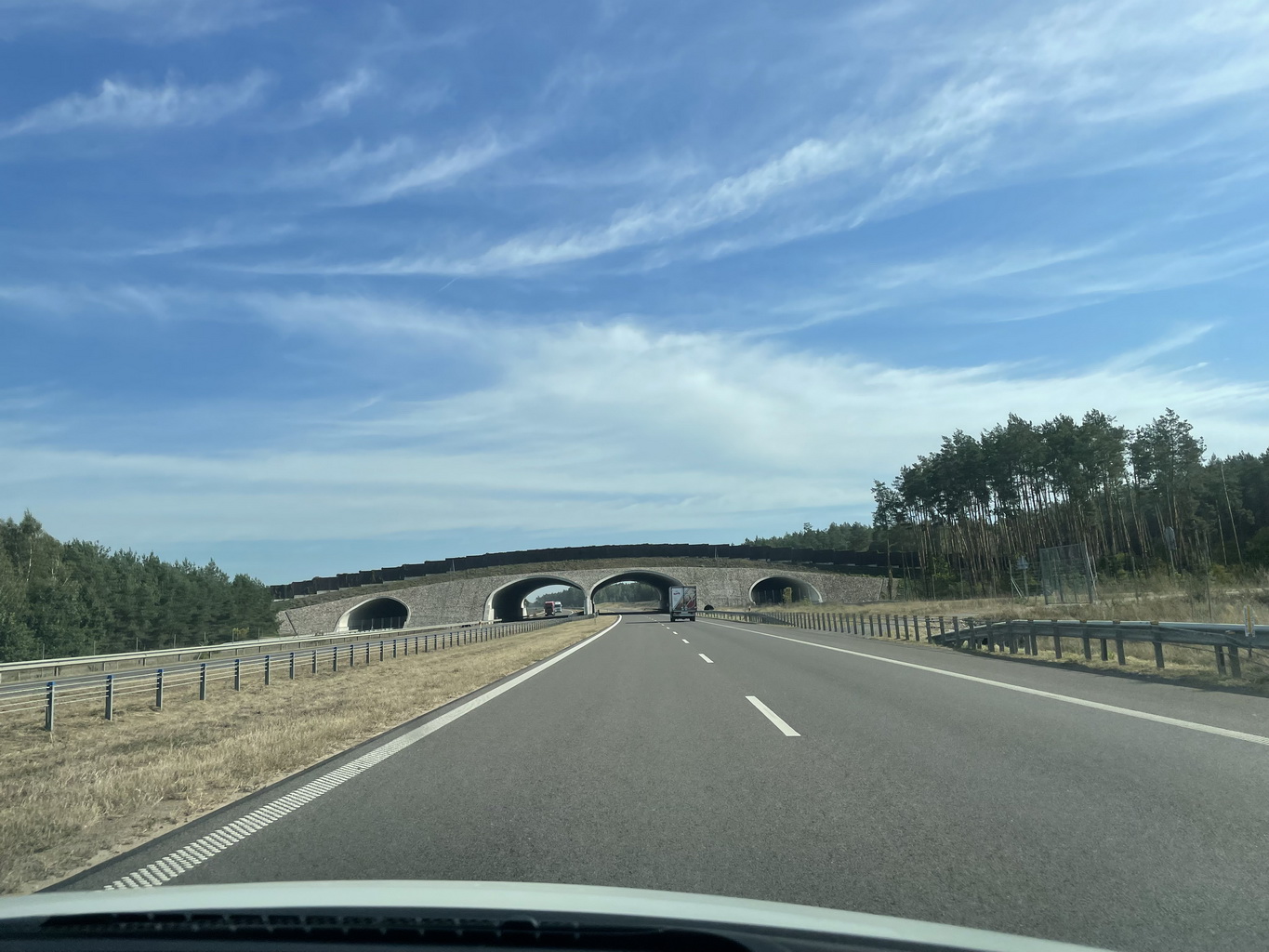
You can always recognize a real autobahn in a normal European country by two signs at once: by bridges for wild animals (cars and people do not go/walk on them) and by serious fences on the sides of the road (through which no animal can crawl – neither small nor large). By the way, domestic animals are also nowhere to be found on the streets and roads of Europe – they all have their own home. Which is the main difference between European countries and other and wild ones.
The exhibition greeted us with its usual crowds in all of its 12 pavilions – everything is exactly like in previous years. And it must be said that these are absolutely gigantic pavilions, when you can’t see the end from the beginning. Moreover, some of the pavilions are 2- and 3-story. It is generally unrealistic to go around them all even in 4 days of the exhibition – you can only run past. But we don’t need this – almost everything related to repair and mechanical processing of engines is traditionally located in the 8th and a little in the 9th pavilion.
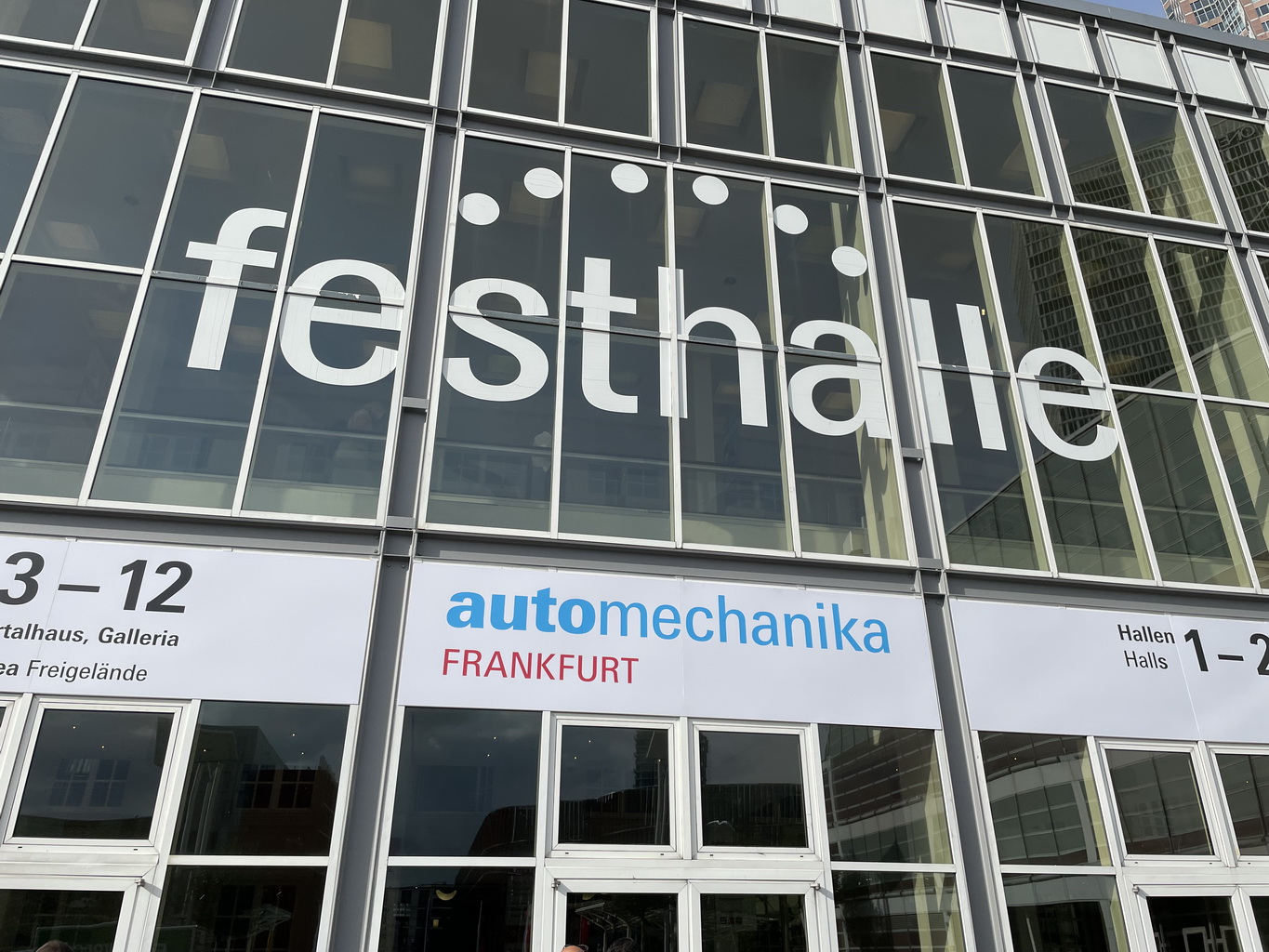
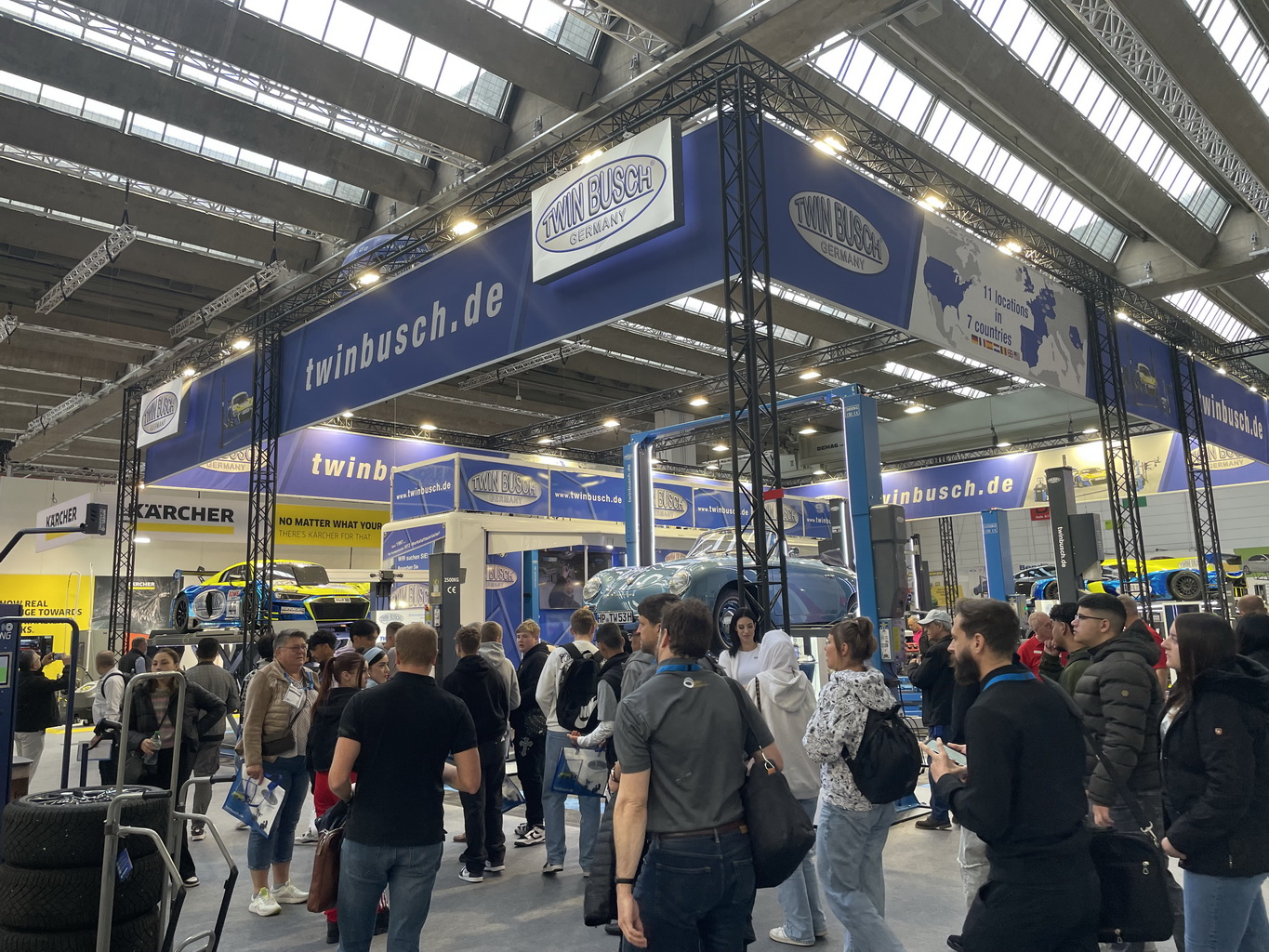
Festhalle is not only the main entrance, but also the name of a station on one of the metro lines. Although it is better to come to the exhibition at another metro station – Messe. Then the train will arrive right in the middle of the exhibition, near pavilion 8. In general, the Automechanika Frankfurt exhibition is always crowded inside. In the photo is shown the entrance to pavilion 8.
We will start from here. In order.
CARMEC
The first place we went was to our long-standing partner, the CARMEC company from Slovenia. In general, this company is a real watchdog at the Frankfurt exhibition – it was there 10 and 20 years ago. Many of the company’s machines and equipment are classic, they are repeated by many other manufacturers. But the company itself also does not stand still, as a result, it has some items from other manufacturers in its production program – market is the market.
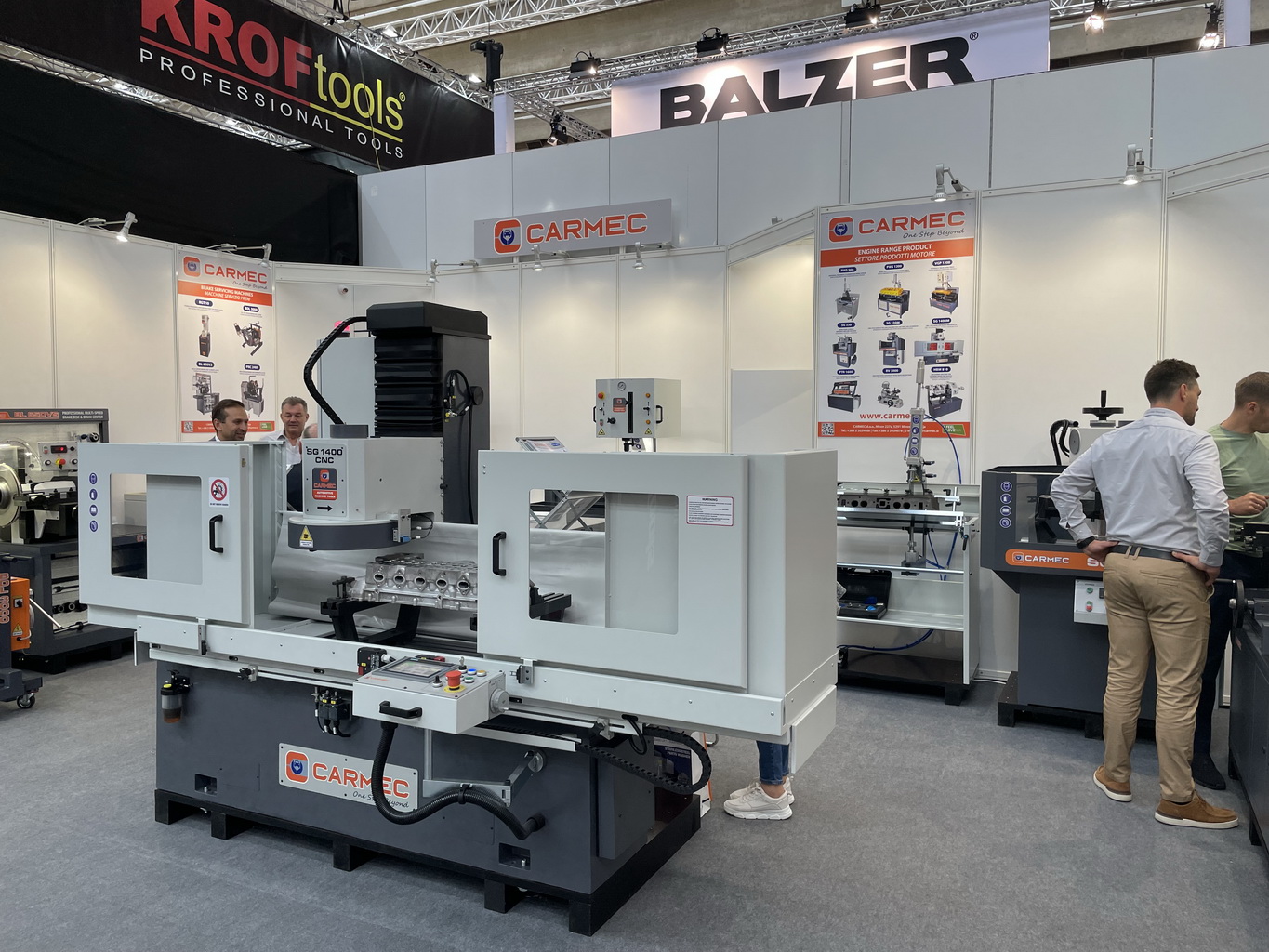
Stability is a sign of mastery – the CARMEC stand has remained almost unchanged in size and equipment saturation for many years.
The CARMEC stand presented all the main equipment positions from its production program, which are traditionally popular on the market. This is a machine for pressing cooling jackets (pressure tester) of large cylinder heads model PTR1600XLH, a workplace (pneumatic press) for disassembling and assembling valves model SW900, a pneumatic press for pressing out and pressing in valve guides model VGP1200 and a horizontal boring machine for cylinder head bearings model HBM810.
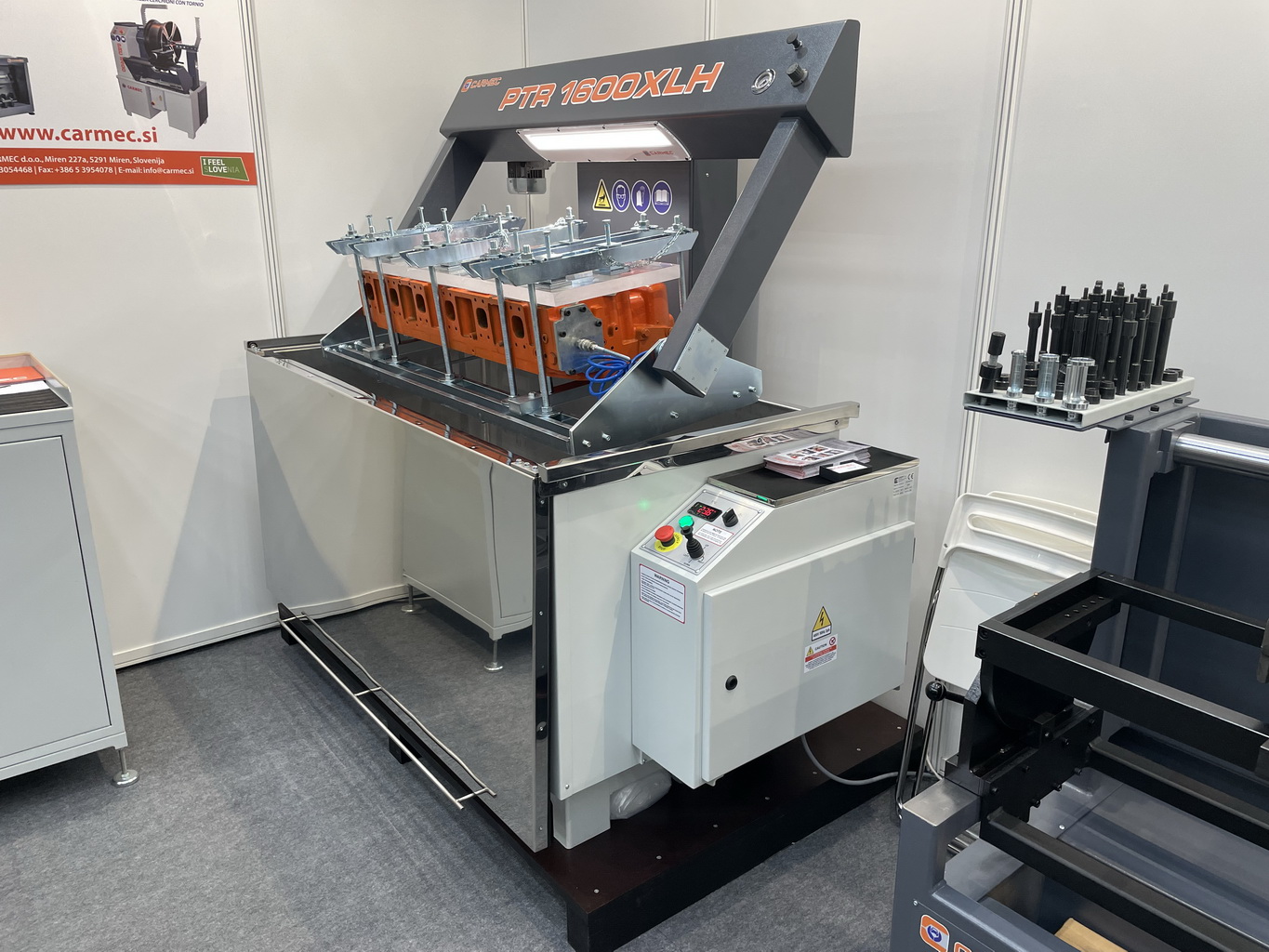
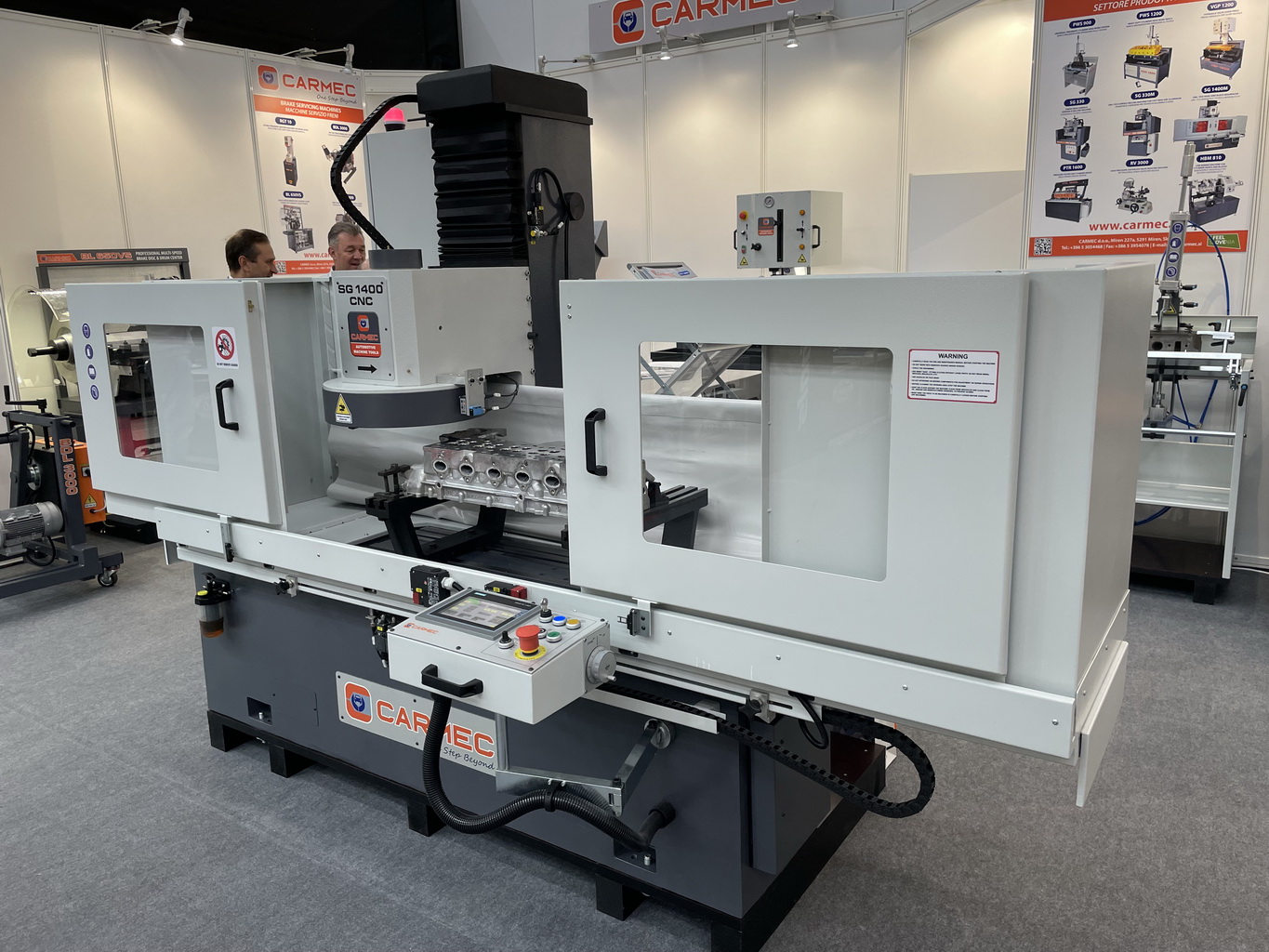 The flagship of CARMEC is the SG1400 surface grinding and milling machine. No hydraulics – only servo drives and electronic control. But one of the most popular positions of CARMEC is the PTR1600XLH cylinder head crimping machine. The mirror cover made of polished stainless steel is only for true connoisseurs of techno.
But the centre of the CARMEC exposition was, without a doubt, its flagship – the SG1400 surface grinding and milling machine for surface machining. This very effective machine with servo drives and touch control screen is exactly what is needed in today’s repair.
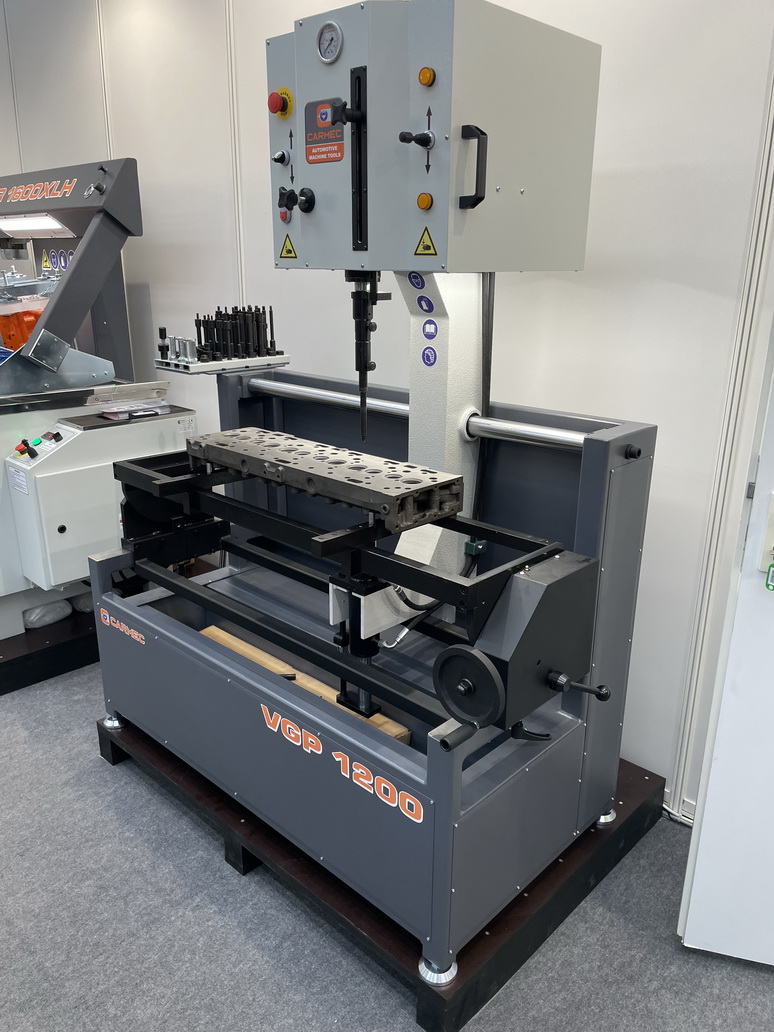
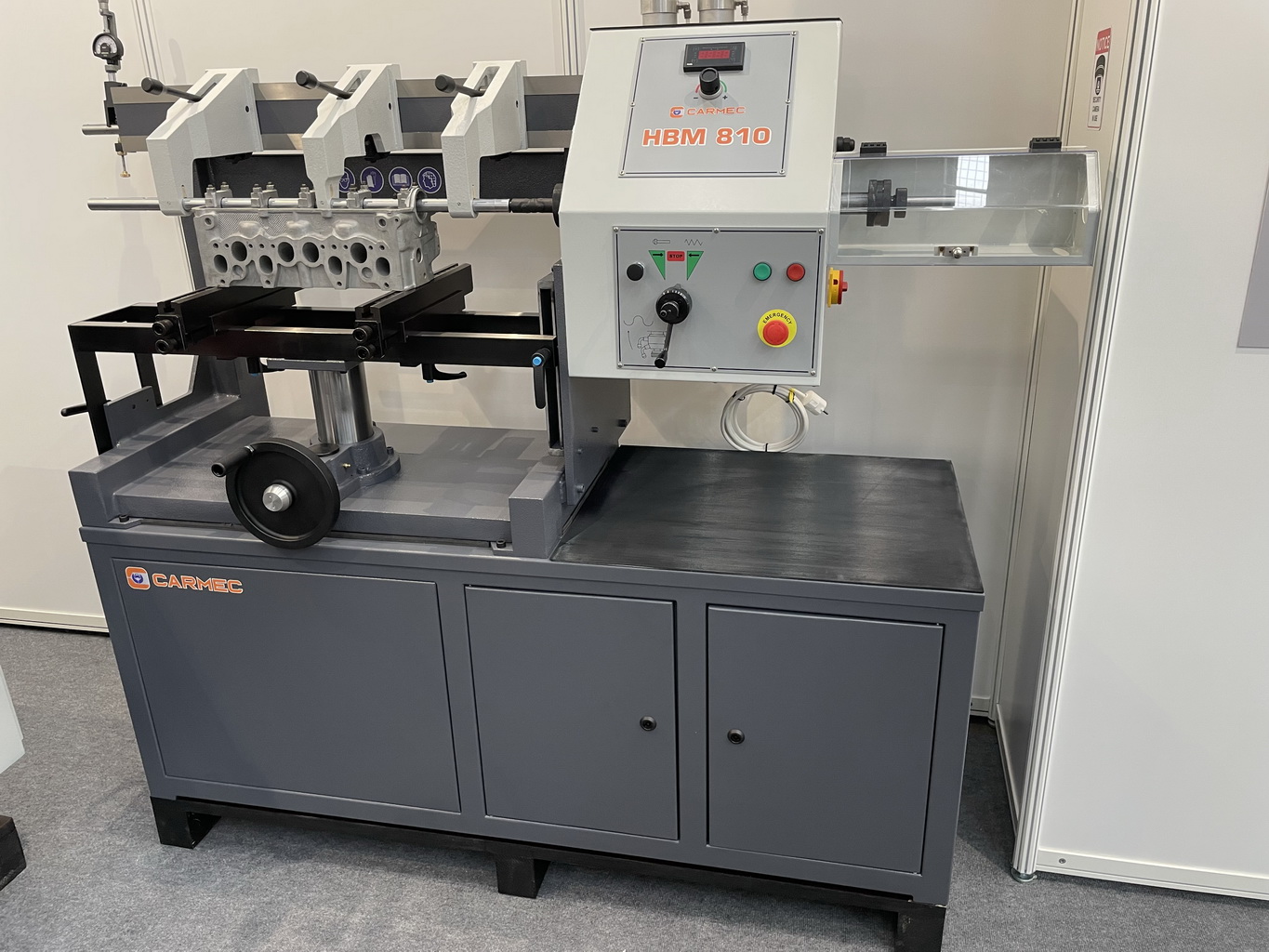
Good stuff from CARMEC: for truck cylinder heads, it is the CARMEC VGP1200 pneumatic press for valve guides pressing in and out, and for passenger car cylinder heads, it is the HBM810 horizontal boring machine for bearings.
That is, the CARMEC line already has almost all the machines and equipment for repairing cylinder heads, and of the highest European quality. Does this mean that you can easily assemble a complete specialized workshop for repairing cylinder heads from CARMEC machines? No, wait, there is something missing there… Oh yeah, the line is missing only one, but the most important position – there is no machine for seat machining. Which means that perhaps it may appear there soon?
ROTTLER
As always at such exhibitions, the American company ROTTLER shone with its technologies. It showed 3 CNC machines at once. And this is very serious equipment. However, from the point of view of practical repair, not everything is simple with it. Thus, CNC machining centres for boring cylinders and, especially, bearings in cylinder blocks are not actually repair equipment in the full sense of this definition.
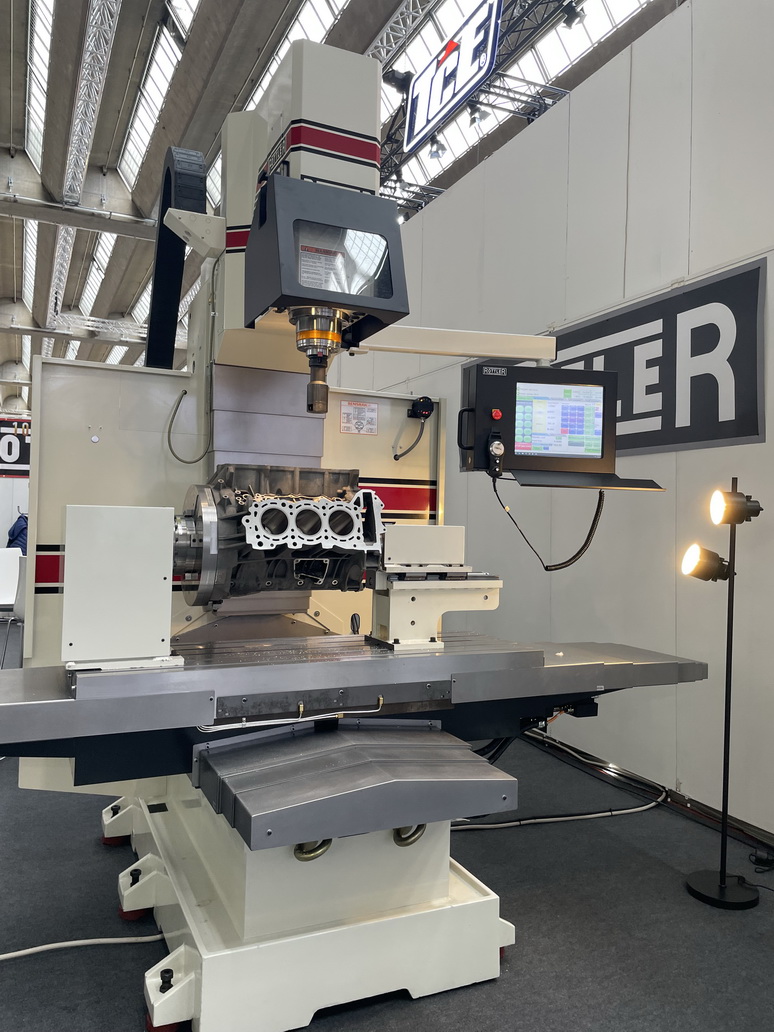
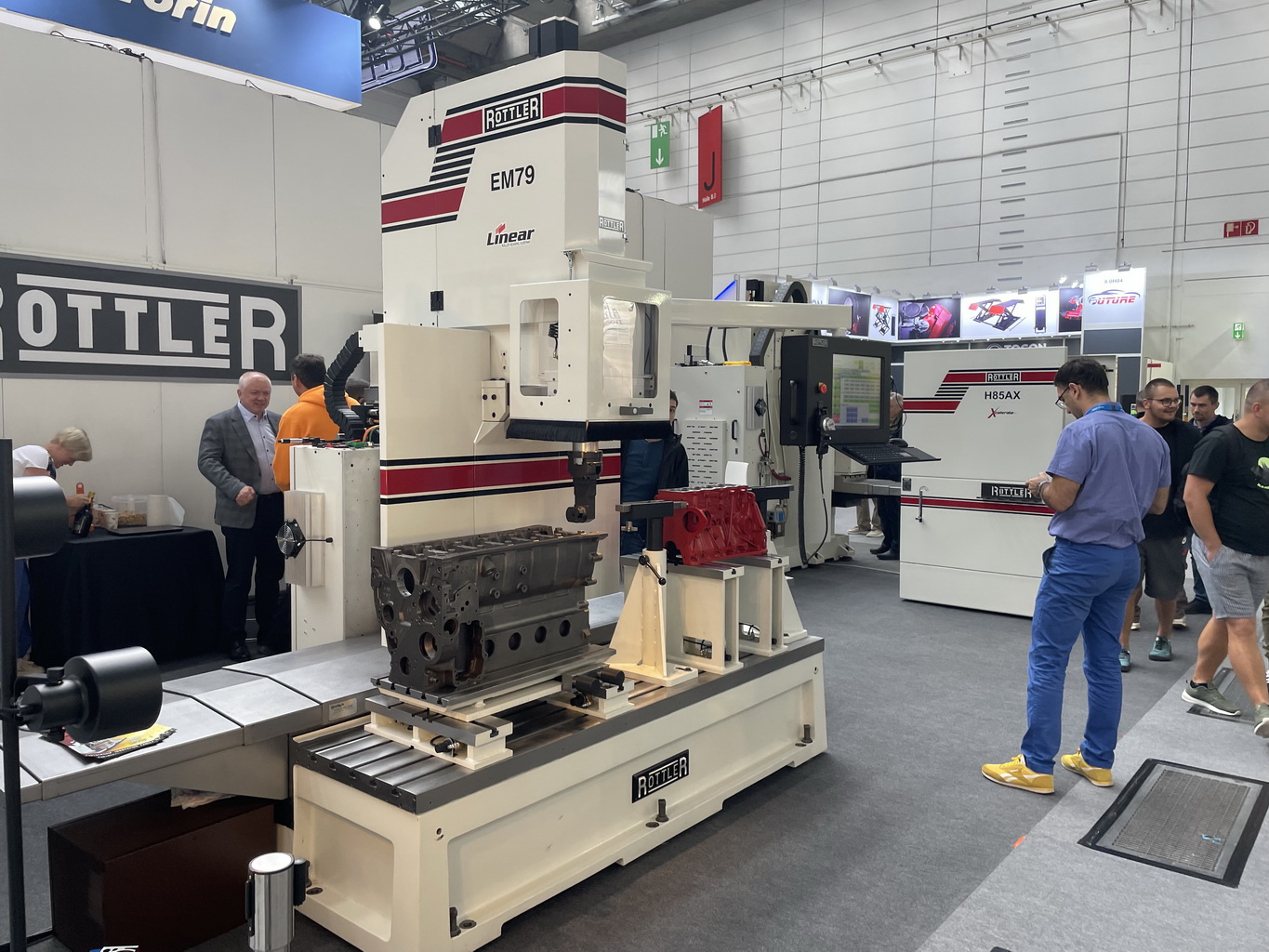
ROTTLER CNC machining centres for boring bearings (“from around the corner” strictly coaxially with the “optical” axis) and cylinder blocks are, without a doubt, ultra-precise equipment, but there are lots of questions with recouping its cost in repairs.
The reason is simple: given the ratio of their price to the established market prices for repair services, it is almost impossible to recoup such equipment. Well, or extremely problematic. As a result, it is usually bought only under specific conditions. For example, for “other people’s” money that you do not have to give away. Or as a special means of “killing” local competitors by confirming your privileged position in the engine repair service market. That is, mainly in those rare cases for today’s repairmen when payback is not a priority.
The situation is somewhat different with the ROTTLER honing machine model H85AX. The company’s long work on creating and improving honing machines seems to have been crowned with success this time: a real model has been created, which today has no competitors on the market in terms of technical parameters. And indeed, if 15 years ago ROTTLER still showed its far from the most successful model at exhibitions, today its place has been confidently taken by a real vertical honing machine with CNC.
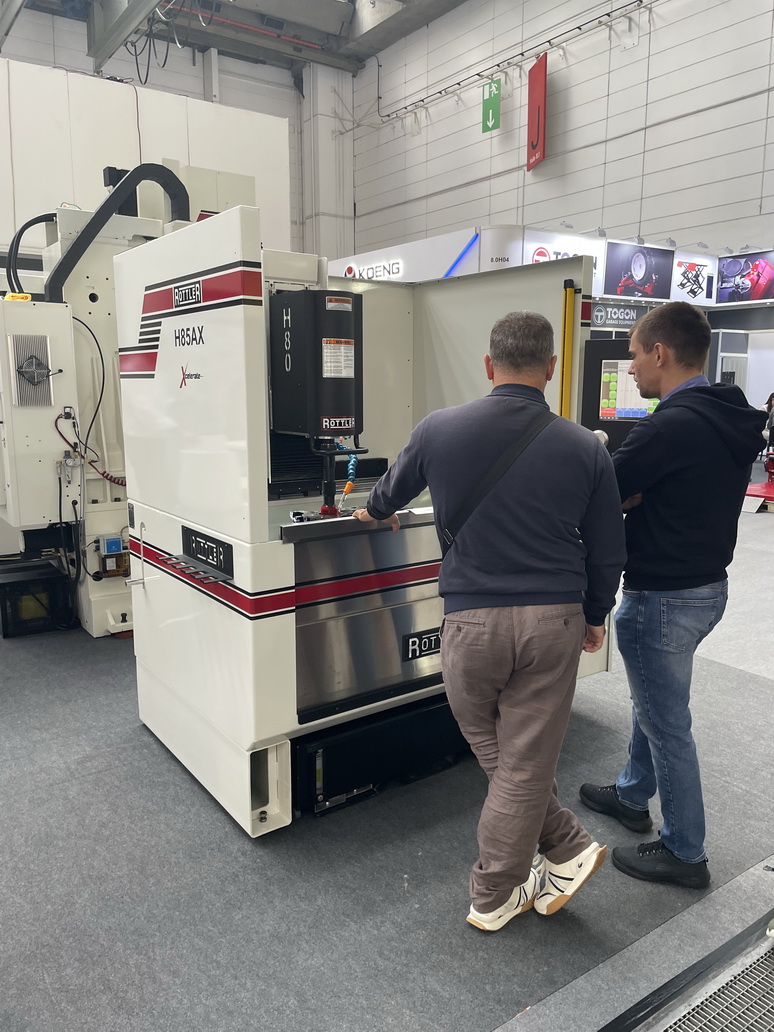
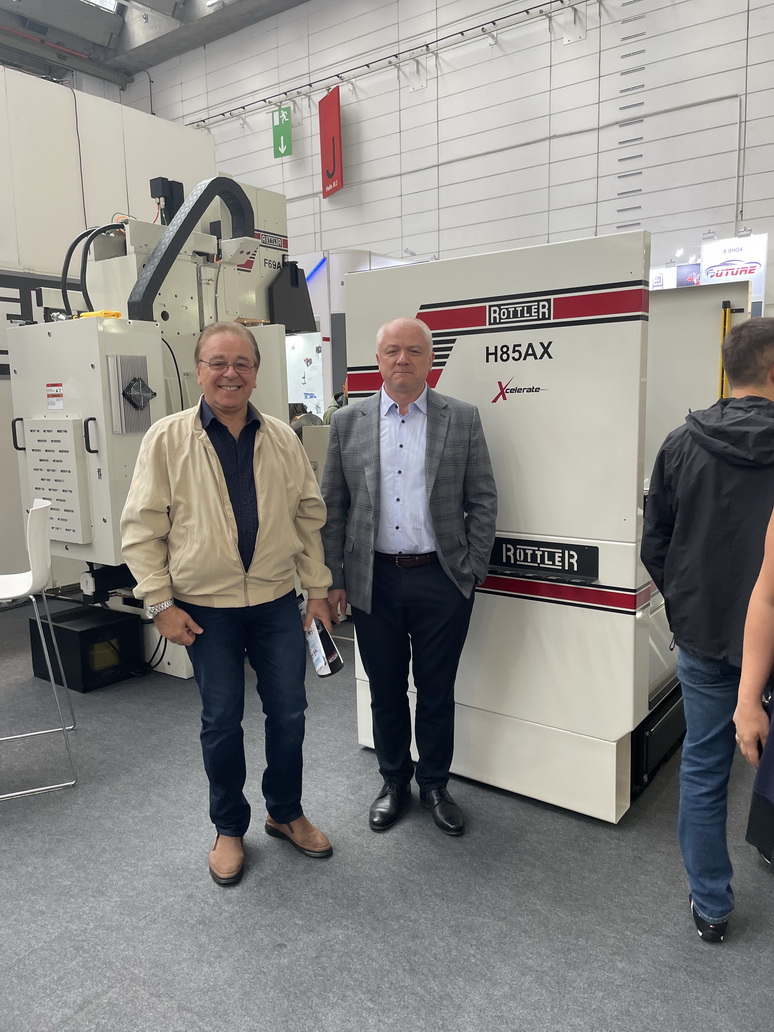
Without a doubt, the vertical honing ROTTLER H85AX currently has no competitors in terms of technical data. Although its payback is also not as good as we would like. Well, and acquaintance with the representative of ROTTLER Andrew Kharkhalis (on the right) goes back far to the noughties…
By the way, with honing process in the repair world, things have always been somewhere in the middle between “bad” and “very bad”. Most of the well-known machines currently do not meet the most basic requirements for honing quality. First of all, this applies to those manufacturers who previously tried to pull the blanket of the legislator over themselves in this type of processing but used for this purpose clearly unsuitable machines and mechanisms such as a “rocking goose” in the honing head drive. This only ensured a fatally low quality of honing, and incantations about the advantages of “direct” honing of any allowance without boring only further damaged the image of such manufacturers. Which ultimately made some once very popular machines practically unsellable.
Today the situation is no much better with other manufacturers. They are still dominated by ancient hydraulic machines with fully manual control, not marked by even a hint of automation. Without a doubt, the ROTTLER H85A machine (model with the letter X is distinguished by the presence of automation for switching from one cylinder to another) has not only quantitative, but also serious qualitative superiority over almost all competitors with manual control. Although with one “but”: the price of the sample is on the payback border, it will be possible to recoup such a machine only with intensive work in the workshop of some well-known repair company. But this equipment is clearly not made for beginners. For example, in America, the presence of ROTTLER machines in a repair workshop is the same sign of professionalism as the presence of Snap-On tools in a mechanic.
AZ
What else immediately caught the eye at the exhibition is that some manufacturers are experiencing difficulties. This is evident from the size of their current exposition in comparison with the previous ones. For example, the stand of the famous Italian machine tool manufacturer, AZ, has shrunk quite a bit in size – unlike previous years, this time only one machine for repairing connecting rods was shown. And this is not a very good sign. Especially for a company like AZ – of all the competitors presented at the exhibition, it clearly takes first place in the range of types, models, sizes and characteristics of machines!
As is known, many manufacturers traditionally send finished machines from current customer orders to the exhibition in Frankfurt. But the connecting rod machine is clearly not one of the popular ones. Therefore, the display of only one such machine may indicate a general decline in the order portfolio. Although it is clear that it is too early to draw final conclusions. Moreover, when competitors have even more serious problems (this includes the closure of the Italian BERCO machine tool factory 15 years ago, and the gradual transformation of Danish AMC-SCHOU into a typical Chinese manufacturer, and the completion of Italian ROBBI’s transition to the production of industrial machine tools only), AZ risks remaining on the market as the only one of the entire old “heavy” guard of manufacturers. And this, whether you like it or not, is a good prospect.
SERDI
The stand of the French company SERDI, which has been a “trendsetter” in cylinder head repair for a long time, was not very pleasing either. The CNC machine SERDI Profile and two main and long-standing traditional repair machines from the production program – SERDI 3.5 and SERDI 4.5 were on display. By the way, the company showed the same repair machines 10 and 20 years ago. In general, these are solid and time-tested products, well known for their reliability and efficiency. And these are the main, most affordable and popular repair machines from the entire SERDI line. But…
Unfortunately, for 25 years, since the end of the 90s of the last century, these machines have not undergone almost a single improvement, if you do not count the rejection of the eternally leaking hydraulic clamps of the working headstock of the old SERDI 4.0 Power in favour of vacuum ones in SERDI 4.5. That is, these machines have remained with the traditional push-button and lever manual control of the last century. Even despite the company’s significant experience in developing CNC machines. But CNC is completely unnecessary for repair, which has long been shown by the experience of the famous NEWEN machines, which seemed to be good in all respects, except for the main thing – productivity, price and the impossibility of recouping them in repairs.
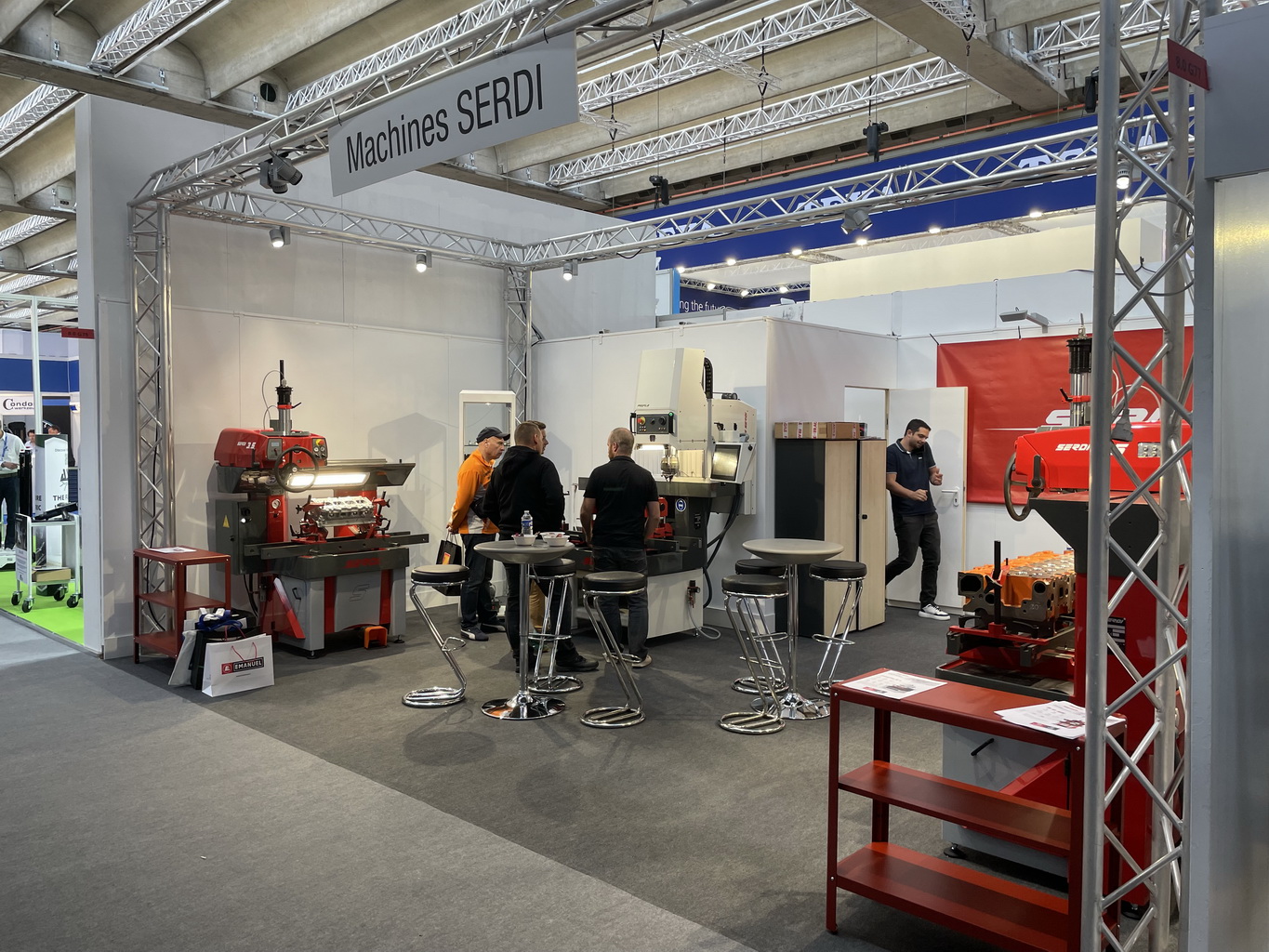
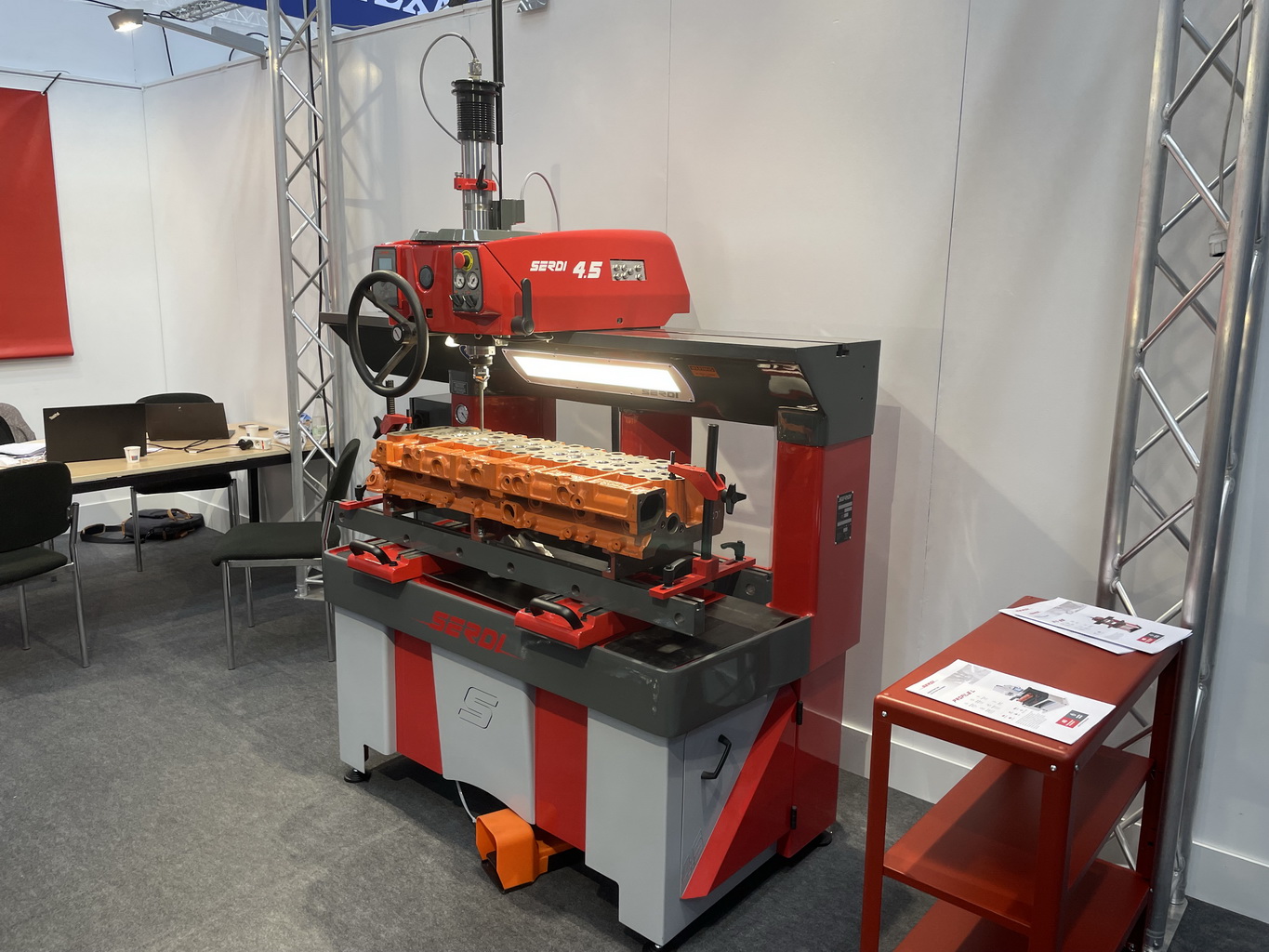
The SERDI stand shows constancy in space and time – in terms of size and equipment, it has hardly changed in 10 years. But, unfortunately, SERDI repair machines, demonstrating the absence of changes for a good quarter of a century, are a very dubious merit.
Once, in the good old days, the introduction of SERDI machines into the practice of engine repair was revolutionary. About 20 years ago, with their unimaginable precision and productivity, they completely destroyed and practically swept away the manual tool for cutting saddles from professional repair. However, at a time when most manufacturers have long ago implemented touch control, SERDI repair machines have not changed from year to year and today look like some kind of anachronism from the last century. But not only the appearance was same fine – they also work the same. Despite the fact that time does not stand still and does not wait for those who do not keep up with it.
On the contrary, the practice of engine repair has long shown that it will be much more convenient if manual control is improved, transferring a number of its functions to automation. And since any automation is associated with the use of computing technology, the next step will be a touch screen with continuous monitoring of the machine. Which has long been successfully used by other manufacturers (for example, the Turkish Provalve).
Unfortunately, today these SERDI machines can no longer satisfy the market as it used to be. There are several reasons for this. On the one hand, Chinese copies of these machines are seriously putting pressure on them, which actually have a price a good 3 times lower. Yes, their quality is so-so, but they work, and the Chinese are not standing still either. At the same time, another problem is creeping in from the other side – with personnel. It is no secret that finding a competent machine operator has long been difficult, and this problem is gradually getting worse.
Indeed, with manual control, the sequential activation of 4 air cushions of the machine for the correct centring of the spindle strictly coaxially with the valve guide bushing in the cylinder head requires a serious understanding of the meaning of each operation. Moreover, the machine with manual control is completely “blind” – it does not help the operator in any way and does not show him any of its parameters. Apparently, counting on the diamond eye, the dog’s nose and the operator’s instinct. And where can you get such a person? And how much to pay him? From here, for high-quality work, the requirement for such a high qualification of the operator directly follows that it further increasingly comes into conflict with the situation with personnel in the market.
All these problems inevitably affect the sales of such machines and far from for the better. Because the market does not forgive mistakes, and this is evident from the exhibition. Unfortunately, not all manufacturers of engine repair machines have remained afloat over the past 10 years. As it turned out, the Italian Serdi S.r.l., which had shown promise with its machine designs made according to the well-known SERDI system, but with some simplifications, did not survive. It is possible that it was the archaic manual control and the complete lack of automation that played a cruel joke on these quite good machines, causing a critical drop in popularity and sales.
PEG Rossi&Kramer
But is it really a dead end with the automation of saddle processing machines? Not at all. Automated touch control has long been inexpensive and works well with other manufacturers. Therefore, it cannot be ruled out that the Italian company Rossi&Kramer also carefully analyzed this situation. As a result, the company made a serious step forward, releasing a new line of saddle processing machines using the same scheme as SERDI S.r.l. (spindle centring using a flat air cushion of the work headstock and a spherical air cushion of the spindle), but with certain improvements.
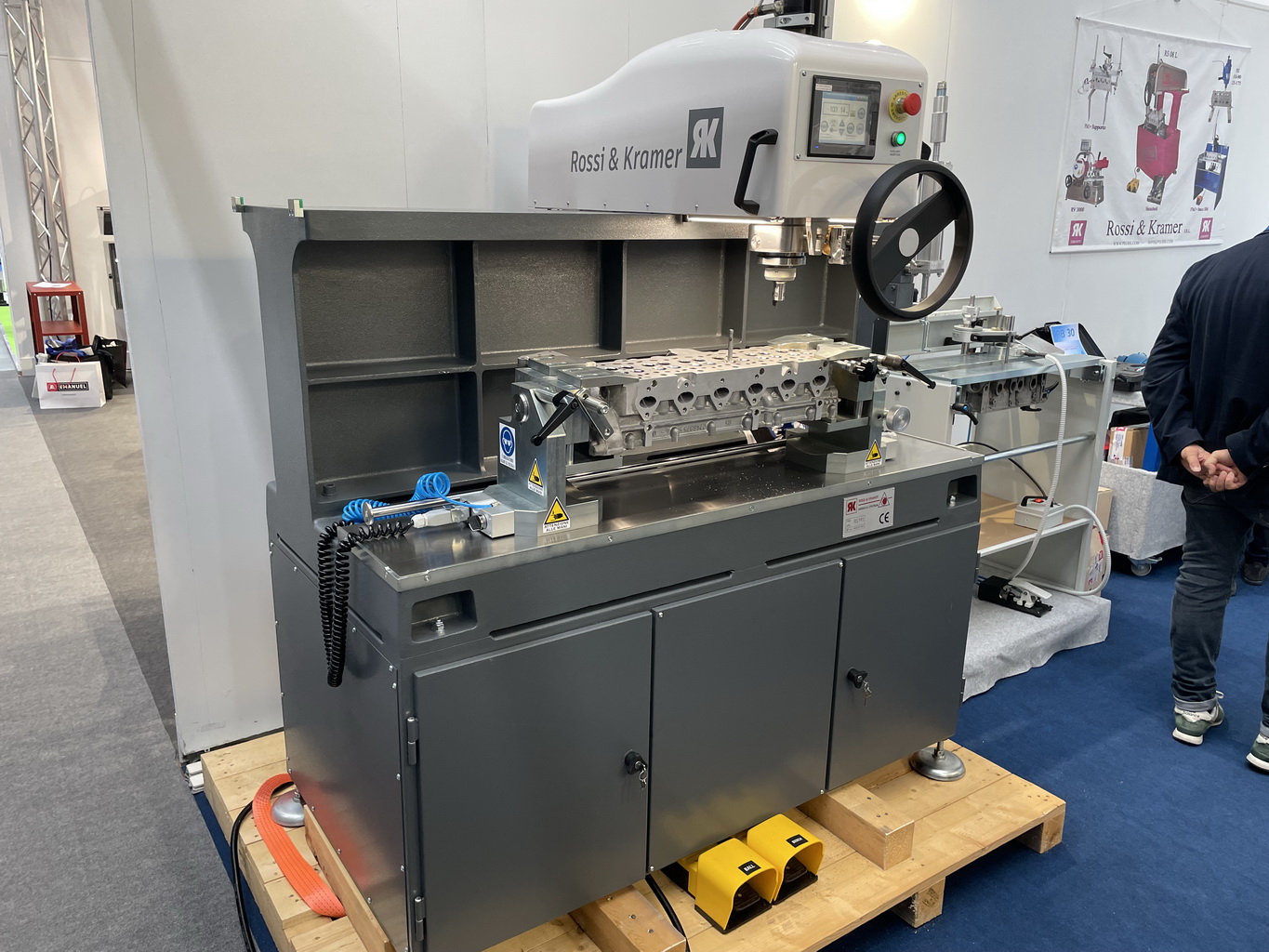
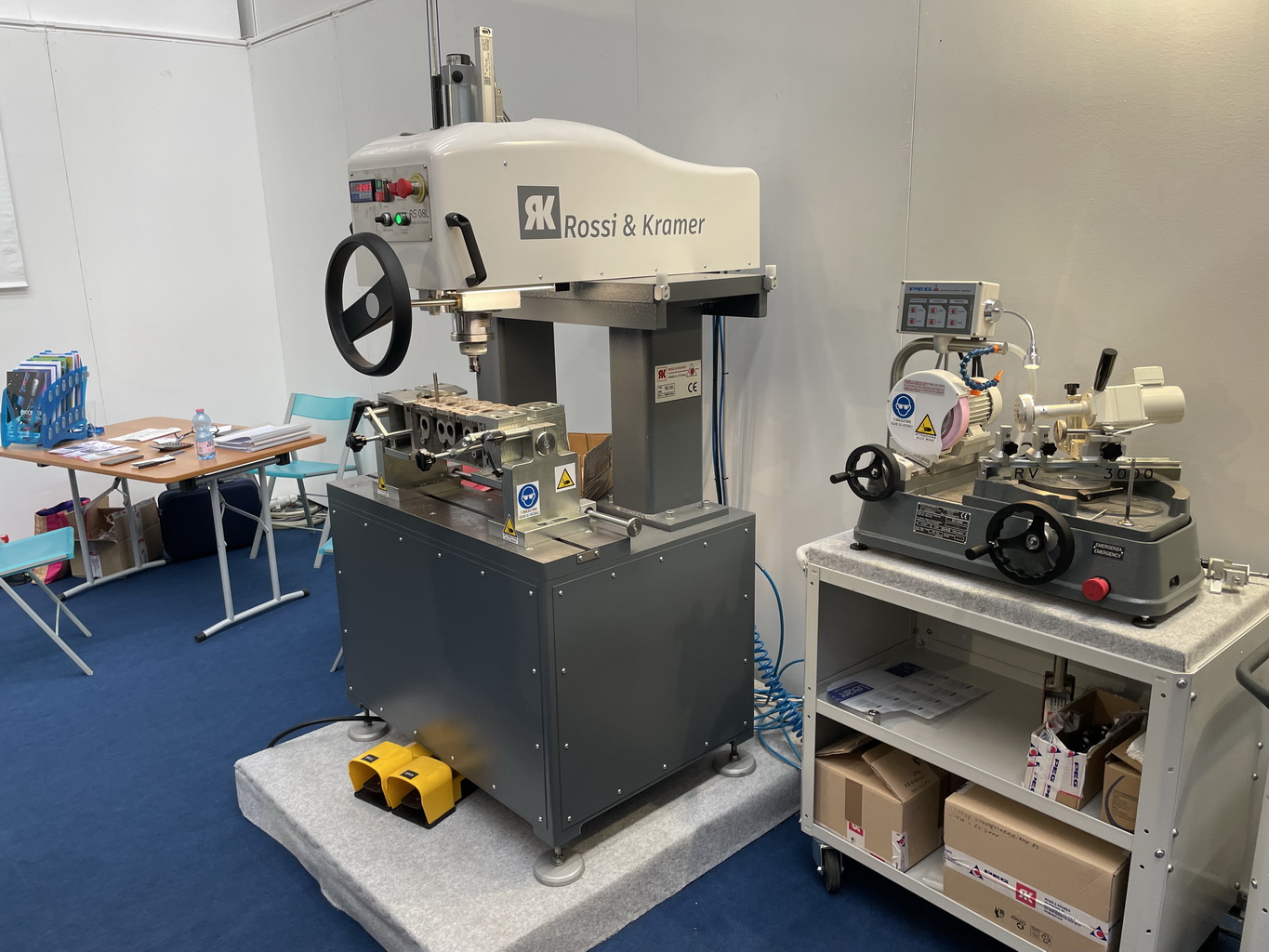
Seat cutting machines Rossi&Kramer are solid: they are made by analogy with the scheme of the machines SERDI S.r.l., but have very interesting improvements, which testify to the high technical level of the company’s engineers.
Judging by the two models of machines presented at the exhibition – RS 08L and RS 993, the improvement of the control has affected only the larger model, where a touch screen was used as a standard element. The machines also received a rather useful device – spindle micro feed, which can improve the quality of saddle processing compared to the original.
But the company went even further. It was able to resolve the eternal and practically insoluble dispute between supporters and opponents of “live” cylindrical and “dead” conical pilots with one blow. The latter did not require any magical bayonet joint between the spindle and the toolholder with the cutting bit – a universal conical holder of the SERDI type was quite suitable, in which, depending on the operator’s wishes, a cylindrical pilot can be fixed or a conical one can be installed with the ability to rotate. As a result, Rossi&Kramer machines is the one, which acquired unique versatility (and possibly the accuracy of spindle centering before processing), missed and not yet used by other manufacturers.
POLEKS
At the exhibition, the Turkish company POLEKS demonstrated the result of what can be achieved by tracking modern trends in repair technologies and taking them into account in the design of equipment. POLEKS is generally one of the few Turkish manufacturers of engine repair machines that participate in the exhibition of such a high level.
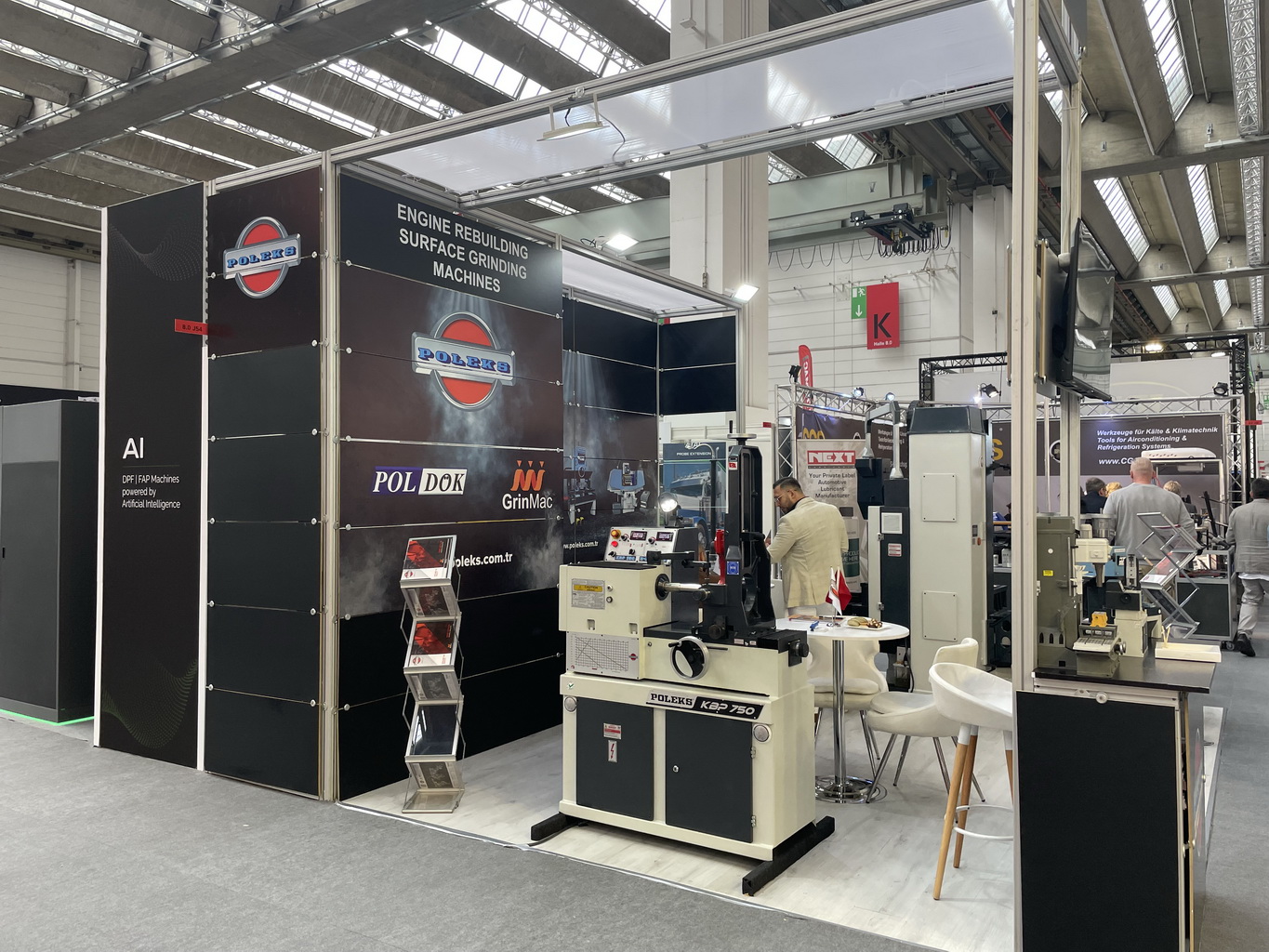
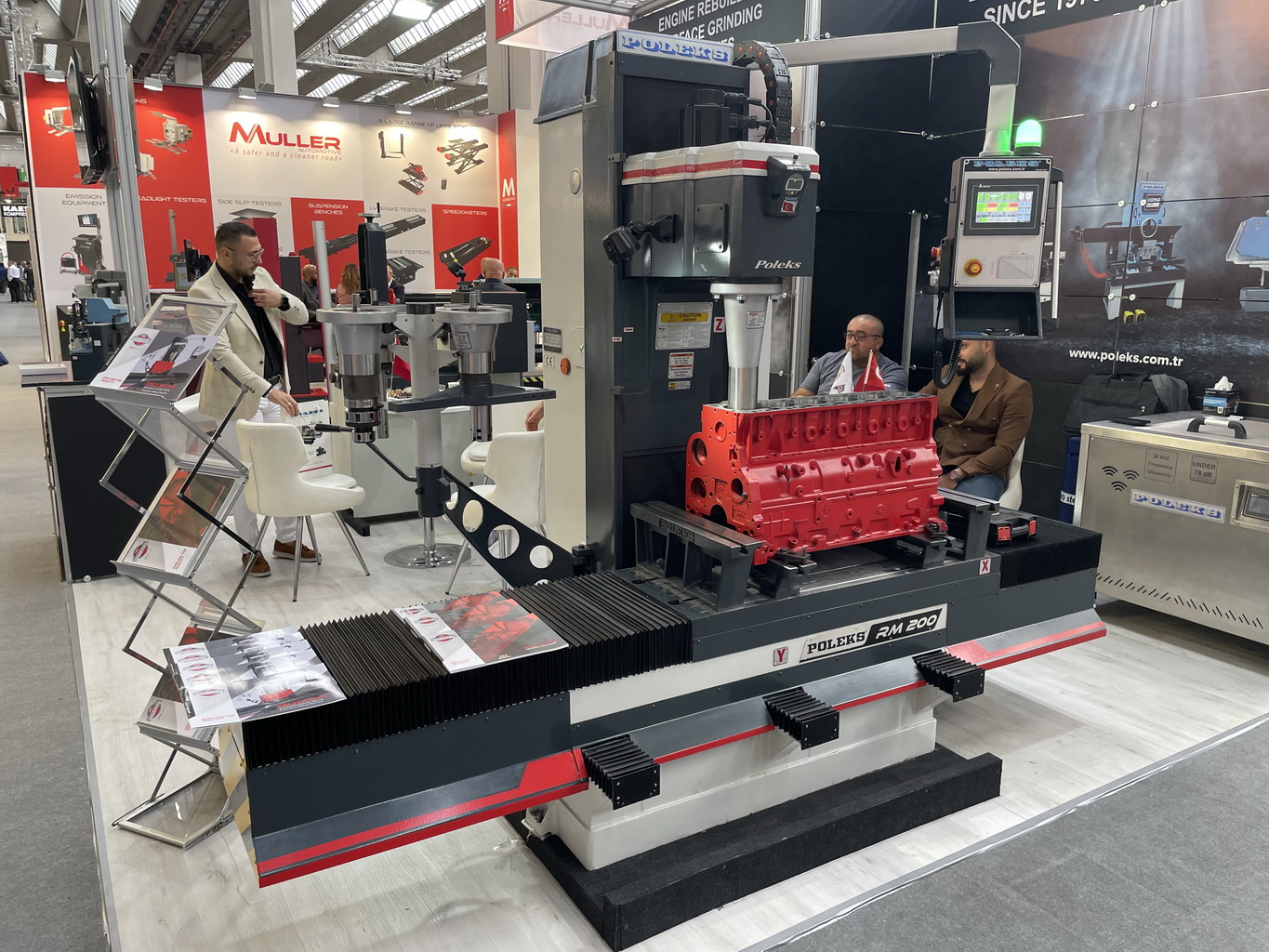
The Turkish company POLEKS showed only 3 equipment positions at the exhibition, but they were enough to understand that the company chose the right direction, taking advantage of the “fall” of most European competitors.
The main reason for the company’s participation in the exhibition is seen in that it has long been focused on the global market. Other Turkish manufacturers are more “stewed in their own juice”, prefer the domestic market and, as a rule, do not go far beyond the Middle East. POLEKS is rapidly developing not only in depth, but also in breadth: the company recently even opened a machine tool production in the USA (which a number of well-known European companies were unable to do at the time).
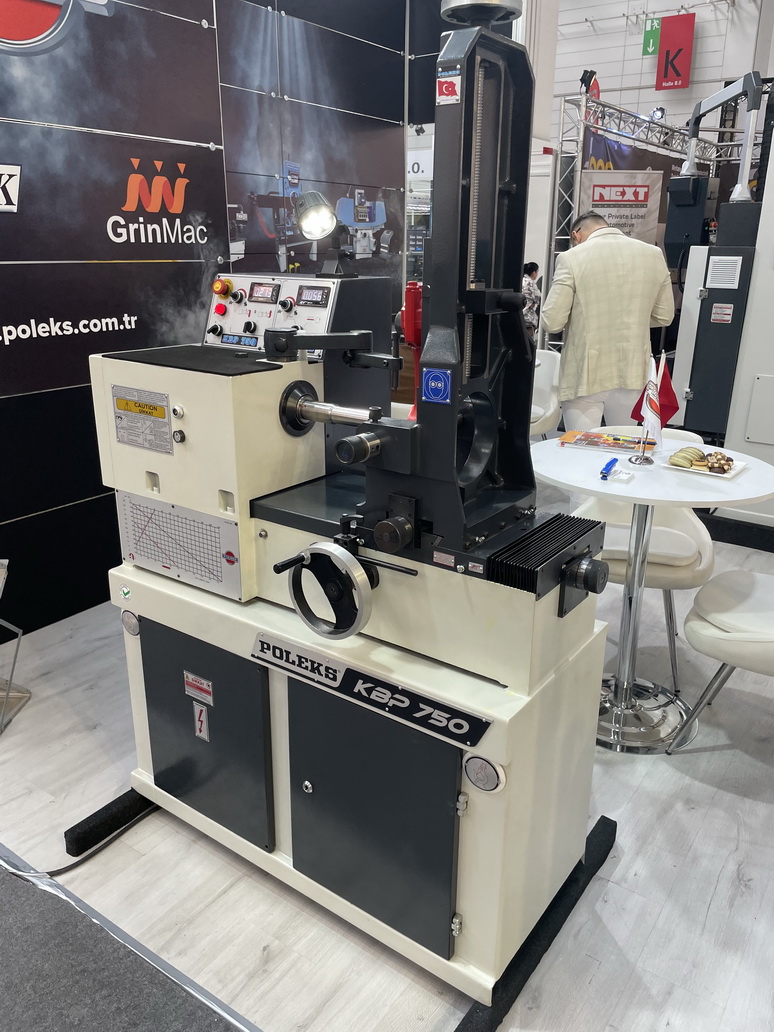
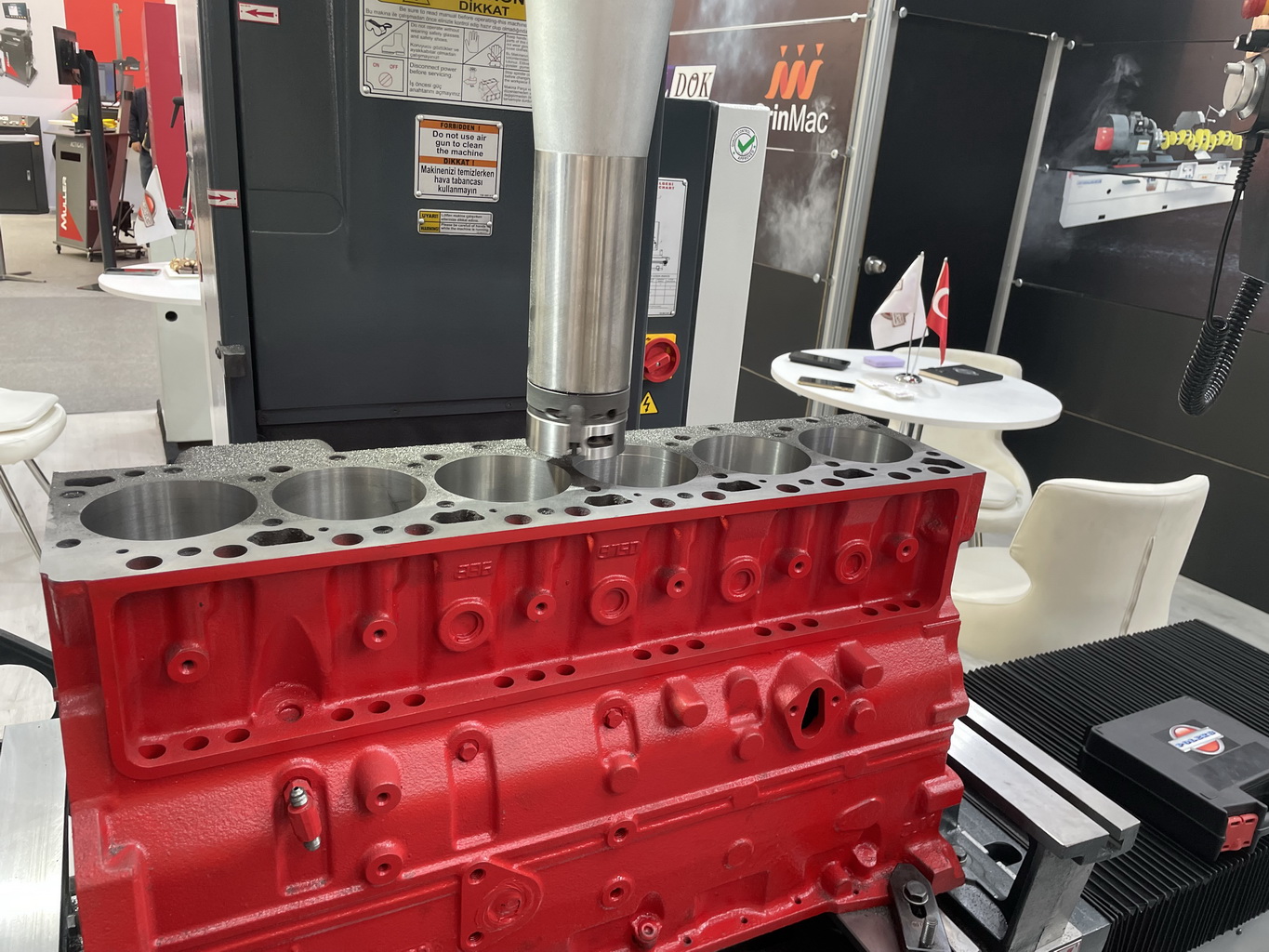 The quality of POLEKS equipment today is not inferior to the level of European manufacturers in their best years. In many ways, this is the result of proper management of a large complex production and competent work in international markets.
At the exhibition, in addition to a simple horizontal boring machine KBP750 for repairing connecting rods and an ultrasonic washing machine (by the way, also with touch control), POLEKS presented a vertical boring machine for cylinders of the RM200 Servo model from its serial line of machines. This machine, in addition to servo drives for longitudinal feed of the working table and vertical feed of the boring headstock, has a simple, but very clear, and therefore very effective automated control with a touch screen.
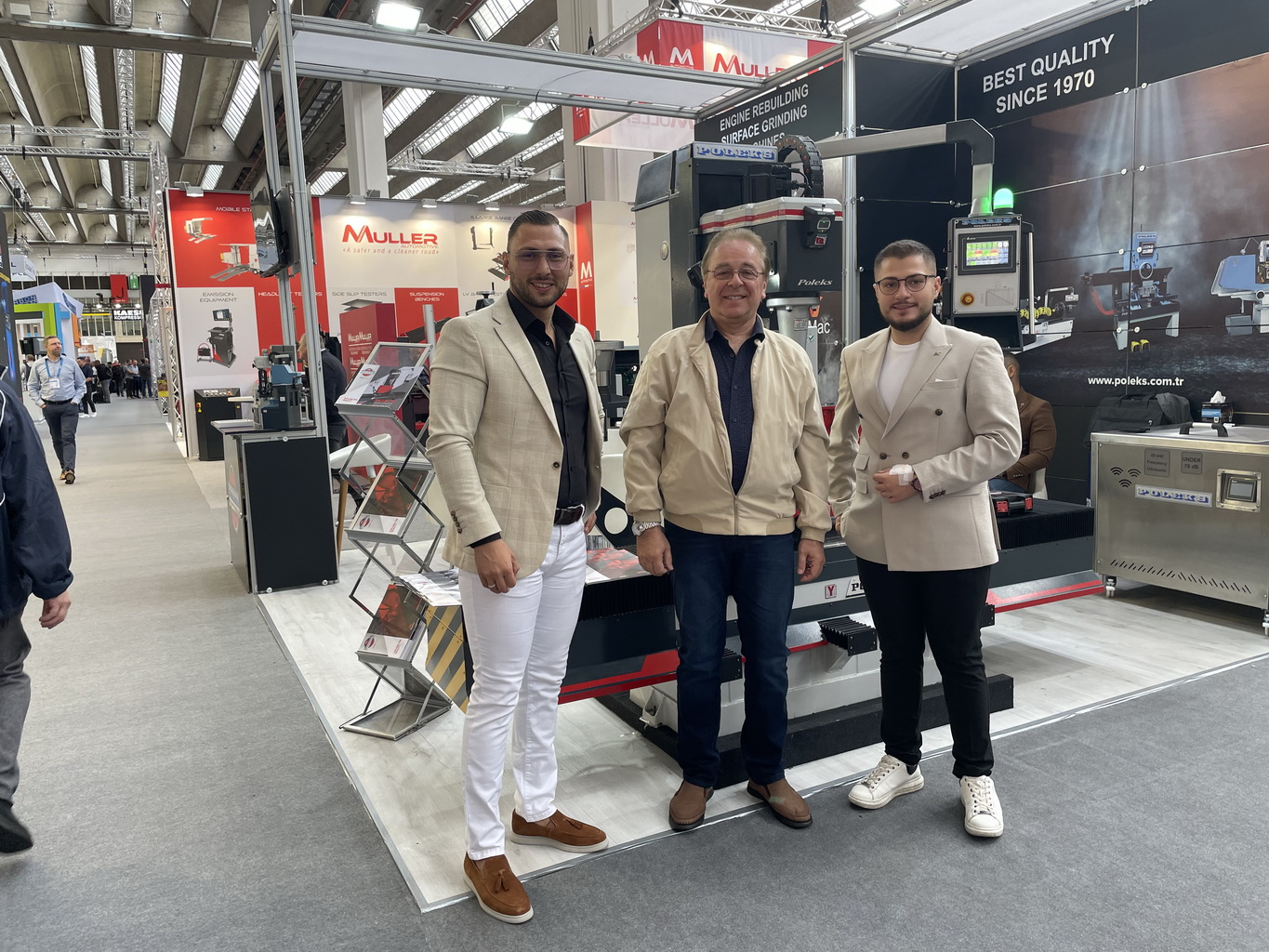
With the management of POLEKS: Sales Director Mr. Ibrahim Polat (left) and the company’s chief engineer (right)
This is not a full-fledged CNC, but a so-called PLC, but with its help the machine has the ability to independently adjust to the cylinder axis and automatically move from one cylinder to another. At the same time, the program draws a clear processing scheme on the screen. Looking at which it becomes approximately clear what a modern engine repair machine should be like. At least, POLEKS confidently shows this.
COMEC
In general, nothing revolutionary new, but the trend in the development of engine repair equipment at COMEC is also quite clearly visible. At its rather spacious stand, it is the only one at the exhibition that shows a complete line of engine repair machines from all its products. These are 6 machines at once – a vertical boring machine ACF200CNC and a honing machine for cylinders LEV300, a surface grinding and milling machine RP1400, as well as machines for processing seats FSV100, grinding valves RV516.ASM and boring bearings LBM950.
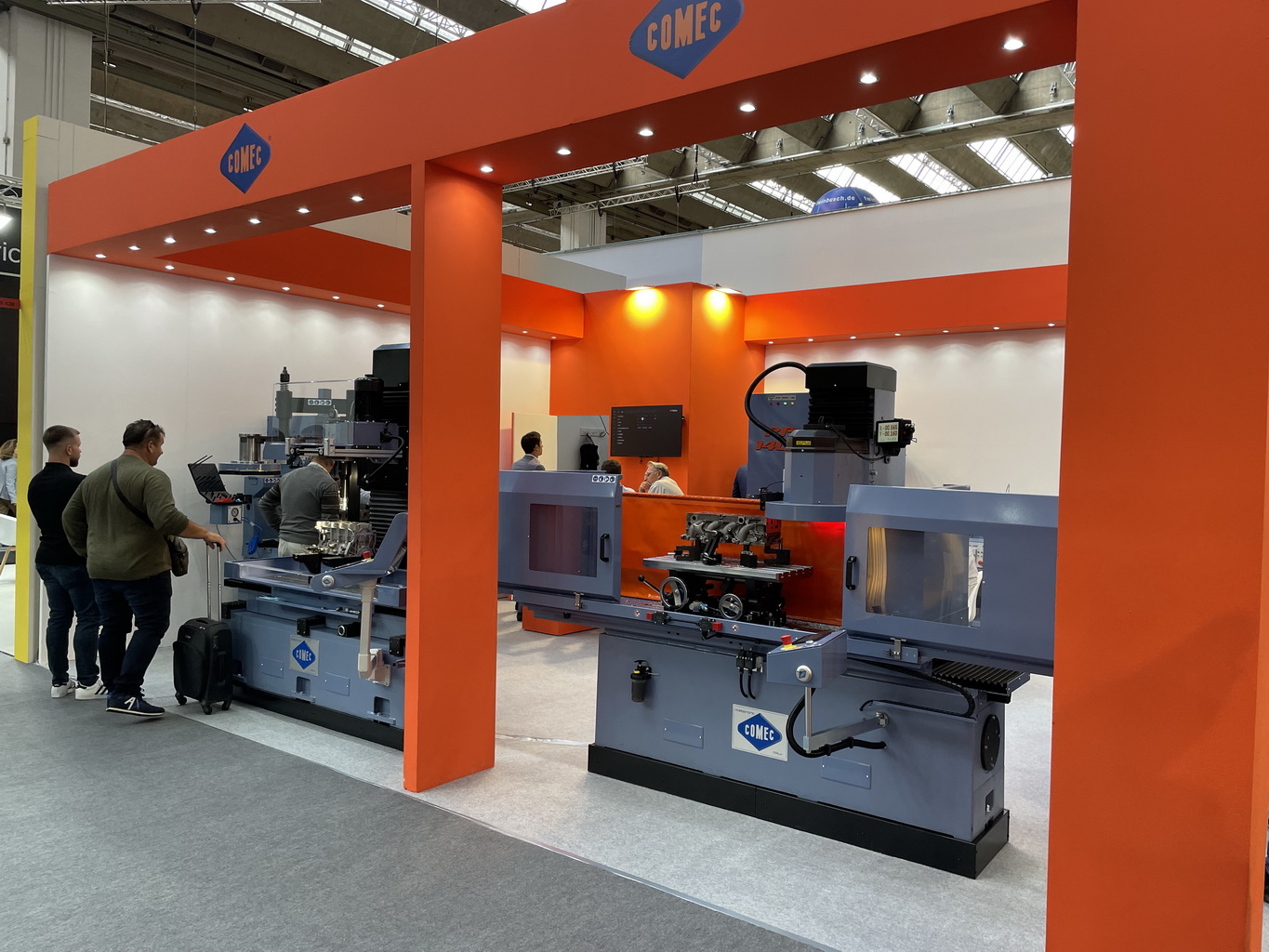
COMEC presented its entire line of engine repair machines at the exhibition.
Success? To some extent, undoubtedly. In general, it can be said that COMEC products are the most obvious example of a business approach to the construction of engine repair machines. This is when only what is in demand and is sold is produced. And vice versa – what is not sold is not produced. And sales are built on proper advertising, proper pricing and competent work with the customer. Which is absolutely correct. If not for one “but”. With this approach, the technical details of what is produced are not very important and somehow fade into the background. And in vain. Because upon closer examination, affordable prices may hide not quite what a specific customer wanted.
You don’t have to go far for examples. The COMEC FSV100 seat cutting machine has not gone anywhere from the ancient and long-discontinued ROTTLER SG6 (although its clones are still being manufactured in India under the Micron Mustafa and Robins brands). Unfortunately, the processing scheme used in all these machines with the notorious bayonet joint between the spindle and the cutting bit is hopelessly and completely outdated. That is, it is good in all respects, except for one thing – all the rigidity of the cutting system sits on and in the thin pilot (unlike SERDI and others, where the rigidity of the processing is determined by the thick and powerful spindle). Well, when the car engine is a light and modern, then the pilot (the stem at the valve) is thin, for example, 6 mm or even 5 mm. In this case, the cutting bit will no longer cut anything – turning on the hinge and bending back on the thin pilot, it will only be able to lightly smooth the seat (however, doing it “beautifully”).
At one time, about 20 years ago, many copies were broken on this topic, but all of them, it seems, flew past COMEC and its FSV-type machines. In other words, this scheme with a bayonet joint greatly narrows the real applicability of these machines, shifting it towards thick valve stems and big truck engines. But who knows about this, and even more so, will tell a boy in sneakers and with a phone in his hands? And will the boy understand what we are talking about? Unlikely. But the business and the price are good.
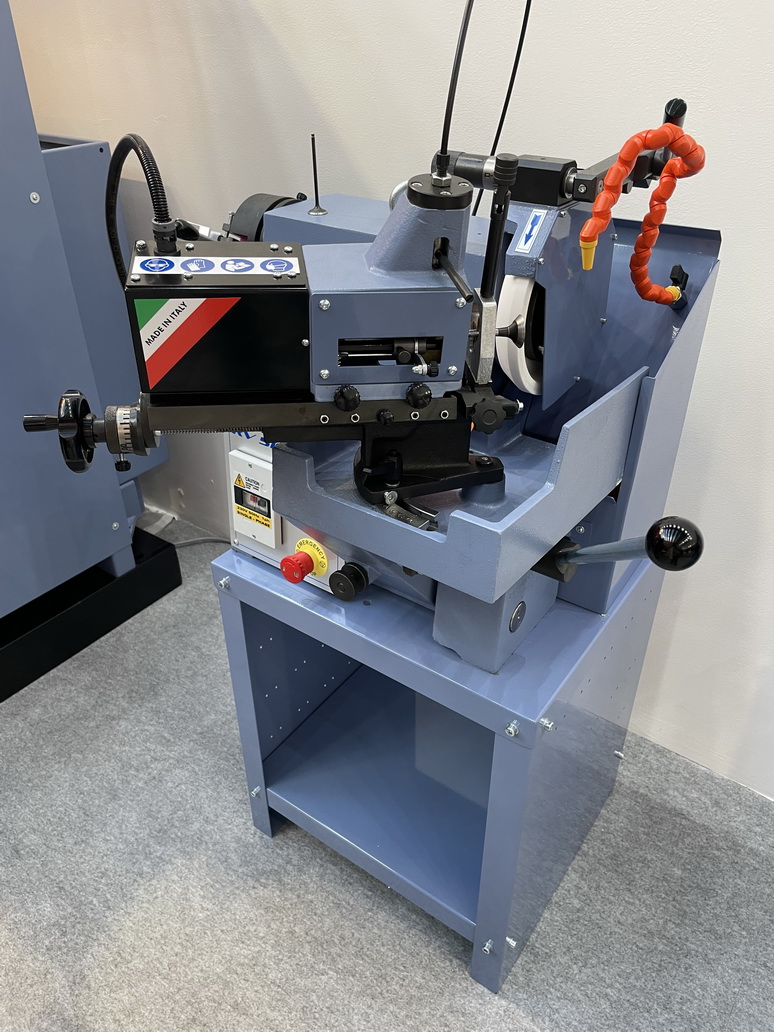
Similarly, the frame design of the LEV 300 honing machine bed did not impress. We have seen something like this somewhere before… Ah, the oldest ROBBI LM150 honer had exactly the same, but its production has long been discontinued due to lack of demand, more than 15 years ago. And what has changed since then? Nothing special, except, perhaps, a new touch control. Even the feed of the honing stones at the honing head has not changed…
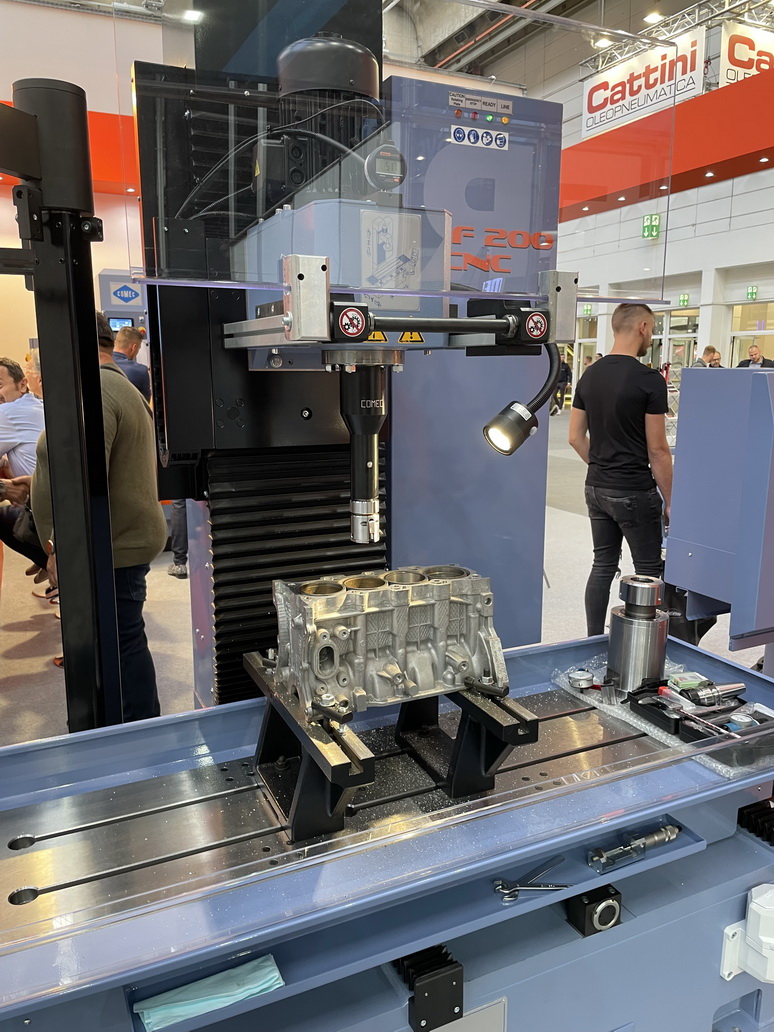
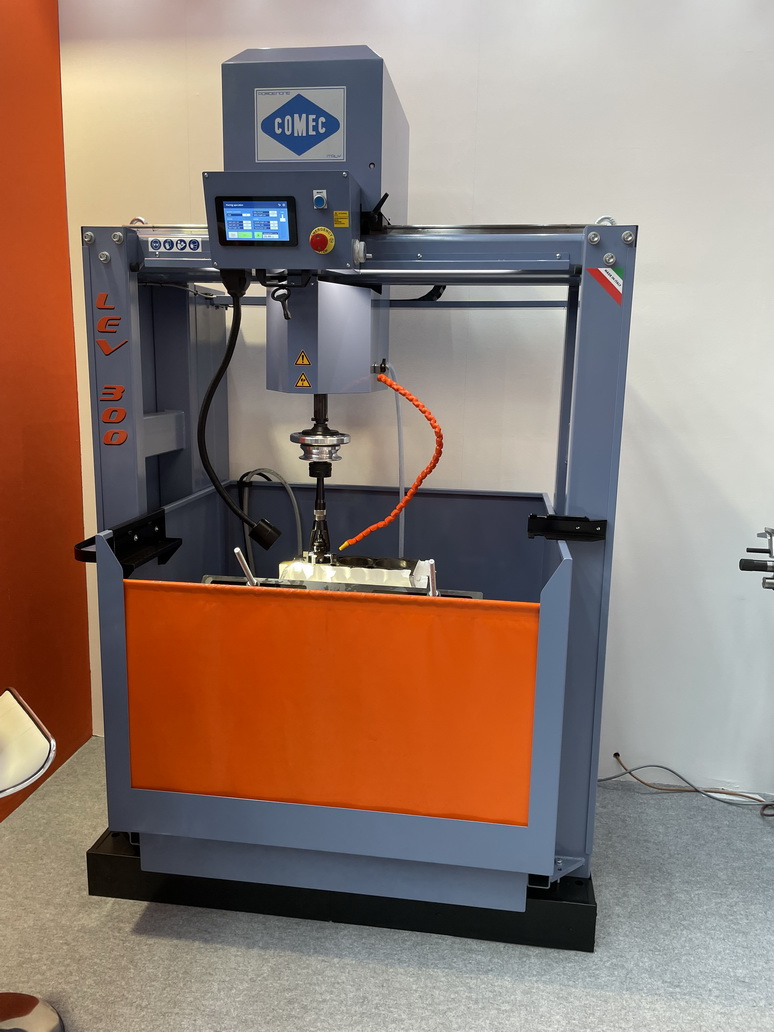
Boring and honing machines are the basis of engine repair. However, there are questions about these COMEC machines…
There are also questions about the ACF200CNC boring machine. If you compare it with classic vertical boring machines (for example, ROBBI Sirio or Spes and, especially, old AMC-SCHOU CM1200 or CM1800 models), then with such a puny column, it is difficult to believe in the processing rigidity that is usually required for machines of this type. At first glance, it even seems that the machine can normally bore only a small cylinder block from a motorcycle. It is clear that the impression can be deceptive, but still. It is possible, however, to assume that in order to save expensive metal, the company carried out some serious scientific research, conducted numerical modeling of rigidity, after which the design of the lower part of the bed was seriously changed. But is this really so? It is not clear yet. But the automation on this machine works perfectly, you can’t argue with that.
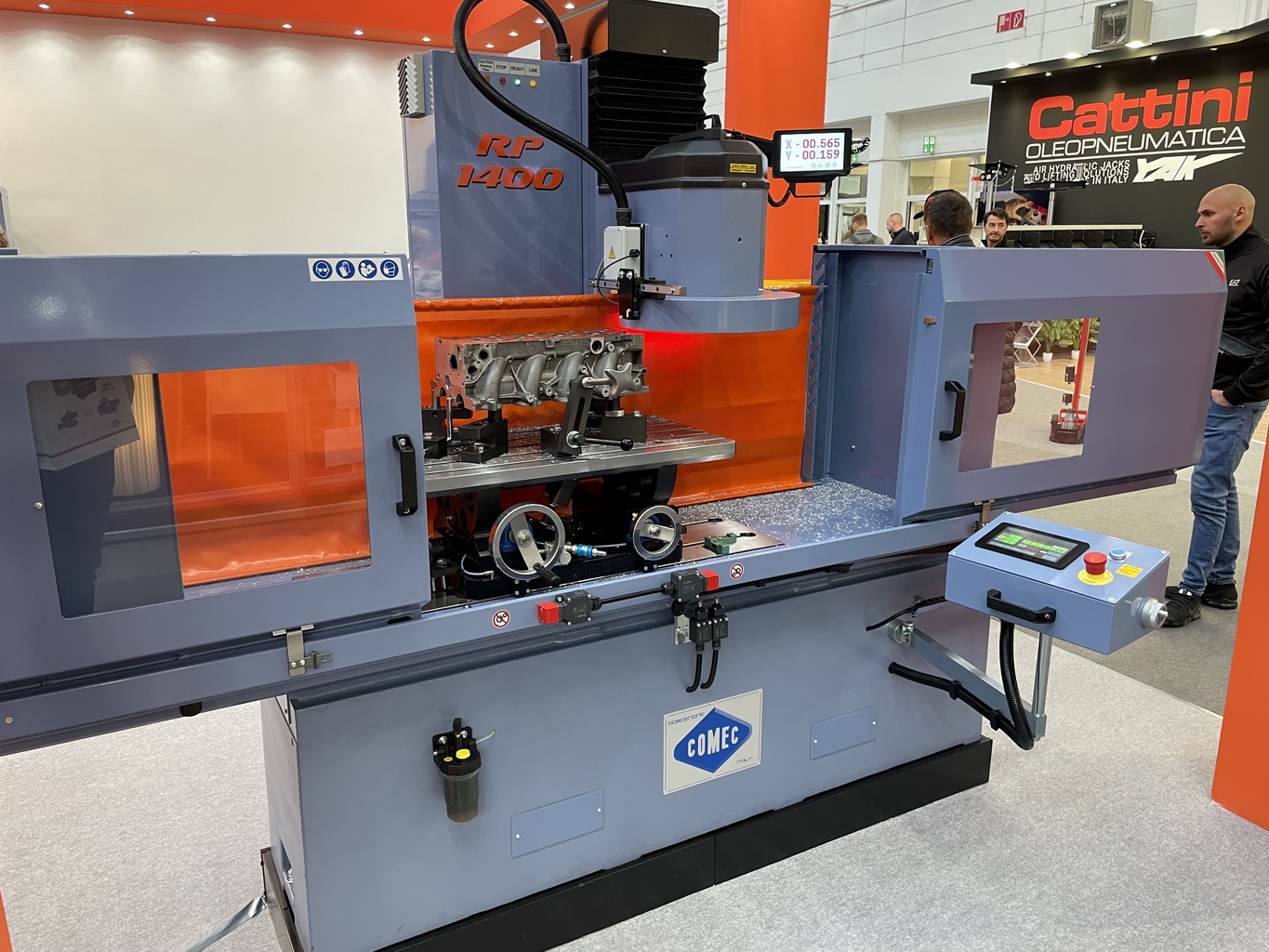 But the COMEC surface grinding and milling machine for heads and grinding machine for valves are confident market leaders
At the same time, COMEC also makes a pretty serious grinding machine for valves of model RV516.ASM. At least, no one else offers such machines, and the machine itself may well become a replacement for the once popular, but already completely outdated Kwik-Way. At least, after the discontinuation of the well-known SERDI HVR90 machine 12 years ago (we are not taking into account its Chinese clone yet), all current competitors against the RV516.ASM are clearly weak. The reason is that, unlike the RV516.ASM, they have problems with the accuracy of grinding small valves, and not all of them are capable of grinding the end of the valve stem.
Nevertheless, technical gaps are closed by very competent management: the Western business school is felt here, and it is at its best, no doubt. Although, it should be noted that in the COMEC machine line itself, there is also a certain obvious gap. And it is understandable. Just imagine the situation: okay, first we repaired the cylinder head, then completely repaired the cylinder block, but what about the crankshaft? Should we immediately run for a new one or still take it to the nearest workshop to competitors? And are they still alive? That is, the COMEC line is clearly lacking a machine for grinding crankshafts. Perhaps.
WESPY
It was very pleased that over the past 10 years, new participants have appeared at the exhibition. One of them is the Turkish company WESPY. In general, it specializes in the production of inexpensive, but very high-quality washing machines of all types and kinds. Such manufacturers are not only in Turkey; there were also many of them at the exhibition. But this time WESPY clearly stood out with its motoring focus, featuring a valve grinder and a cylinder head pressure tester.
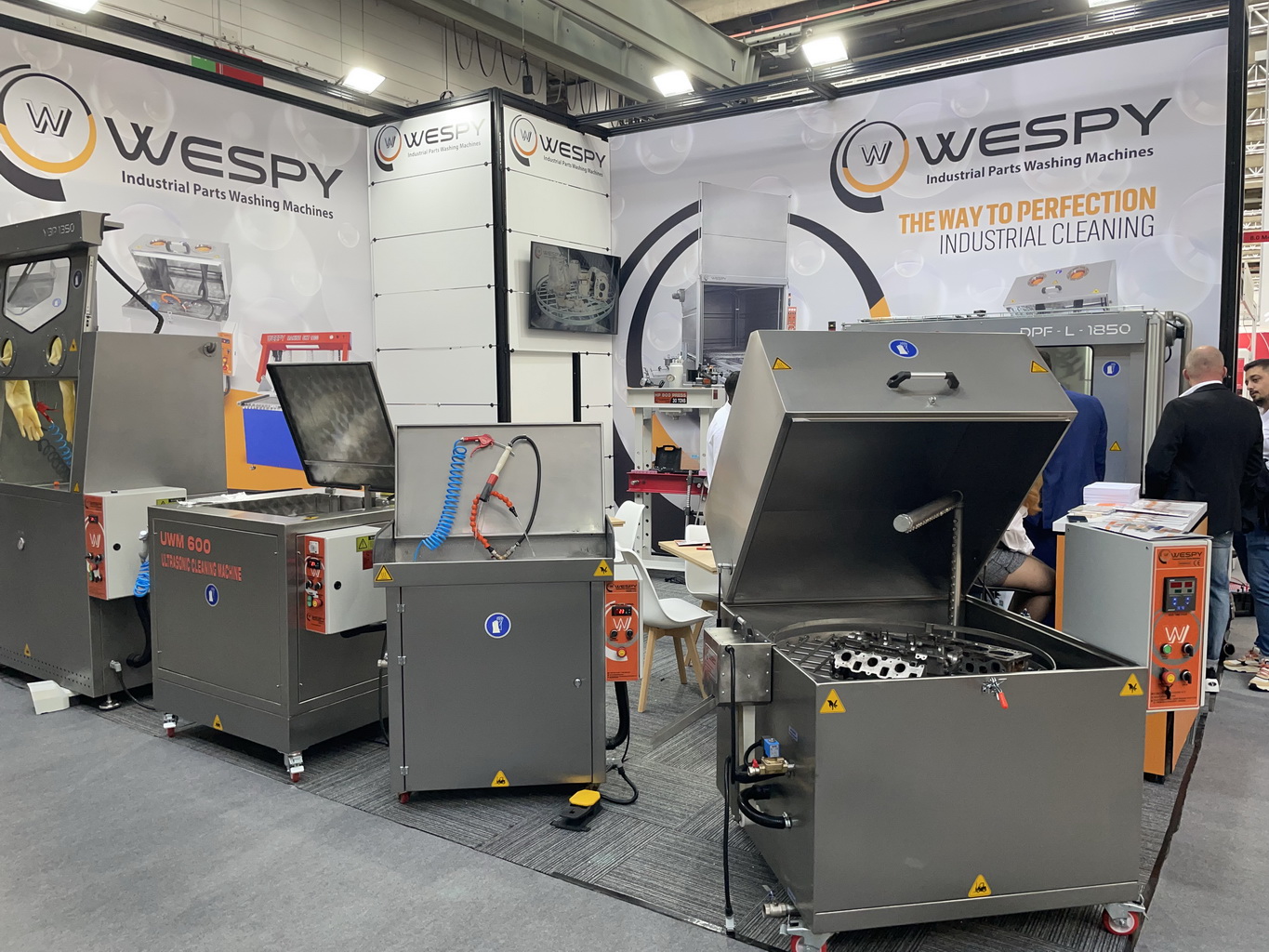
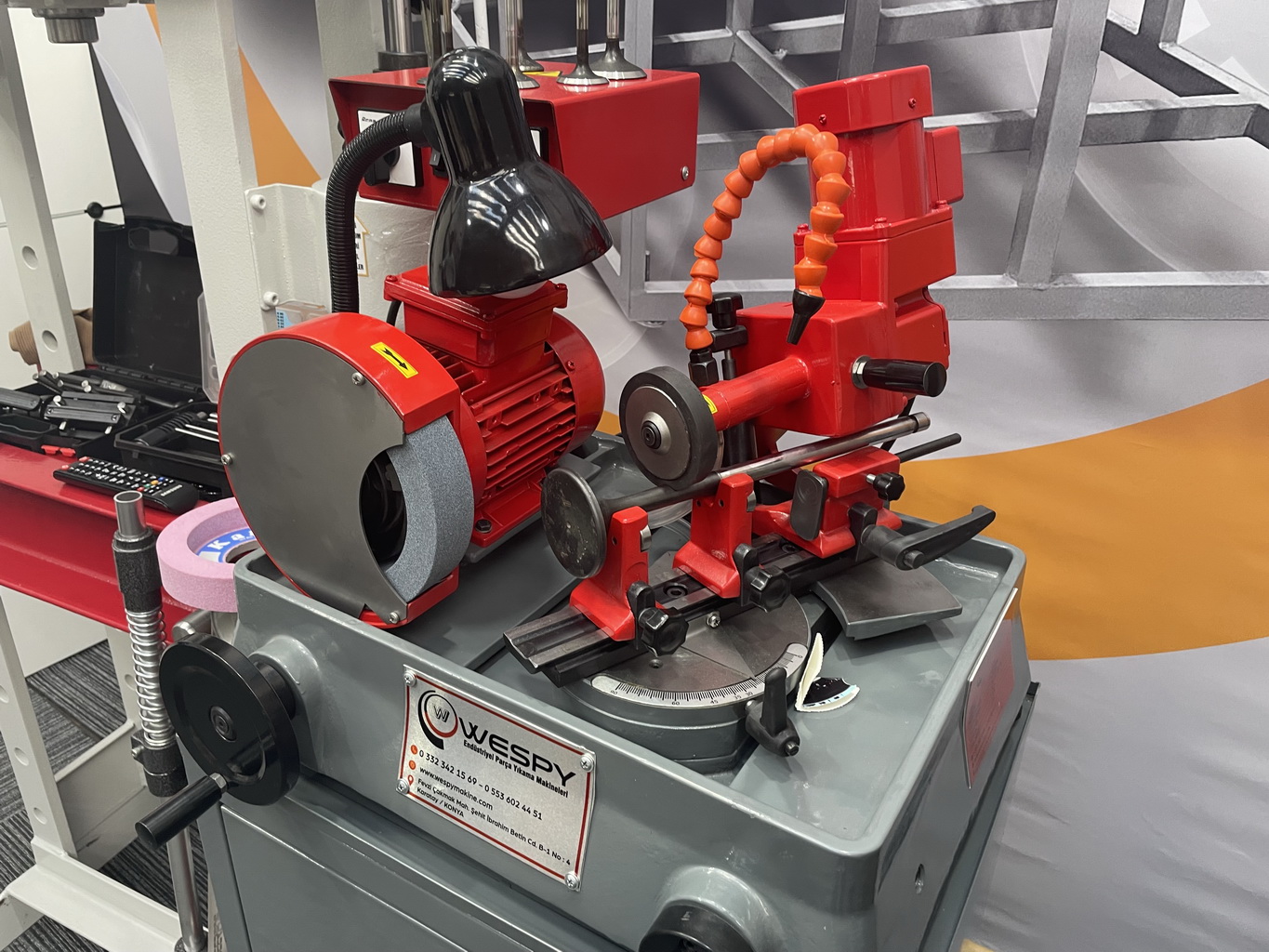
WESPY is a promising Turkish company, and its participation in the exhibition undoubtedly contributed to the engine repair business.
The equipment is quite high-quality, and in terms of price it really competes with the products of not only European, but even Chinese manufacturers. But since “you can’t count your chickens before they hatch”, in 2 years at the next exhibition it will be clear whether the company was able to push its competitors aside.
Who else was there
In the most prestigious 8th pavilion, in the very middle of it, among the most famous manufacturers of the World auto industry and well-known in more narrower circles smaller companies, including giants of diesel diagnostic equipment and monsters of garage ones, we suddenly found… our Ukrainian manufacturer! The family company VTM presented at the exhibition its absolutely incomparable machines, which it produces at its own production facility (!) in Odessa. These are machines for balancing all the types and kinds of rotating rotors – from turbochargers to cardans and large turbines. And it must be said that the quality of the machines is at a very high level. It is therefore not surprising that there were so many visitors at the company’s stand that it was impossible to get closer to see these machines in detail. But we decided that it was not a problem – we took all the contacts and hope to continue cooperation at home. That’s how it happens…
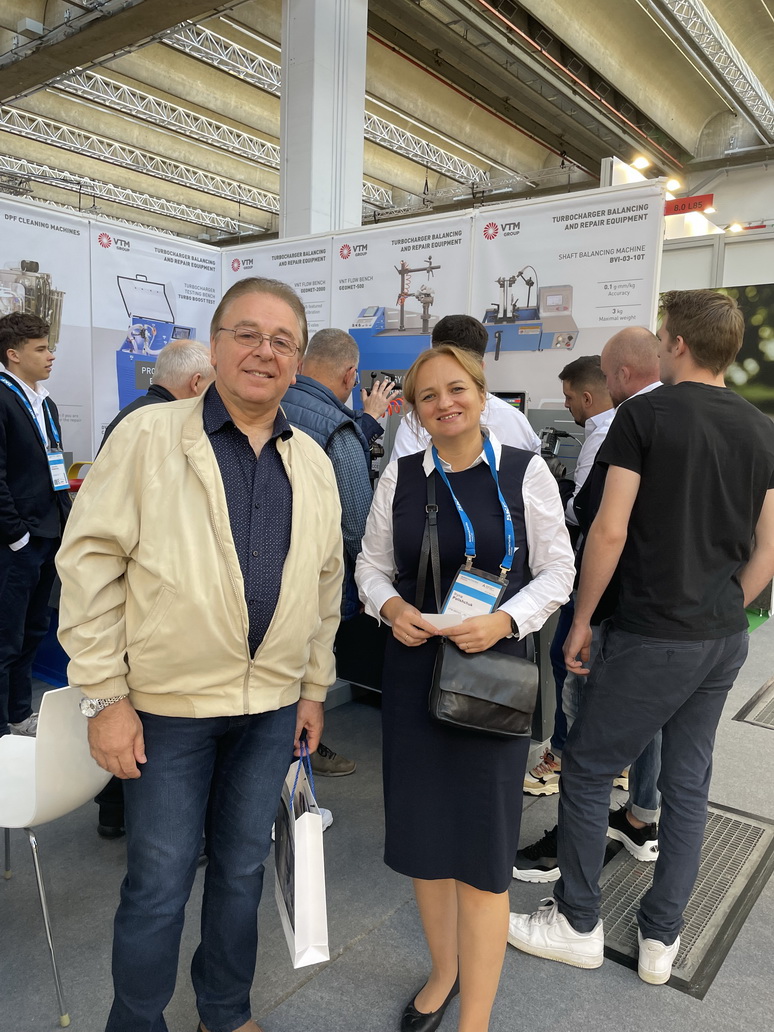
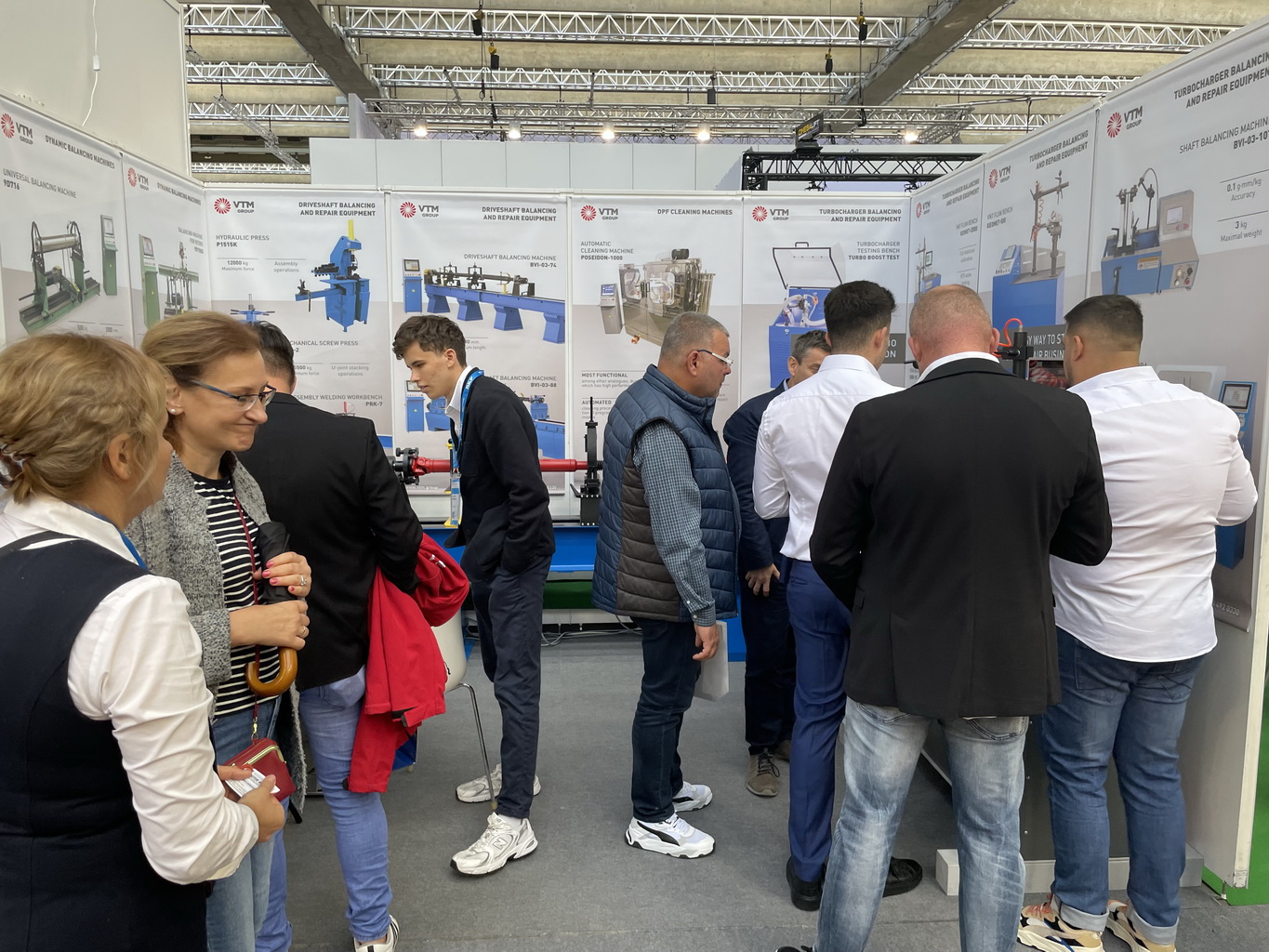 The Odessa company VTM Group at the exhibition in Frankfurt in the coolest 8th pavilion – it’s nice to know that we are also on the level! With the director of the company’s export department Irina Polischuk (on the right).
Well, and you can’t pass by the Bundeswehr exposition, which is located in the far corner of the pavilion. The German military traditionally participates in Automechanika Frankfurt, this time they showed the latest armoured vehicle Eagle 4×4 and the latest dual-circuit turbojet engine with an afterburner developed jointly with the French aircraft engine-building company SNECMA for the new Luftwaffe 2-engine training and combat aircraft.
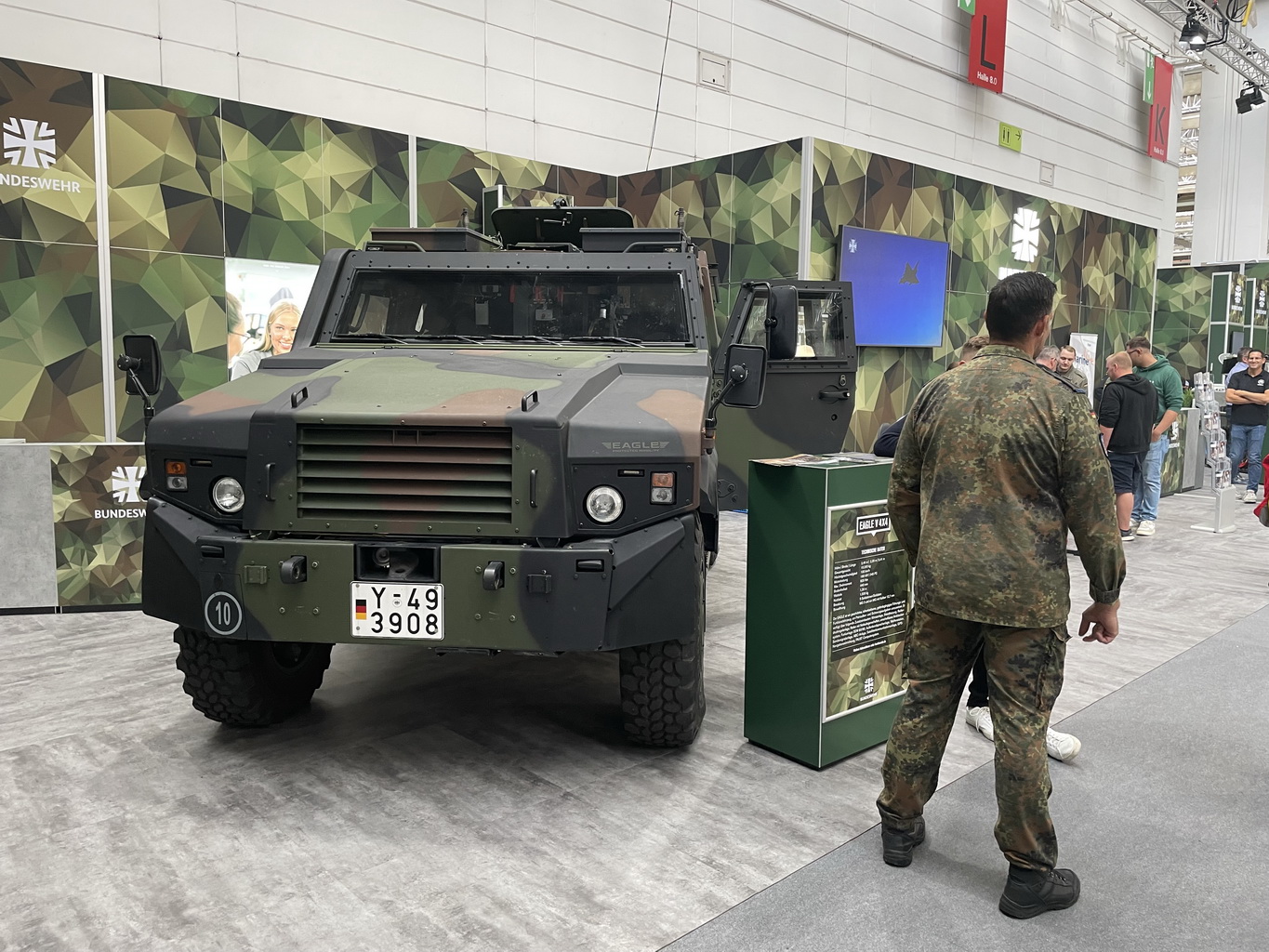
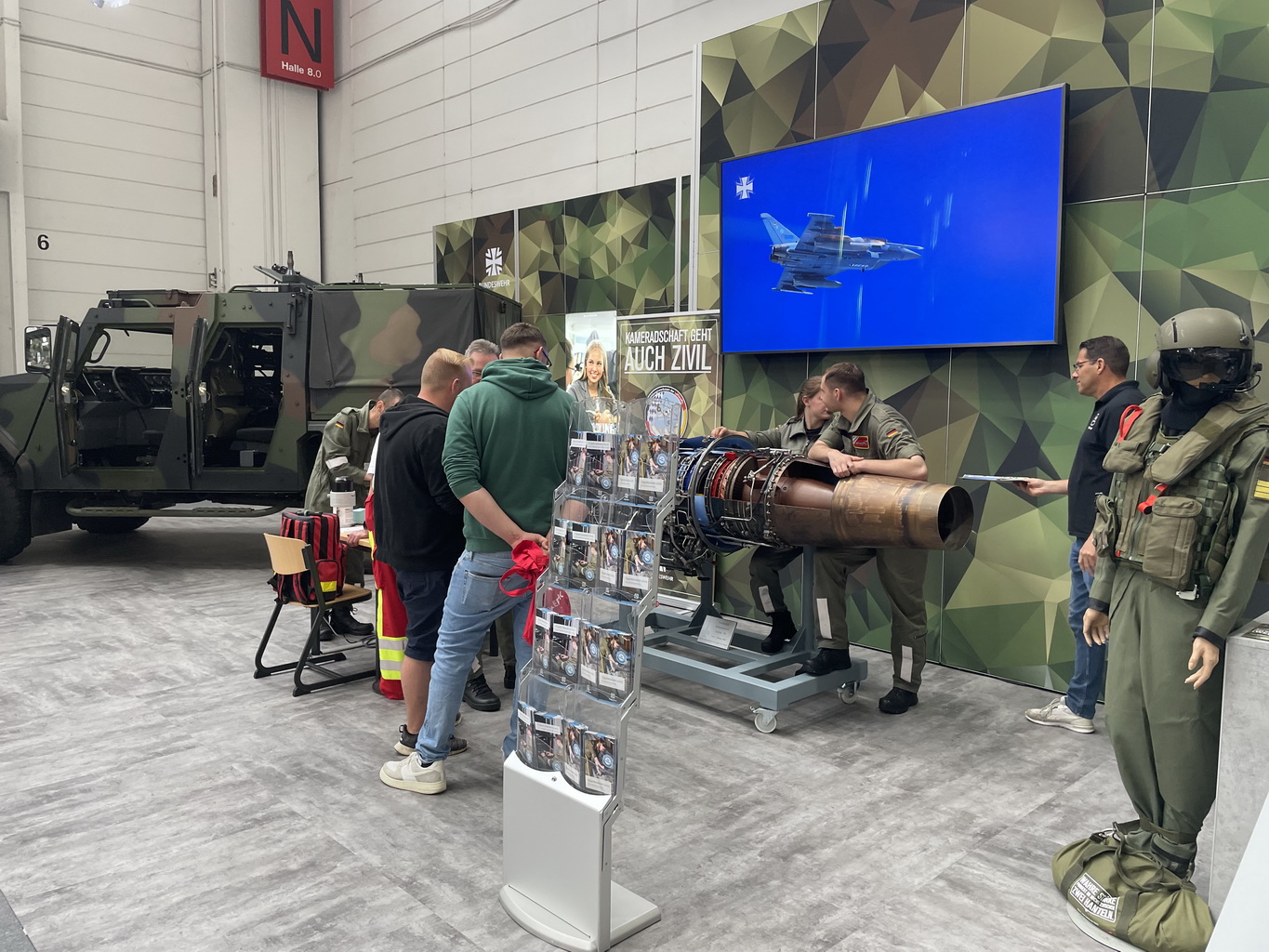
Bundeswehr at the Automechanika FRANKFURT exhibition: German military traditions, expensive, cool.
In short, very serious equipment – from the most serious military engineers with centuries-old traditions, the founders of armored vehicles, jet aircraft and military art (and this is exactly what we lack now). Respect.
Who was not there yet
Now a little about those who disappeared after the exhibitions of past years. Thus, the complete absence of the Chinese-Danish AMC-SCHOU at the exhibition testifies to the actual fiasco of this once in the past the most famous brand on the world market. Which could have been expected already 10 years ago, when not only the entire production of components, but also the assembly of machines were recklessly transferred from Denmark to China by the new Chinese owner of the company. Moreover, the exhibition of 2014, 10 years ago, already showed then – if as a result of this transfer, all Danish specialists, who for 90 years ensured the spirit and traditions of the famous brand, are completely replaced by Chinese, who have no experience at all, expect trouble…
And trouble was not long in coming. After 10 years, it is even more clear that the strategic mistake of the new Chinese management was precisely in the complete transfer of assembly production to China. Instead of keeping it in Denmark, but with a significant reduction in costs due to the reduction of costs for the production of components. Because it was not the production of components, but the Chinese assembly that turned AMC-SCHOU machines from Danish to Chinese. But when you spend someone else’s money on the purchase, such mistakes are quite understandable. It is another matter when such a mistake is made in the very narrow world of repair equipment – in 10 years it led to the loss of the distribution network and all positions in the world market. And now there is probably no talk of this Chinese company participating in exhibitions of such a level as Automechanika – they would only like to survive on their domestic, Chinese market.
The surprising thing is that the result of such a fall was actually predictable, it was just lying on the surface, but was not taken into account. Chinese production is not worth Danish money, and if 10 years ago any AMC-SCHOU machine, manufactured in Denmark, was the most expensive on the market, and its owner was the most respected repairman, then doing the same with a Chinese machine, manufactured in China, turned out to be completely impossible. Only the magic letters of the name of the once most famous brand, stupidly bought out, but devoid of Danish meaning and filled with only Chinese content, could not save the situation. And it is a pity that the Chinese “comrades” did not understand such simple patterns of marketing and business at the time – apparently, they took on something that was clearly not their business (possibly based on the new official directive “why copy Western products when it is easier to buy a Western manufacturer with all the giblets”).
It seems that the French-American (or American-French) company NEWEN has completely and without a trace disappeared from the exhibition too. Once, 10-20 years ago, its super-machines with CNC and the Pantograph system for spot seat processing inspired horror in some, awe in others, and considerable skepticism in thirds (including us). In fact, spot seat machining is when the cutting bit is not profiled, like most machines, which cuts the entire seat at once, but sharp, takes the seat with only one sharp edge (point). And it is, of course, all excellent and super-precise, but what does repair have to do with it? Yes, for unique Formula 1 engines and spaceships (Elon Mask, hello!), such machining technology is exactly what is needed. But what is it for an ordinary customer-repairman?
In addition, it gradually became clear that the accuracy of such processing is completely at odds with productivity: while the NEWEN machine cuts out a single seat according to a program and with all its unimaginable accuracy (you still need to make and record the program in advance!), in the same time, an ordinary machine with a profile cutting bit and manual control can make the entire head with all the seats. In addition, the price of these CNC machines has always corresponded to their main purpose – Formula 1 and spaceship heads, that is, unprofitable in normal repair. Because of which such machines were bought, as a rule, for other reasons – prestige, ousting competitor workshops from the markets, etc. Which, it seems, ultimately left no chance and for the company itself to maintain its own position in the market…
Traditionally, the Italian company ROBBI was also absent – it has never participated in the Automechanika-Frankfurt exhibition, neither before nor now. According to rumors that circulated at the exhibition, ROBBI has practically stopped producing engine repair machines, concentrating on industrial cylindrical grinding and honing machines. Such talk was circulating 10 years ago, but judging by the current state of the market, it is possible that the production of repair equipment has gradually and finally lost not only profitability for the company, but also its meaning.
Well, and someone else was missing, in addition to all those mentioned. Who?
For some reason, none of the main Chinese were there. The famous Chinese SJMC did not come to the exhibition, although 10 years ago it was in all its glory, with all its main machines. True, instead of it there was a certain company AMCO, also posing as a manufacturer (although everyone knows that in China there is only one manufacturer – the Communist Party). But AMCO got lost in the endless Chinese row at a tiny stand, where it exhibited only a couple of machines for turning brake discs and drums, and did not show a single machine for engine repair. In general, in such a situation, it is not even entirely clear whether AMCO is an ordinary Chinese trader or a real plant?
There was also not a single plant of engine repair machines from India at the exhibition. And there are many of them, even very many – at least 6-7, and some produce quite competitive products. It is clear that in India these products are more oriented towards the domestic Indian market, and transporting machines across many seas with the blockade of the Red Sea and the Suez Canal is a very expensive and troublesome business. But nevertheless, the absence of all these manufacturers at the main European exhibition (we specifically searched in the exhibition catalogue – no one from India or China) speaks quite eloquently about the fact that both Chinese and Indian machine tool manufacturers do not consider the European market of engine repair equipment as promising. Otherwise, they would have come, despite the costs.
We also did not see most of the Turkish manufacturers of engine repair machines. And this is a fact – for example, the absence of companies such as SARITAS, HONMAKSAN, etc., may indicate not so many difficulties in the production of machines (it is very difficult to imagine this in Turkey, knowing the absolutely fantastically huge local repair market), but rather the workload of local orders. In addition, it is quite possible that the European market is not yet (or already) considered seriously by these companies. But it is possible that some of them think far ahead (for example, there is such an opinion: if you participate in such an exhibition once, then it is difficult to refuse later, since refusal may cause customers to fear that the company’s business is not going well).
What else did we manage to find out
One way or another, but maybe the Chinese are right, and there is no point in repairing engines in Europe anymore? Then why bring and show machines for their repair at the exhibition? And in general, maybe on the streets and highways of European countries, new gasoline and diesel cars have long since given way to electric ones? What is this repair for then, who needs it?
Such a rosy picture could be reality, but… despite the wishes and dreams of the “greens”, reality is far from their pictures as never before. And this is very easy to verify.
In fact, the exhibition itself presented an absolutely unimaginable amount of diagnostic and repair equipment and tools for gasoline and diesel engines. Some companies producing such equipment, over the time since our last visit 10 years ago, not only have not slowed down the pace of production, but, judging by their huge stands, have increased it even more. Moreover, nowhere at the exhibition was there a particularly large abundance of components, special tools and equipment for repairing electric cars. But all the pavilions of the exhibition are filled from top to bottom with similar components and tools for repairing internal combustion engines, their units and fuel systems, including motor oils.
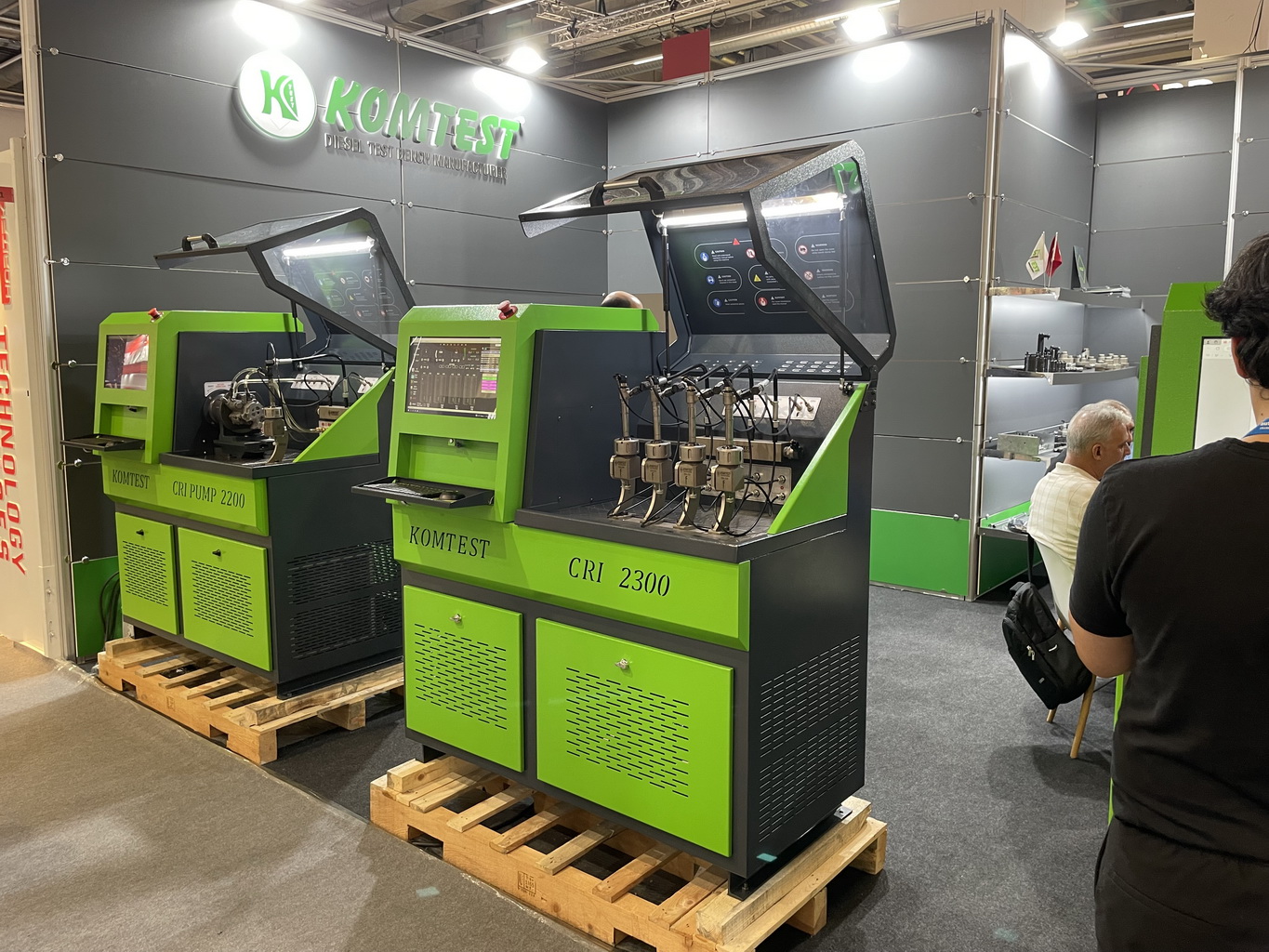
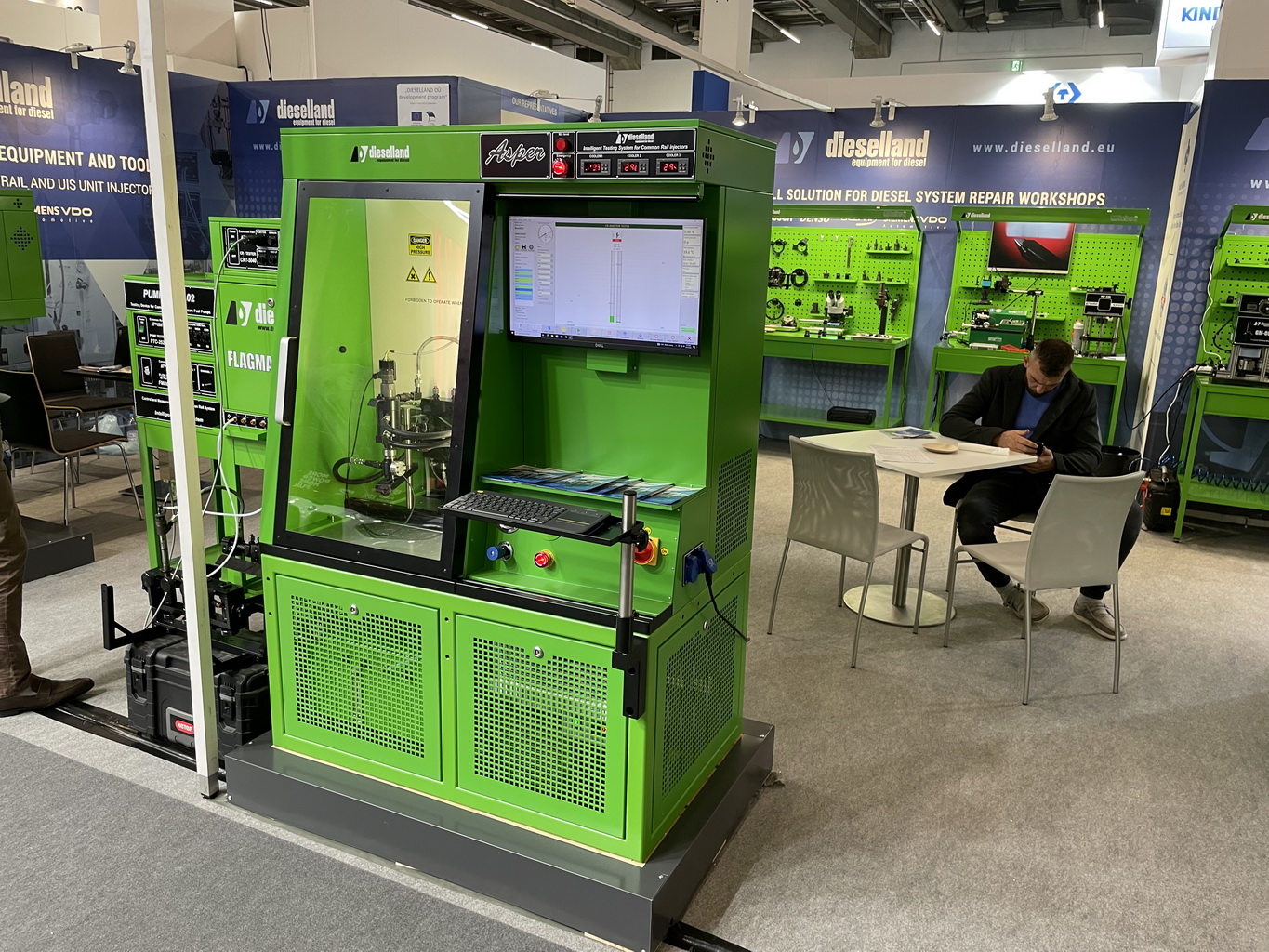
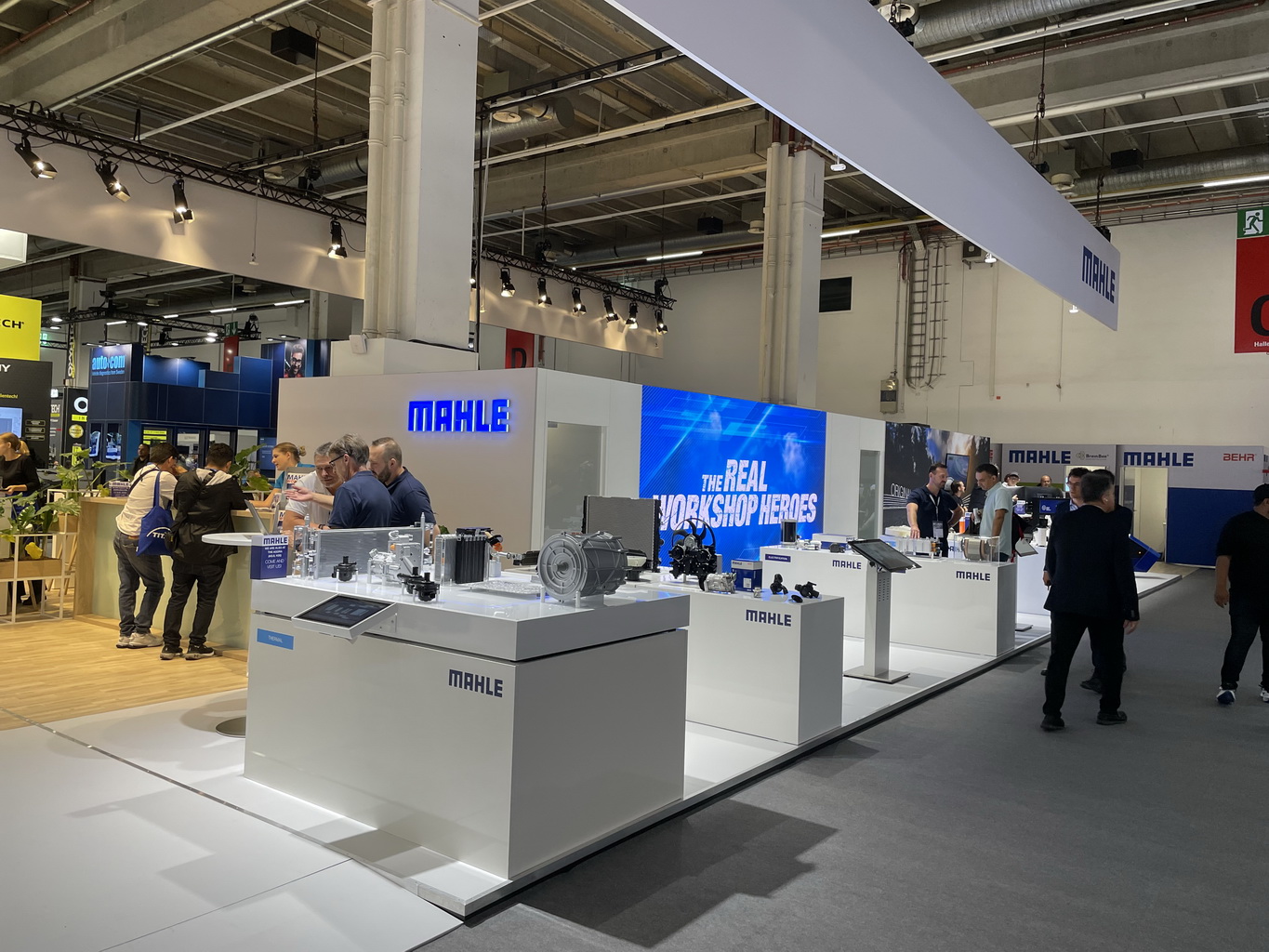
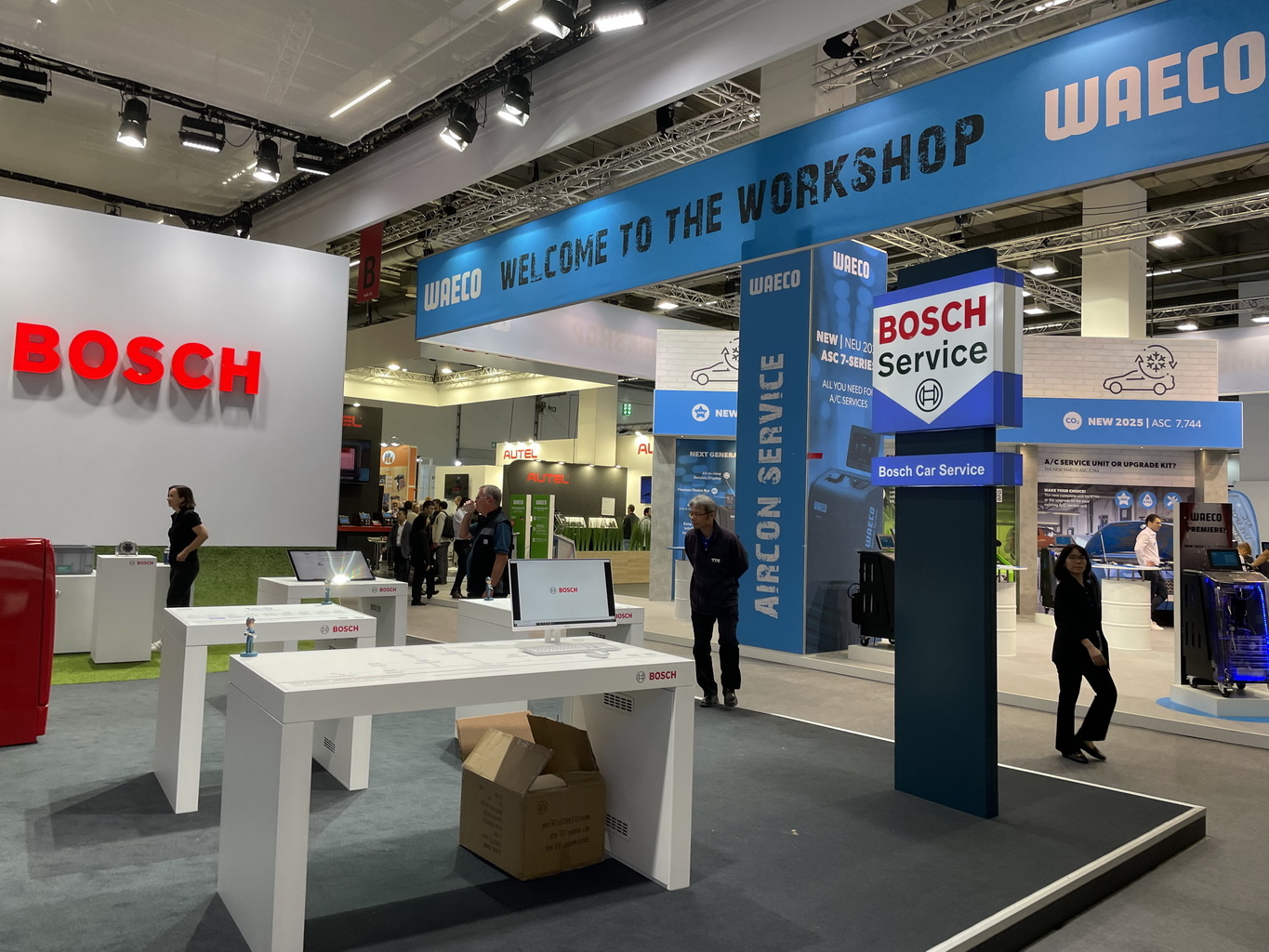
Service, diagnostics, components and fuel stands for internal combustion engines: they were simply dazzling everywhere at the exhibition. But where the companies engaged in the production of components, maintenance and repair of electric cars were hiding, we were unable to find…
It becomes even more interesting when you go out into the city, and then onto the highway. Where are all these promised electric cars, which are supposed to completely replace gasoline and diesel cars either by 2030 or by 2035? They are not visible, at least they are not conspicuous anywhere. And to such an extent that in a small village in the Kyiv region of Ukraine, electric cars are more common than in a large German city! And not only are they almost invisible in the city, they are practically absent on the highways at all (in 2 weeks we drove through 7 European countries for a total of almost 6200 km and saw on the highways, mainly, electric cars only on car transporters). Then how are going to switch to something doesn’t exist yet? It’s completely unclear…
And what is? A huge number of ordinary old cars – 5-7 years old and older. And everywhere, in all countries – even in rich Switzerland. And when we see such machines, we immediately understand that they need to be repaired. And not only the suspension and brakes, but also the engine. But here’s the problem – over the past 20 years, Europe has decided that it doesn’t need engine repairs, it’s easier to buy a new head, cylinder block or even an engine. Or better yet – the entire car. After 3, maximum 5 years. So that nothing else needs to be repaired.
This turned out to be enough to bring European engine repairs to a state of clinical death in about 20 years (and this is clearly visible at the exhibition). To the point that there is simply nowhere and no one to do a number of relatively simple engine repair jobs. However, such a program did not provide for coronavirus, or war, or the invasion of millions of migrants. Who have no money for a new cylinder head, or an engine, or, even more so, a new car. And all the other decent European citizens, apparently, have not had any more money from coronaviruses, wars and migrants either.
What conclusion can be drawn from this? That’s right,… But we will end our report from the Automechanika FRANKFURT exhibition at this point and let all interested specialists and enthusiasts formulate their own conclusions, including those that are pleasant for them in all respects.
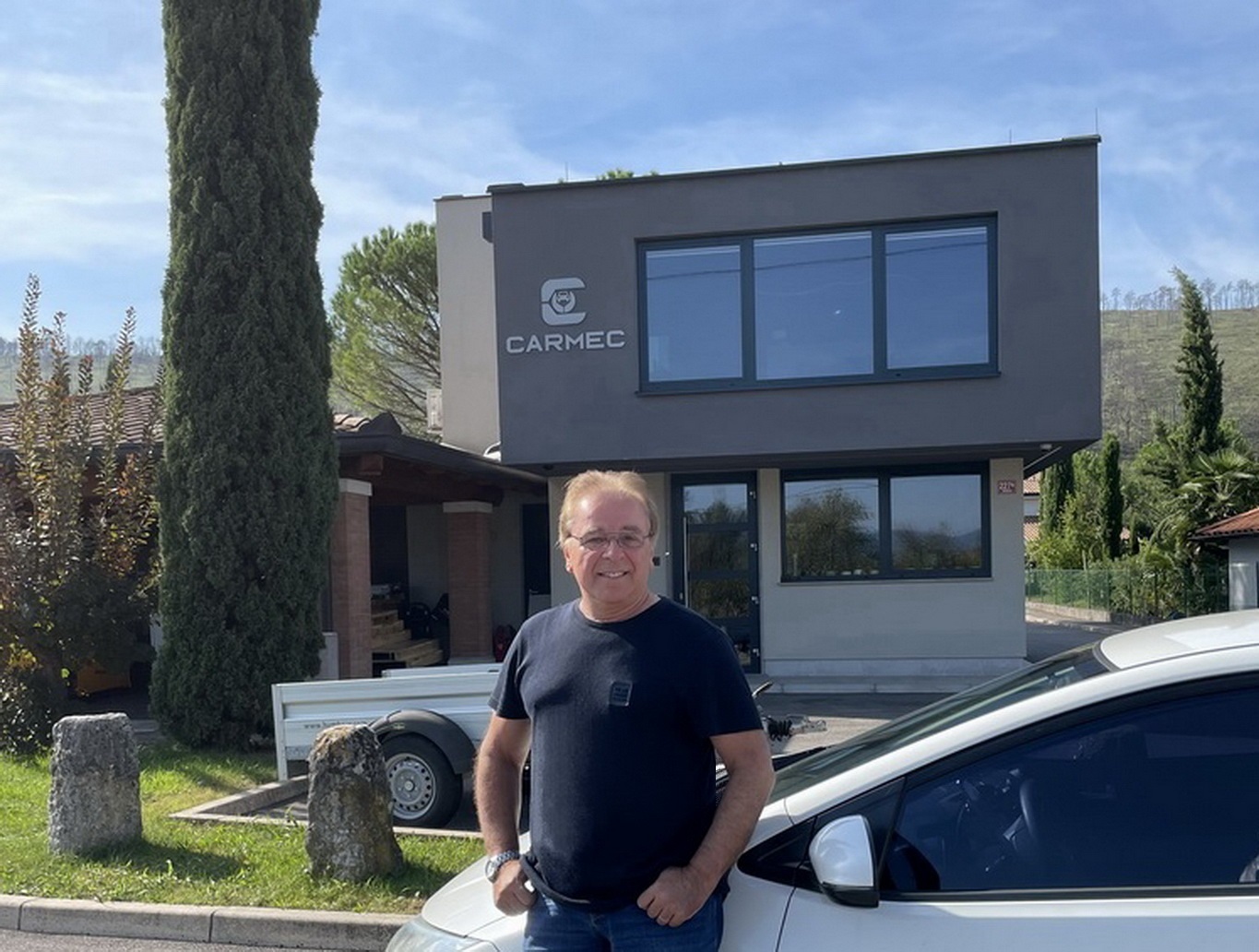
After the exhibition, we set off on the return journey. But with a stopover to see some friends and partners, among whom, of course, was the CARMEC Company – with its very convenient location next to the highway right on the border of Italy and Slovenia, closely to mountains, with very hospitable Director Mr.Samuel Ursic and with his delicious coffee in a glass office on the 2nd floor…
 Alexander Khrulev
22.09.2024