We’ve been thinking and decided to put together a short lecture on the topic “When the Earth was still warm, and winged jet-powered mammoths and pulse-jet dinosaurs roamed it,” or more precisely, on the history of aviation. It will run in parallel with our Youtube lecture series. It’s a very informative lecture, we must say. Stay tuned, you won’t get bored.
So, the first tricky question is: where did it all come from? Who invented this pulse-jet engine, and when? 75 years ago, it was universally deemed completely ineffective, but it hasn’t died out, and instead periodically rises from the ashes like a phoenix. And this process occurs in several stages.
Stage #1 – the classic Argus-type pulsejet
Of course, it wasn’t Karavodin or Kibalchich who came up with the idea, but a simple German — the German engineer and inventor Paul Schmidt, back in 193… or something. But he couldn’t produce a proper engine, although the Reich Aviation Ministry, which Comrade Schmidt bombarded with his letters, nevertheless considered the idea promising and passed it on to Argus for further development. And it must be said, this was a cool company, with its own aircraft engines and all. The company called in about twenty real doctors-professors to help. Among them were Doctors and Professors Diedrich, Gosslau, Zobel, Schulz-Grunow, and others. Incidentally, Professor Schulz-Grunow used this work to invent the so-called method of characteristics, without which even today it’s impossible to calculate the propagation of a single shock wave.
In short, German professors took on the pipe invented by Paul Schmidt. And not just took it on, but over the course of two years, they refined it so thoroughly that for 80 years, no one else could come up with anything more. It’s a pipe like this, closed at the front by inlet reed valves of a special German design, also honed to perfection by the professors:
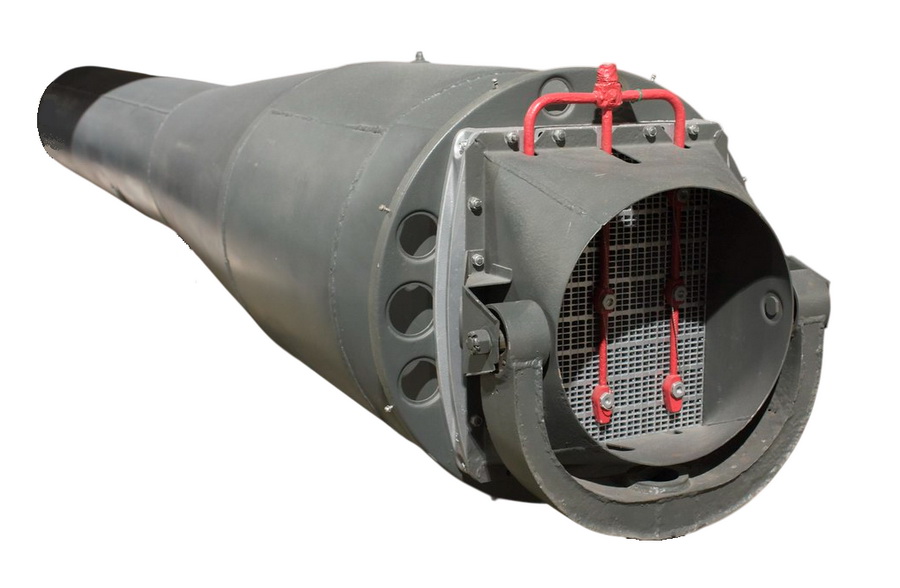
The pipe’s operating process is extremely simple to describe, but extremely complex in practice. It all works like this: first, a fuel-air mixture is ignited in a combustion chamber located in a small, expanded section of the tunnel behind the valves. The pressure in the chamber rises sharply, and the gases flow through a resonance tube, pushing out the air. Then, due to the outflow, acceleration, and inertia of the gas column, the pressure in the chamber drops below atmospheric pressure, the reed valves open, and the chamber is filled with a new portion of the mixture. After ignition, the cycle repeats.
First on models, and then on a full-scale 550 mm diameter prototype, the professors tested every component down to the last bolt and chamfer on the end of the resonance tube and even flew them. As a result, the Argus As 109-014 pulsejet engine achieved a finished appearance and a thrust of 300 kg. This allowed the German company Fieseler to develop and begin mass production of its famous cruise missile, the Fieseler-103, or the very same V-1, this one:

Regarding the V-1, the sniveling and crying of the Soviet communists and other democrats of history is very typical, trying to use beautiful pictures to show what an ineffective weapon it was, compared even to simple bombers:
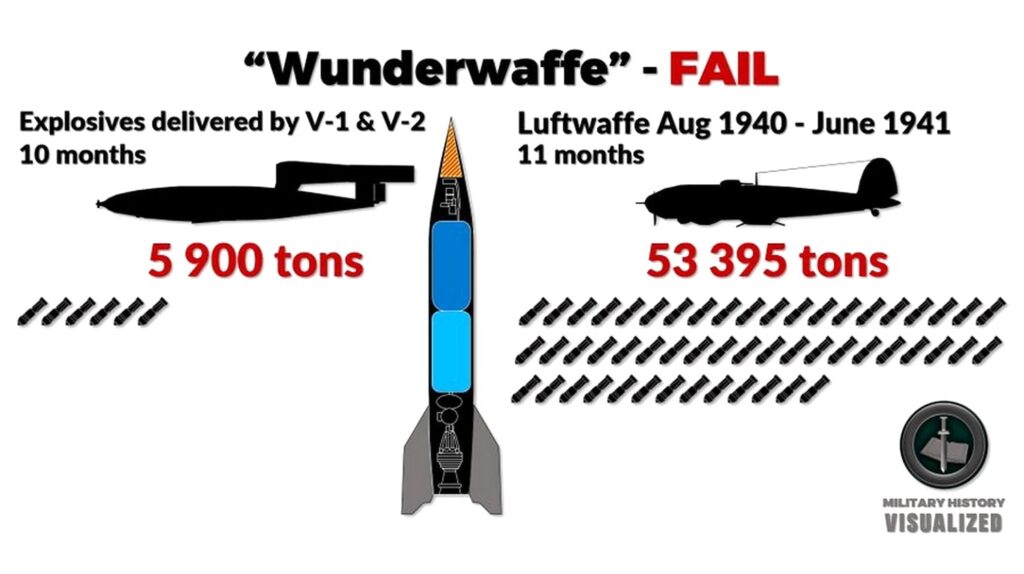
This nice image is a complete lie, deliberately ignoring the cost of losses, not only in equipment but also in pilots. Perhaps this was due to a desire to demonstrate the superiority of the victors over the vanquished by any means necessary. In reality, the V-1 turned out to be the most effective German weapon of World War II — the cost of producing a single rocket was simply laughable (although communists have been blabbering for 80 years that it was all due to the use of prison labor, but that’s nothing new, well-known Soviet Comrade Beria will tell you). And this weapon didn’t even require expensive pilots, of whom the Luftwaffe was clearly in short supply by the end of the war; just a few soldiers with brief training were enough to fire such missiles repeatedly.
But the damage from a 900 kg charge was so severe, that there’s simply impossible to compare with something, resulting the devastation of London in 1944 was so heavy:
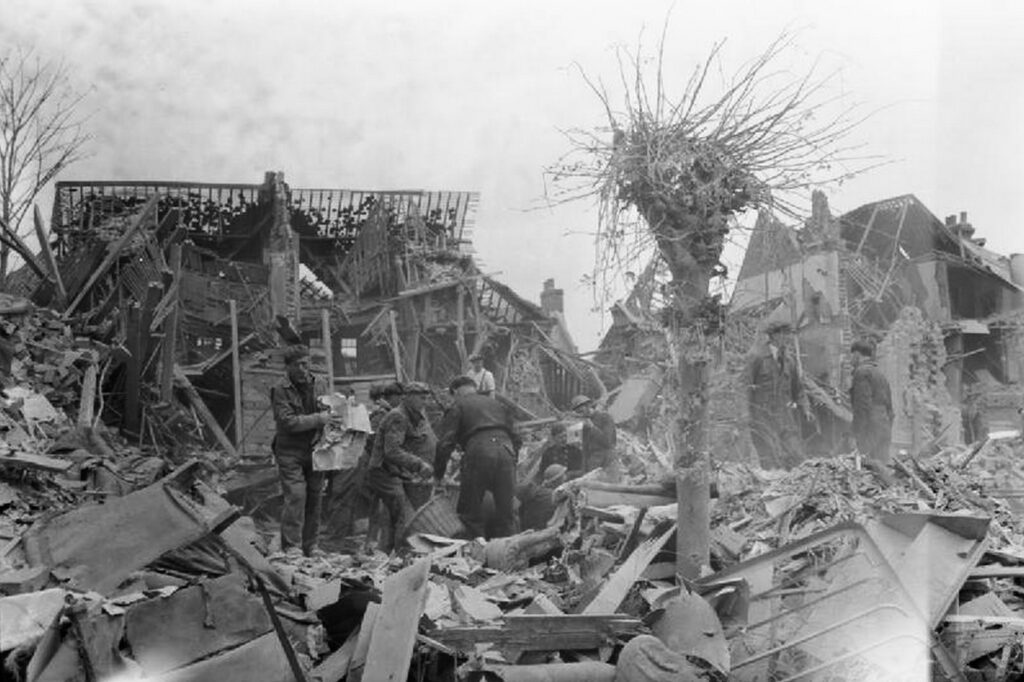
But. Its effectiveness was achieved solely and exclusively through mass production and widespread use (more than 25,000 units were produced!!!) — for pinpoint, isolated strikes, this weapon was completely unsuitable.
However, an entire army of specialists, who hadn’t created anything themselves, spent decades writing mountains of paper and erasing tons of computer keys to prove that the classic valve-operated pulsejet engine from the German professors, despite everything, had five very serious flaws:
1. Very poor fuel efficiency due to low chamber pressure (maximum 2.5 bar). This pressure determines engine efficiency, which is inversely proportional to the specific fuel consumption per 1 kg of thrust. This fuel consumption turned out to be a good 5-6 times higher than that of piston engines, and 2 times higher than that of the first German turbojet engines. This immediately led to the limited range of the V-1 rocket — no more than 300 km. But was it really necessary for a cheap rocket to fly further than London? Because if it wasn’t necessary, then what was the drawback?
2. Extremely loud noise. The original Argus engine had a frequency of 48-50 Hz and over 150 dB of noise, so loud that, reportedly, some cows couldn’t stand it when it flew over peaceful English meadows. Although, whether this is a drawback is a bit of a moot point. A drawback for a single rocket? Yes. But when 1,000 of them are flying? Then it’s not a drawback at all, but a real deterrent to the enemy…
3. Extremely strong vibrations. This had a serious effect on all the V-1 rocket’s fastenings and connections, as well as on all the electronic equipment, requiring special design solutions and extensive refinement. Yes, but every new product in aviation requires this, doesn’t it?
4. The tube walls reach extremely high temperatures — over 1000°C. Because of this, the initial designs for placing the pulse engine inside the rocket fuselage failed, and the engine had to be mounted externally. Most experts consider this a fatal flaw. They believe that an external pulse engine produces such terrifying thermal radiation that such a missile would inevitably be shot down. Perhaps, but that’s only for a single, highly accurate, and unique missile. What if there are 1,000 simplest of them?
5. The reed valves have a very short service life — only 20-30 minutes. But the Germans, being true Germans, have been able to fit the flight duration precisely within the valve service life, and the professors perfected the stability and reliability of this component. After 1948, when all pulse engine rocket projects were abandoned, no one paid much attention to the service life of any kind valves. Therefore, it’s impossible to say right now what valve service life is available and what isn’t — let’s first, conduct research, test modern materials, and then we’ll talk.
It’s significant that, despite all the real and imagined shortcomings, German rockets paid for themselves, and they did so with their extremely low cost — they were a piece of cake! And it’s perfectly natural that the so-called “allies” all wanted to get this weapon. To this end, they mobilized all their intelligence, spy, and saboteur resources to secure trophies. And plenty of them. And when such trophies were secured in 1944, things took off.
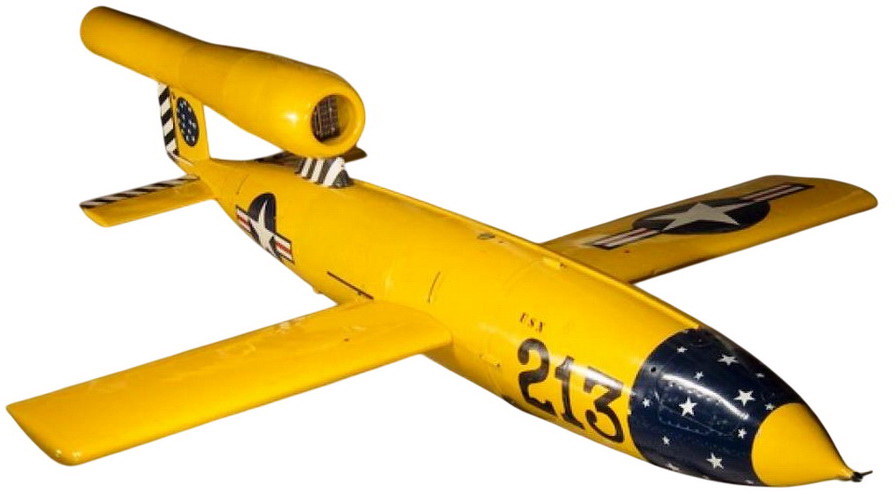
The American copy of the V-1 is the Republic JB-2, powered by a pulsejet engine from a genuine Ford PJ31 — a surface-to-surface attack cruise missile for the US Navy, model 1945, which was mass-produced:
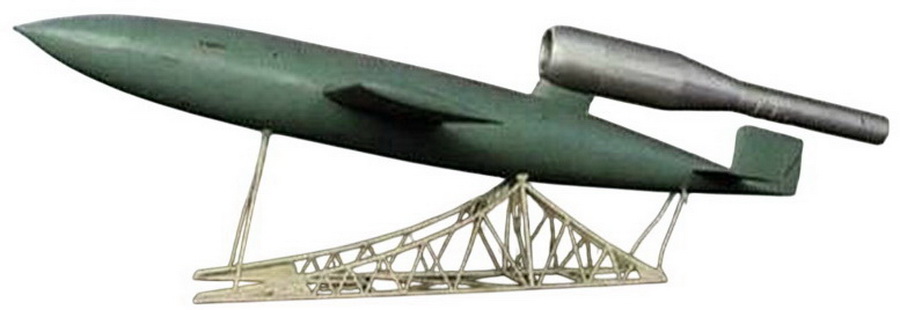
The Soviet copy of the V-1 is the 10X from well-known General Designer Comrade Vladimir Chelomey — an experimental attack cruise missile from 1947 that never entered production. It was indistinguishable from either the German or American versions. Except for the extremely poor manufacturing quality, which meant it almost always missed the target:
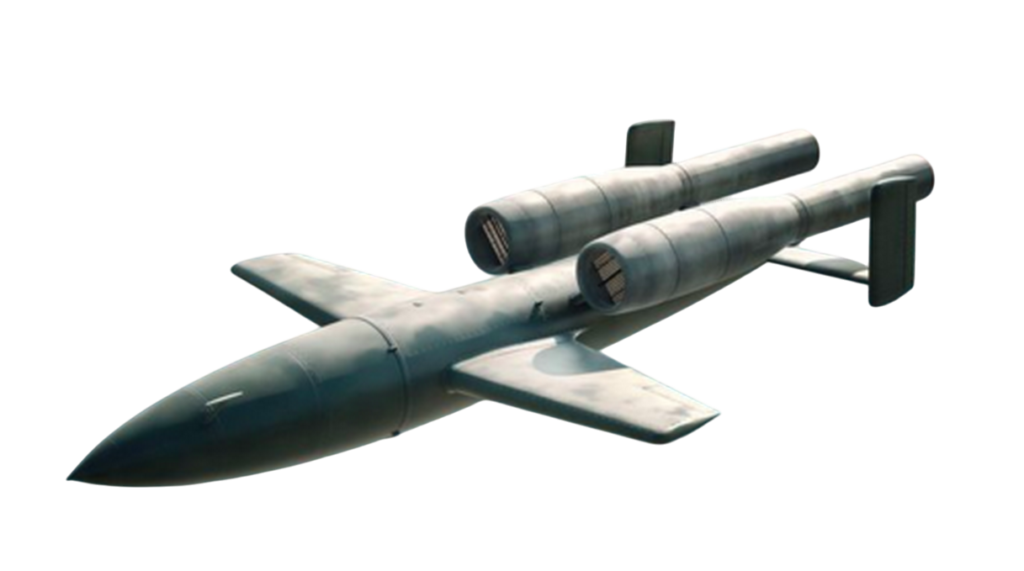
Comrade Chelomey was so enthusiastic that he even invented his famous 16X super-rocket, which featured… two pulse engines! We believe such an idea could only have been conceived in the delirium of a complete misunderstanding of the principles of pulse engines. But, as they say, the Soviets have their own pride, and, as Comrade Stalin said, there are no obstacles true communists can’t overcome…
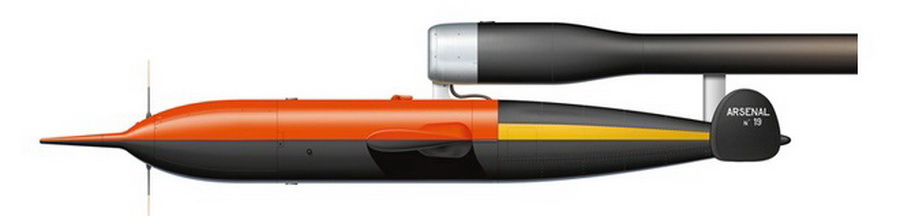
France, as one of the victorious countries (because it defeated someone too), also wanted something similar. The French near-copy of the V-1 is the ARSAERO CT 10 (Arsenal/SFECMAS Ars 5501) — but this is just a fly target, not a missile:
And it would be strange if they hadn’t copied them, because the entire coast of the English Channel was dotted with these missiles.
But unlike others, the United States did everything on a particularly grand scale, and strictly followed German experience (mass production is essential for maximal effectiveness), since they had many German engineers, including those involved in the Paperclip program. Therefore, they planned to produce as many as 70,000 cruise missiles for the attack on Japan, but… Only a little over 1,300 were produced — with the use of nuclear bombs instead of conventional missiles and the defeat of Japan, the need for their mass production disappeared. And as soon as that disappeared, the turbojet engine immediately took over. But the missiles that were produced continued to be launched and tested for various variants for a long time, until the mid-1950s, giving the United States extensive experience in the use of cruise missiles.
When copying the engine by Ford, it’s likely that no German doctors-professors were allowed to work on it (they were the enemies yet), because American research reports on Argus-type pulsejet engines from 1944-47 differ from German ones about as much as first-year student notes differ from… doctoral dissertations. But America wouldn’t be America without its boundless resources. Therefore, American engineers were able to make one single, yet crucial, improvement: they applied DuPont’s then-new neoprene coating to the valve petals. As a result, the valve service life increased significantly, to three hours. Although this was only at low throttle; at full throttle, they never managed to achieve more than 40 minutes. But even that was still a very good result.
Furthermore, and most importantly, the Americans apparently used this weapon with their own guidance system, including specifically to ships, not at large areas (and where have you ever seen large areas as missile target at sea?). It should be noted here that any ship is an extremely massive piece of iron, for which even in the mid-1940s it would have been possible to develop an automatic guidance system, which America likely did. For some reason, the Germans either didn’t realize this, or assumed their submarines could handle the Allied ships on their own (and they were wrong).
And only the British stood quietly to the side, with their canes and top hats, chuckling softly — they had all the materials on the V-1 cruise missile long before anyone else, having collected nearly intact fallen missiles on their southern territory from the English Channel to London still in 1944. This allowed them to study all the design features in great detail, even conduct tests to determine whether such a missile would be of any use after the war.
The Soviets, as usual, turned out to be Soviets. No one in the Soviet Union ever realized that the whole point of this ground-attack missile was simply mass production and deployment (otherwise, it could only be used for naval ship-to-ship attacks). Far from it. Comrade Chelomey, like all the other great Soviet copyists of captured German-American aviation technics, beat his chest and claimed that he himself (!) had invented the Argus engine back in 1942. But the 10X missile and all its modifications building by Comrade Chelomey, for some reason — though this only became clear many years later — exactly replicated the shape and dimensions of the V-1. At the same time, they never quite got the targets, and they kept falling in shoals in the wrong direction…
It’s worth noting here that German scientific, engineering, and design thought and training ensured the V-1 rocket’s precise impact at a range of 300 km from the launch point, within a circle with a radius of about 3 km — and without any radio control, automatic guidance, or GPS, only a precise inertial system, thanks to electronic lamps and the precision of German gyroscopes. This was more than enough to bomb half of London across the English Channel. The Soviet copyists (and what kind of engineering school could there possibly be in a parish school or workers’ faculty?), due to their clumsy hands and the complete lack of their own brains, couldn’t hit even 5 km radius from 200 km away, so the Soviet marshals couldn’t figure out what to bomb with such low accuracy (although, if 100,000 missiles were made for free by the hands of millions of the Soviet prisoners, so called as enemies of Soviet people, under command of other Stalin’s Comrade, Lavrentiy Beria, that would have been quite good, simply by the theory of probability). And about creating an automatic ship-targeting system like the US — that’s about a question of understanding difference between America and Soviets.
In short, the Soviet Air Force marshals absolutely refused to adopt this crap (they simply wanted different crap). So, already in the early 1950s, all of Comrade Chelomey’s projects were forcibly shut down by top imperial decree. Comrade Chelomey’s design bureau was taken away (what did he expect?), and Comrade Chelomey himself nearly found himself in the crossfire, when Comrade Stalin, smoking his pipe in his mustache, called him a swindler or something even stronger… Comrade Stalin probably didn’t believe Comrade Chelomey that he had invented all of this. But someone did save Comrade Chelomey. Although, probably under a certain condition (and we even suspect who it was). Because then everything related to Project 10X and its ilk was completely and utterly destroyed, so that neither the enemy nor they own would get anything — the Soviets have their own pride, and no experience matters to them.
So what do we have from this entire swarm? A mountain of declassified American reports from 1944-57 on this topic, as well as German materials from actual German developers, engineer Schmidt and professors Gosslau, Diedrich, and Schulz-Grunow. And exactly zero (zero, nothing) materials from those Soviets who beat their chests and talked about their priorities — everything was classified and essentially destroyed. So thoroughly, in fact, that nothing existed.
So don’t be fooled, as they say, and feel the difference. Between the West, which declassified unnecessary equipment that had previously cost a fortune, so that anyone could use it completely free of charge and perhaps even create something useful. And the Soviets, which stupidly squandered the people’s hard-earned money (let’s not forget that in the 1950s, a significant number of impoverished Soviets lived not even in houses, but in dugouts), and then collected it all and tossed it into the abyss as useless junk (well, rightly so — they’re not going to give it away, are they?).
And all this, in general, marked the end of the first stage of the pulsejet development, and the beginning of the second.
Stage #2 – classic pulsejets, scaled-down versions of the Argus
These are numerous American flying targets.
Here’s one of them, a Globe KD2G-2 Firefly (XKD5G-1) with Marquardt-PJ46 engine (some sources say it’s Solar PJ32):
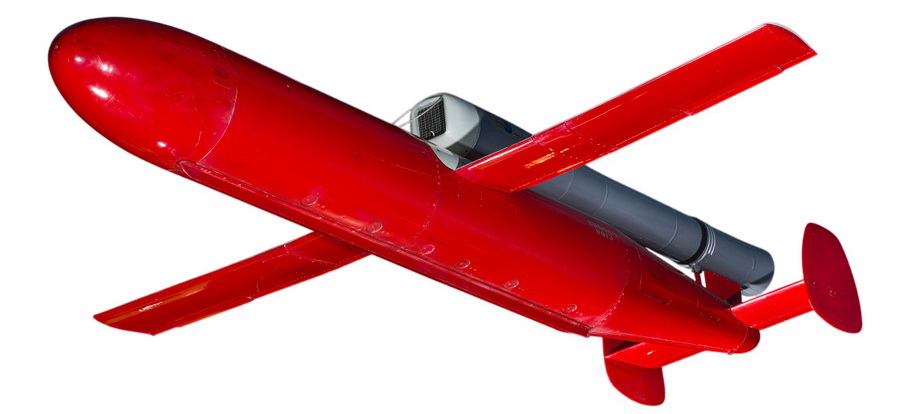
Here’s another one — a McDonnell TD2D Katydid with a Solar PJ32 engine, but with a modified side inlet (it was first proposed for a pulsejet by Professor Schulz-Grunow back in 1944, but other Germans still didn’t believe it and thought that a straight inlet was better)

Well, and the coolest thing — Curtiss KD2C Skeet:
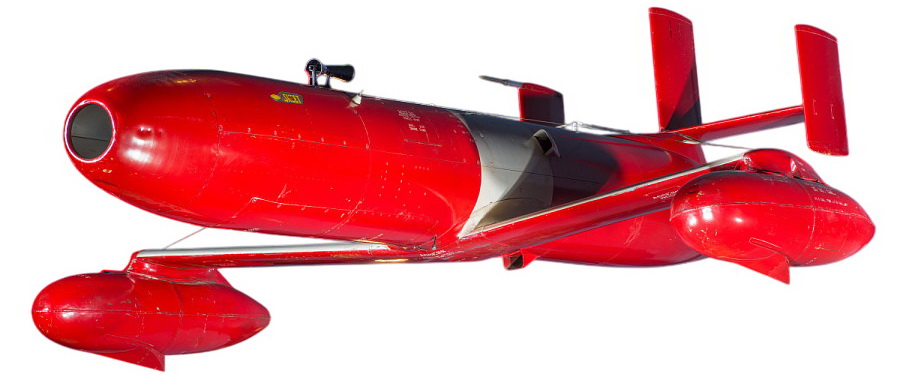
The coolness of the Curtiss design lies not in the fact that it developed the famous P-40 Kittyhawk fighter, but in the fact that the KD2C Skeet is practically the one design from 2 where a pulsejet engine mounted inside the fuselage — it was also Northrop JB-10 Hawthorne flying wing:
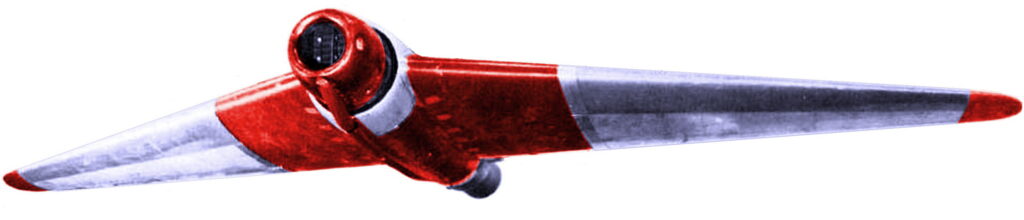
And it appears to be a full-size engine, not a scaled-down replica (no one knows for sure either). To achieve this, the fuel tanks had to be relocated by Curtiss to the wingtips under aerodynamically shaped fairings, Northrop traditionally made them inside the wing. But, as is often the case, the challenges of such an innovative layout (try stuffing a fiery, vibrating, and screaming monster inside a fuselage) proved beyond Curtiss’s technological capabilities. Moreover, this was the last aircraft project this once-famous aviation company attempted. Therefore, it never came to fruition, other than prototypes that ended up in numerous American museums. A real shame.
Other targets perhaps fared somewhat better, but despite this, virtually nothing is known about them. Nevertheless, it can be concluded that the most renowned American aircraft manufacturers were involved in the development of aircraft powered by pulsejet engines! Which, undoubtedly, proves the complete and utter inefficiency of this engine, yes, of course.
There was even another example of a sea-launched cruise missile — the Swedish Robot-310. It must be said that the Swedes have always distinguished themselves with their own design school, and in this case, they remained true to their principles. The engine stack was simply placed in the rear half of the fuselage, where the fixed tail was simply welded to the stack. This significantly reduced aerodynamic drag, improving flight performance, but did not make the project’s fate any easier, as it did with all the others.
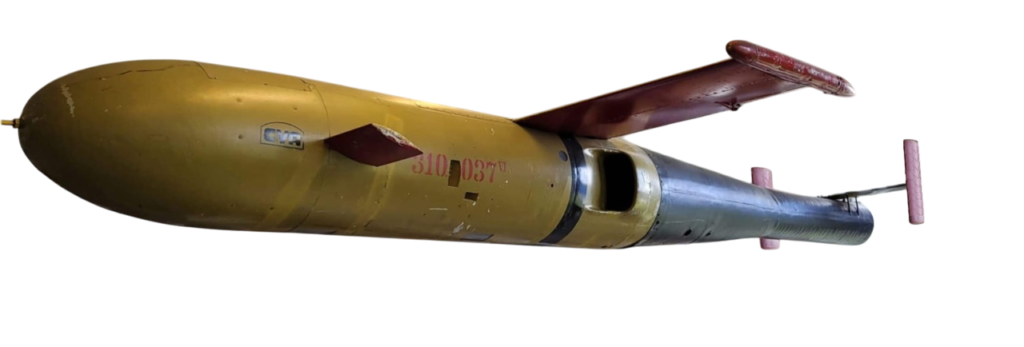
Because individual missiles of this type, as we’ve already established, are clearly inferior to missiles with turbojet engines. So, it’s perfectly clear that they all ended up in museums after the 1950s. And then, sometime in the 1960s, came…
Stage #3 – Timelessness
From this point on, the history of the pulsejet truly entered a timeless period. Any serious work ceased, and almost everything was relegated to the private garages of aircraft modeling enthusiasts. For them, even two engines were considered a large production run.
Nevertheless, in the 1960s, after the declassification of certain classified reports, there was a slight surge of interest in pulsejet engines, not the classic valved type, but the so-called valveless type. For the simple reason that this type of engine simply has no valves at all – it’s simply a pipe that will run indefinitely, as long as there’s gasoline or the stainless steel doesn’t burn out.
This is a gimmicky engine, real “gibberish”, designed by engineer Lockwood (an improved version from the French company Snecma).

…and here’s a “cuttlefish” from an unknown engineer:
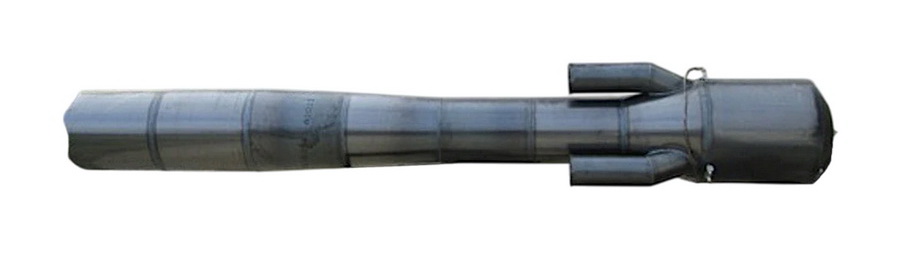
This type of engine operates somewhat differently than a traditional valve engine. In fact, it operates even completely differently. After ignition, the exhaust gases flow simultaneously into both the intake (there may be several) and exhaust pipes, which both create a thrust impulse. However, because the intake pipe is shorter, the vacuum created in the combustion chamber initially reverses the flow in the intake pipe, and then, as air enters the chamber, intake and combustion begin. Because of this, the pressure in the chamber is even lower, rarely exceeding 1.5 bar. Therefore, a valveless engine is even less efficient than a valved engine (where else could it be?). However, due to its virtually infinite resource, it is preferred by the uninitiated.
But only a true garage modeler can love a valveless pulsejet engine — the valveless design only eliminates one of the five main drawbacks of a traditional pulsejet (the lack of valves), while the others remain. Moreover, since nothing is ever free, even in a mousetrap, fuel efficiency fallen down and fuel consumption became completely high (it couldn’t be worse). But that’s not all, because a new drawback was added: frontal thrust was significantly reduced, since a valveless engine, with the same dimensions and half the pressure in the cycle, generates much less thrust. And its aerodynamic characteristics in airflow are so worse that not for aviation. This means that, unlike a valved thruster, a valveless engine is clearly not suitable for high speeds.
Therefore, although the cuttlefish was a better fit for the aircraft than the gibberish, neither the cuttlefish nor the gibberish will ever achieve 800-900 km/h. But this is not always necessary, if you build a garage jet cart. That’s why garage-based modelers continued cutting and welding tons of stainless steel for 30 years straight, building cuttlefish and gibberish on a near-industrial scale. Until disaster struck unexpectedly — technology had advanced to the point where it became possible to create mass-produced micro-turbojet engines. After that, by the late 1990s and early 2000s, only a handful of enthusiasts and devotees of pulsejet engines remained…
During this time, only one project has emerged that is somehow still in small-scale production. This is the Kazan-built Enix E95 — an aerial target aircraft with a valveless pulsejet engine. Overall, this is a rather complex and expensive system, where the engine accounts for 0.0%—and it’s not even clear whether the game was worth the candle: what we are getting at is that if a similar target, produced in small batches, were to replace a barely functional valveless pulsejet with a proper turbojet engine, the cost of the entire system (aircraft, catapult, control shelter, and a bunch of other stuff) would increase by barely more than 0.0%. But the target would be transformed into a fully-fledged UAV. Otherwise, it’s just a bummer. But it’s overflowing with grandeur. And it looks especially “good” when all the targets around the world now have turbojet engines.
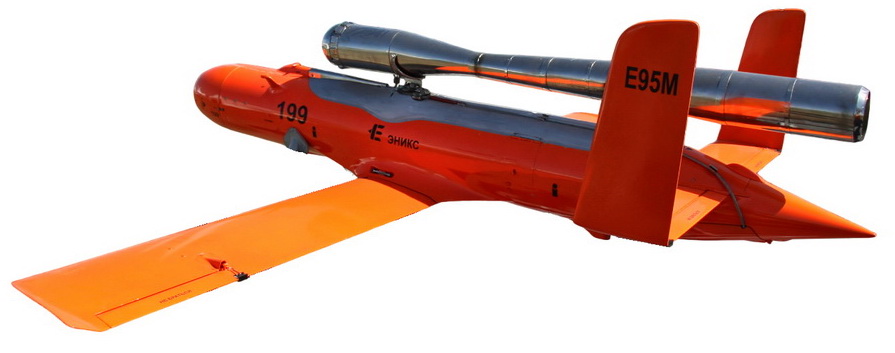
As far as we know, development of this “engine” had been slowly underway during 2 decades, since the early 1980s under the leadership of engineer Pobezhimov, a valveless propulsion enthusiast (for comparison’s sake, the Germans developed their valved engine from scratch to completion in just two years). It’s impossible to say more, as the fly targets never really stood out for their performance — it flies, OK, until the first shot.
By the way, we also made some contribution to the pulsejet industry in the 1980s (which is where our Pulsejet-Sim program originated). Our small engine for air-launched UAVs was valved and had side air intakes, almost exactly as Professor Schulz-Grunow had dreamed of, but it had a very sophisticated automatic air-launch system. And our production run was correspondingly small — only three engines.
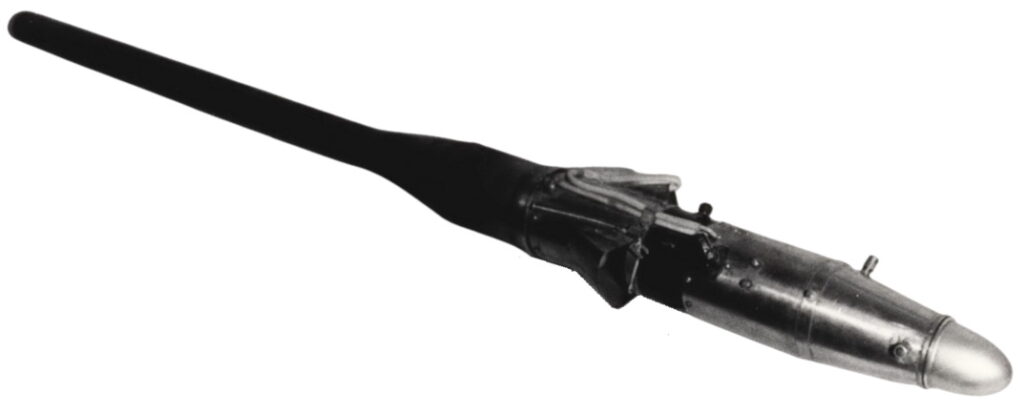
And so it went on, piece by piece, for about 30 years, until a very strange, if not downright shady, American company called Wave Engine Corp. showed up with its supposedly super-new wave engine, which was actually an old, classic, 60-year-old tube designed by engineer Lockwood, which they had mounted on some strange foam plastic apparatus called Scitor:
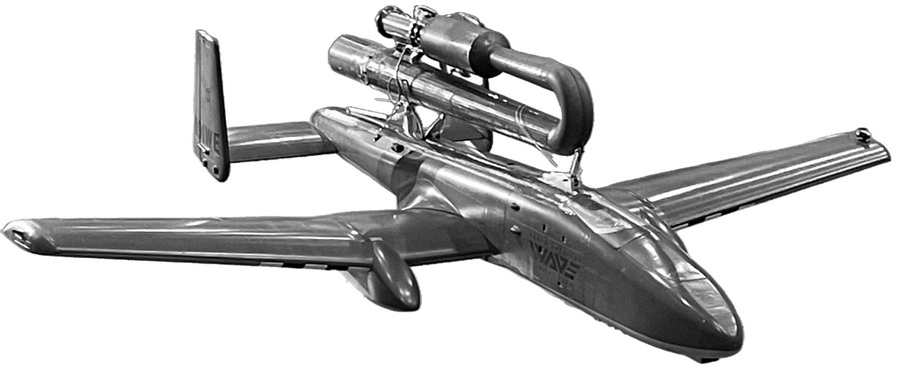
The trick and the profit of this project remain unknown for at least five years. Even despite the million grants and the company’s list of consultants and employees including former Boeing and NASA executives. This already suggests that this might just be some kind of money laundering scheme, not a genuine project — their designs look so flimsy and unserious. Or perhaps it’s just a gimmick, a way to turn attention to a worthless project — a common practice among intelligence agencies. But perhaps everything will soon be revealed…
Well, and one of the latest developments in a pulsejet-powered aircraft is the Trembita, an attack UAV from Ukrainian PARS Company:
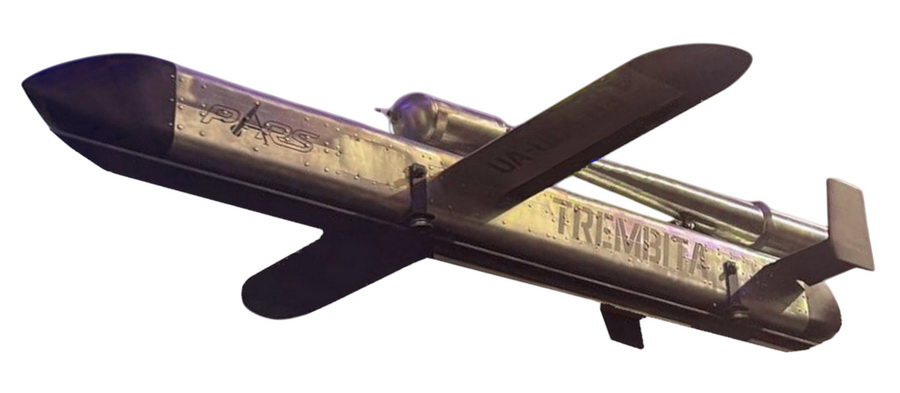
The similarity between the Trembita’s engine and the Enix E95 engine is striking. As we already know, this is a valveless engine with very low efficiency, meaning it consumes a lot of fuel. Low efficiency also means low frontal thrust, which won’t allow this UAV to fly at high speeds; 400 km/h would be a maximal bet. Therefore, this UAV won’t fly very far, hardly more than 200 km (or maybe that’s all it needs?). And it’s unlikely to be able to deliver any serious payload over that distance — it would be good if it could get there itself, without any payload at all.
It’s for this reason that valveless engines, which garage enthusiasts have been working on for 70 years, and continue to work on today, aren’t truly aircraft engines. For a garage cart, yes, they’re an engine. But for aviation, no — just a noise generator. It’s just a sparrow-scare, nothing more. So, it’s only natural that, two years after its presentation, this project still hasn’t strayed far from the advertising slogans. Although…
Little bit more about the technology
Numerous attempts to use turbojets on small UAVs clearly demonstrate that such projects will never become widespread — as we’ve shown above, due to the technical and economic impossibility of mass production. But such engines have another significant drawback, which turbojets’ proponents try to avoid mentioning.
If we’re talking about a thrust of 10-20-30 kgf, then don’t hesitate to look up the technical data for such engines and check the compressor pressure increase. How much? 3.5? Oh, some even have 3.0? And what about the pressure increase for a normal valved pulsejet? 2.5? Don’t notice anything?
Engine theory suggests that fuel consumption is inversely proportional to the cycle pressure. It turns out that the pressure difference isn’t actually that critical. And if the pressures are similar, then what kind of fuel savings could such a turbojet offer compared to a pulsejet? That’s right, low-thrust turbojets don’t actually offer any significant savings. Even despite all their beauty:
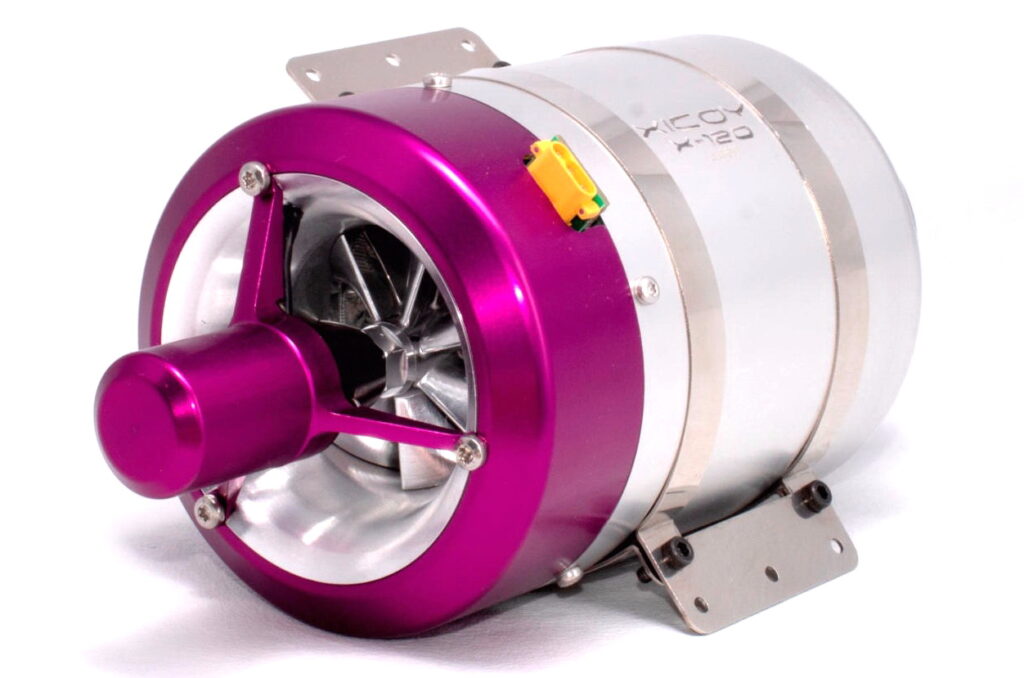
This means that small-size turbojets consume only slightly less fuel than pulsejet engines! But no one anywhere mentions the drawback of such turbojets — excessive fuel consumption. What’s the big deal?
The big deal is that the vast majority of experts compare the parameters of pulsejet engines with those of full-size turbojets, which have a pressure ratio of ten to twenty or more. And this “result” is quite sufficient for them. But in reality, this is a deception, or self-deception — if we compare small-size engines with the same thrust in the range of up to 30 kgf, the fuel consumption of turbojets and pulsejet engines will be similar. At the very least, the difference won’t be great enough to indicate that the pulsejet engine consumes more fuel.
So, if this drawback, along with noise and radiation, is eliminated, then in the specified thrust range, the pulsejet engine has virtually no obvious drawbacks that would prevent its use on high-speed, mass-produced UAVs…
Little bit more about economics
And finally, a quick economic calculation (how could we do without it?). The cost of a micro-turbojet engine, which propels a UAV at almost the same speed as a turbojet (700-800 km/h), averages around $8,000-$10,000. And how much does a pulsejet pipe cost? Let’s say $800 with all the components, hardly more. Now imagine we need to make four batches of UAVs: 10, 100, 1,000, and 10,000. What will the engine savings be?
So:
10 engines — the savings from using a turbojet instead of a turbojet is $72,000. But the possible headaches will far outweigh the savings.
100 engines — the savings are already $720,000, and that’s really something to think about.
1,000 engines — the savings become fantastic, $7,200,000 (!).
10,000 engines — the savings are already sky-high, $72,000,000 (!!!). Do you have that kind of extra money to just invest in the project?
You can approach this from another angle. Let’s say internal combustion engines and turbojets cost 20% of the UAV cost. Then, for any number of UAVs with a thruster jet in production, we have a consistent savings of 18% compared to UAVs with internal combustion engines or turbojets. But this savings is too small for small production runs, and only with increasing numbers of UAVs in production will it become significant. Moreover, it is the production of thrusters that provides unprecedented savings in materials and labor costs.
Furthermore, how can you manufacture, say, 10,000 turbojets? We’ll let you in on a little secret—it’s impossible. It’s technically impossible. 100 units are still possible, 1,000 are questionable, 10,000 are simply impossible—there won’t be enough materials, equipment, or anything. And this is the main reason why turbojet engines will never become a mass-produced engine, and why a rocket powered by such an engine will always be an expensive, one-off toy. Incidentally, this also applies to internal combustion engines to some extent—they also face a host of problems with mass production.
Okay, let’s say some part of the aforementioned series turned out to be feasible. But is there the money for all of this? That’s just it… Let’s remember how many copies of the V-1 the Germans actually made? 25,000? In 1944, each rocket cost 3,500 Reichsmarks, because on average, each V-1 required only 280 man-hours. At the exchange rate at the time, that was just 1,400 real greenbacks. It was, admittedly, a nearly fantastic sum — in 1944, in the real United States, you could have bought a car, a house, furniture, a whole bunch of other things for it, and still have some left over for some business.
Unfortunately, since then, the greenbacks have suffered a serious devaluation, practically a fiasco, and now it’s… how much? … 25,500 real greenbacks. You can’t really spend them now as before, because you definitely won’t be able to start a house or a business, and the car would be probably just used. But what’s interesting is this: if a real German cruise missile now costs less than a modern car, then the entire German V-1 rocket program was 25,000 x 25,500 = (how many zeros can you think of?) = 637 million dollars (!). Does anyone have that kind of money now, enough to benefit from the $180 million dollars (!) savings on the engine? That’s exactly it… But the Germans had it.
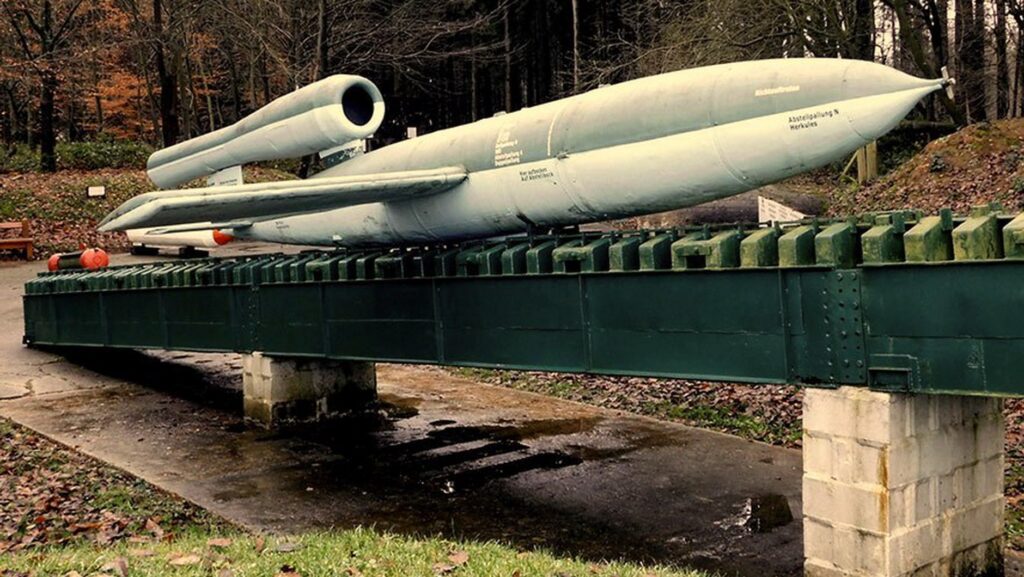
But now it’s clear why they chose a pulsejet engine, not an internal combustion engine or a turbojet. After all, no one seemed to stop the Germans from installing a piston engine on a cruise missile. And there were also V-1 designs with Jumo-type turbojets. But someone truly smart in the Reich Ministry of Aviation realized that launching a production run of 25,000 internal combustion engines or turbojets was completely unrealistic, both technically and financially. But making 25,000 tubes was as easy as pie — even a simple factory that makes, say, ventilation ducts would do the job! And so, the Germans ended up being the only ones in the world to date to produce a mass-produced cruise missile — any other solution would have been impossible!
Instead of Conclusions
Recently, a very smart expert declared: “The V-1 is complete nonsense because it’s a completely stupid, indiscriminate weapon!” It turns out that indiscriminate is a very bad thing. So, in today’s conditions, weapons must necessarily be discriminatory? Perhaps because “indiscriminateness” violates some good “laws of war” that only the laziest haven’t wiped their feet on now?
On the contrary, something tells us that 25,000 cheap, captured German V-1 cruise missiles, completely stupid and indiscriminate, with the same captured, antediluvian pneumatic-mechanical control system, mechanical gyroscopes, and even the famous “turbine” counter on the nose to count the distance travelled, with the same 900 kg payload, 700 km/h flight speed, and 300 km range, would now be very and very useful in stopping one madman in a bunker, along with his 100 million other madmen.
And it’s just a shame that Dr. Gosslau, Diedrich, and Schulz-Grunow are long gone, and their invaluable experience is hopelessly lost…
Alexander Khrulev©
Dr.Eng.Sci., Senior researcher
*This article represents the author’s value judgment (opinion) on the topic discussed in the article and expresses a personal point of view that does not claim to provide irrefutable evidence or assert any indisputable facts. Accordingly, any use, in whole or in part, of the materials in this article must include a reference to the author’s value judgment.
More about our articles on pulsejet engines
Visit our YouTube channel
More about the website and the Pulsejet-Sim simulation program