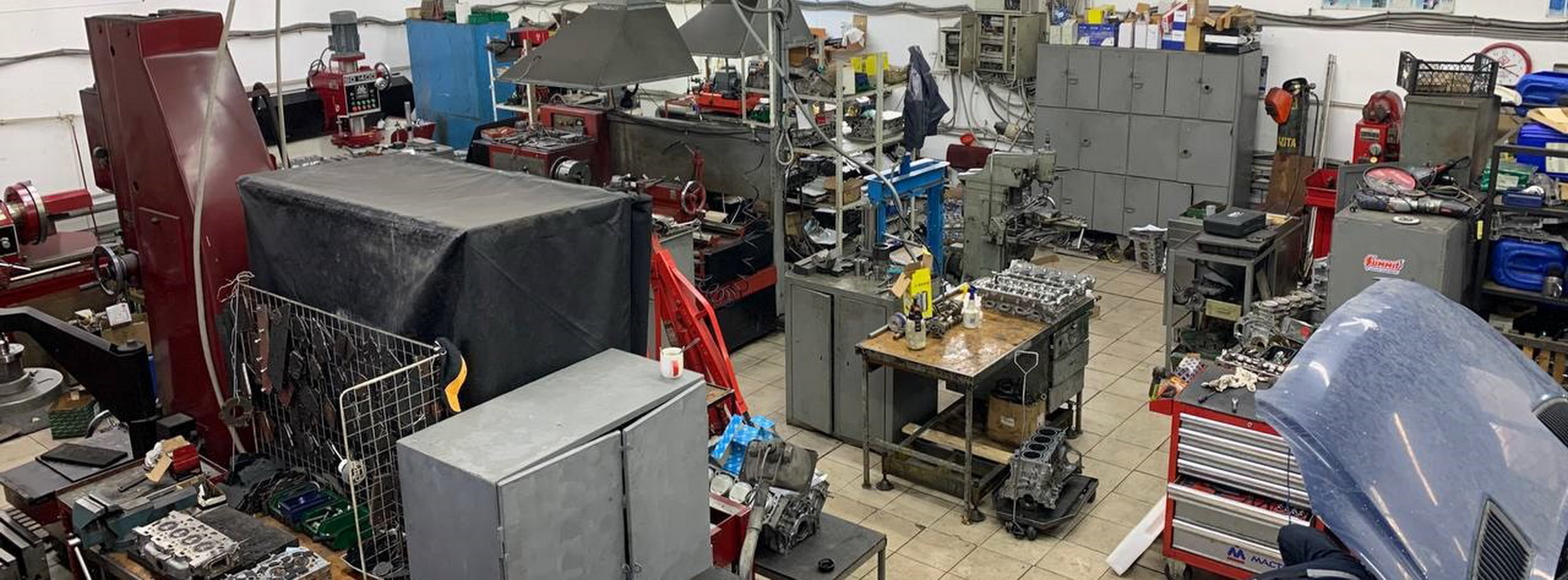
Everyone knows that starting your own business is difficult. And when it comes to opening your own engine repair shop, the number of difficulties increases squared. And one of the main problems is, of course, money: how much is needed, and where to get it in such quantity? Because everyone knows very well that you need a lot of money to equip a machine shop. Or even a lot. And then it immediately becomes clear that the problem cannot be solved. Head-on. And if you think about it?
Indeed, here is the question… A shop for mechanical processing of parts is expensive. Very expensive… Probably, for such a business you need so much money that you can’t open anything. But is it really so?
To answer the question, you first need to decide: what kind of shop are we talking about? Well, and in general, one shop is not like another. And what does practice say on this issue?
And practice shows that there can only be 2 types (kinds) of shops: a full-cycle shop and a shop for repairing cylinder heads. That’s it. No other options. And if someone names another type, then most likely it will be just chatter of comrades far from repair. Who are not comrades to us at all (joke).
So, let’s start with a full-cycle shop. All the main elements of engines should be repaired in it: at least the crankshaft, block and cylinder head. And what does this mean? It is clear that for the first two elements, 3 heavy machines will be required at once: a grinder for crankshafts, a boring machine and a honing machine for cylinder blocks. And this is really expensive. Very expensive. Even without detailed calculations, we can immediately say that it is unlikely that it will be possible to keep it under 130-150,000 dollars. Do you have them? (then we will not come to you, you have enough money without us).
A full-cycle shop has other problems. How quickly will it start working to at least break even, that is, to self-sufficiency? A year? Two? Or maybe all three? In other words, for such a shop to start working, it is not enough to buy expensive equipment; it will be necessary to actually pay for its work for several more years, since expenses will still exceed income. And will investors-creditors wait so long? And where to get so many competent personnel for all these machines? This is generally an almost insoluble problem…
Well, what, is everything really so expensive and difficult that nothing can be built?
No, build. If you don’t take on the whole immensity at once, but start with something small. And this small fits exactly into the cylinder head repair shop. Without repairing crankshafts and cylinder blocks, all this can be added later, if desired. Or not added, also at will.
All this equipment is required to open your own machining shop: not so much, actually

Why do cylinder heads allow you to build such a specialized workshop? For many reasons at once. For example, because the cylinder head is a separate unit that fails quite often. And removing and disassembling this unit does not require, as a rule and in the overwhelming majority of cases, either dismantling the engine from the car or disassembling the engine. That is, repairing the cylinder head is not a major overhaul, it does not require special conditions, much time and significant costs. This means that this type of repair is much simpler and more accessible to the consumer. And for the repairman, with the right approach.
But, in addition to this, it is the cylinder head that is associated with the maximum number of problems and “ambushes” in repair. Let’s start with the lack of equipment: if for repairing crankshafts and cylinder blocks you can somehow use “trophy” equipment from the Soviet era, then for heads such equipment simply does not exist.
And what does exist? In many workshops and garages they still gnaw the head seats with toothed cutters, and then rub the seats with valves without sparing the abrasive paste. Even in the 21st century (horror!). The result of such “work” has long been described and is quite predictable: the seats and valves do not last long. This means that they will soon require new repairs. And where to do it?
As a result, opening your own head repair shop is becoming a very, very promising business. And the paradox is the more ignorant the local repairmen are, and the harder and more thoroughly they rub the valves and seats with paste, the faster the new shop will break even! (Rub better, guys!)
Well, OK, now let’s look at the practical side. And what equipment should such a shop have? Briefly and in general, the list of mandatory items is clear:
1. Machine for cutting seats. The main item around which the entire complex is built. Without it, it is not a workshop or even a repair shop. So don’t skimp.
2. Machine for grinding valves. Without this machine, item #1 does not work. Not at all. Even if you are told fairy tales about new valves that do not require repair (in fact, they do).
3. Pressure tester for heads. Without it, neither item #1 nor item #2 work. Why? Because before sharpening something, you need to understand whether there is any point in starting at all? If the cylinder head is cracked (and at least a third of diesel engines are like this!), then repairing the seats on it is useless — it will only be a waste of time and money.
4. Good washer. Without it, item #3 does not work, because when the water in the installation immediately becomes black and opaque, the crimping installation will stop performing its functions (it will be simply impossible to see the leak!). Well, and items #1 and #2 are also useless then.
5. Good compressor. Without it, not a single equipment item works — not #1, not #2, not #3. Preferably a screw compressor, but that’s it…
6. Machine for surface machining. Most heads that go for repair have a curved plane, and if the head is removed due to overheating, then its plane is 100% curved. So, you can’t do without a machine for planes. But here’s the problem: this item is no less expensive than item #1. And without it, you can’t do a “dealer” set of works “wash-pressure-surface”.
7. Valve spring press. Of course, you can disassemble the valves with springs hand-to-hand, but our advice to you is that this is a waste of time. Especially when item #1 and item #6 have already been ordered, saving “on matches” completely loses all meaning.
8. Lathe. Well, the choice here is huge, so you don’t have to bother with this position at all: even a decommissioned trophy Soviet model will do for turning and sharpening bushings with seats.
What else? In our difficult times, it is not just extremely desirable to purchase, but generally mandatory to have an electric generator in the workshop — it ensures the continuity of the workshop. Calculations show that the generator should produce no less than 20 kVA, but better 25-30 kVA. Less than 25 kVA will have problems with turning on the washing and pressure testing (these machines will need to be turned on alternately), and more than 30 kVA is not required, you simply will not have so much equipment turned on.
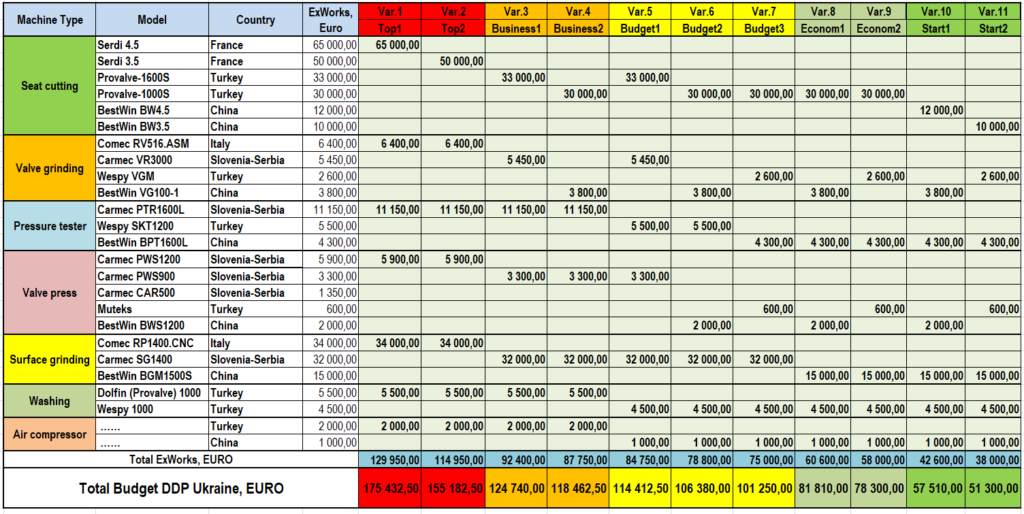
The table contains almost all the available options for shop equipment today (the only thing missing are some “fashionable” machines for “electronics in sneakers”, but that’s it). Just find your available budget below and see what your own shop can consist of.
Measuring tools are also needed; they are inexpensive and can be easily purchased at any suitable place, even on Aliexpress. By the way, this is where you can find many useful consumables for machines — from pilots and cutters to abrasive wheels. But all this is not so expensive, you can buy it later “in the process”. Also, for now, we will skip all sorts of “little things” like a sharpener, press, pallet trucks, drills, etc. We will not take into account furniture either: workbenches, racks and other devices are a good thing, but they can be acquired. We will also leave the arrangement of the workshop for later: floor tiles (for a head workshop this is almost mandatory), paint on the walls, lighting, heating, etc.
In short, we get our cherished table of workshop equipment, and there is only “bare” equipment. We enter possible options into it and divide them into groups (types of kits) — from the starting to the full TOP.
And what do we see? It’s simple. You can really open a workshop with just… 50,000 Euros in your pocket! That’s all. And it will all work quite well. And it’s not such a terrible amount of money. But it’s quite real.
But it would be better, of course, to have a little more — 70-80,000 Euros, then there will be a much wider choice of equipment, and you can choose the best. And if you have 100-110,000 Euros, then your workshop will not only be able to work successfully, but will also really bite off a significant part of the services market from all local competitors.
At the top of the pyramid is the TOP set, but it is shown not to be implemented, but on the contrary, to show how best not to do it. Although… if someone needs to spend as much as possible, then for a measly 170-180,000 Euros you can easily build a workshop from the most expensive equipment. Although there is no limit to perfection: if you want, you can easily go for 200,000 Euro, if, for example, you take a CNC saddle machine. But here it will be right according to the proverb: “a bad deed is always simple”.
Something like that. If our recommendations seemed useful to someone — use them, do not hesitate. Well, and of course, always remember that no workshop — neither for 50,000 Euro, nor for 200,000 Euro, will ever work without knowledge of cylinder head repair technology. And especially, without knowledge of how not to and cannot do it. But that’s a completely different story…
Alexander Khrulev©
Dr.Eng.Sci., Senior researcher
